
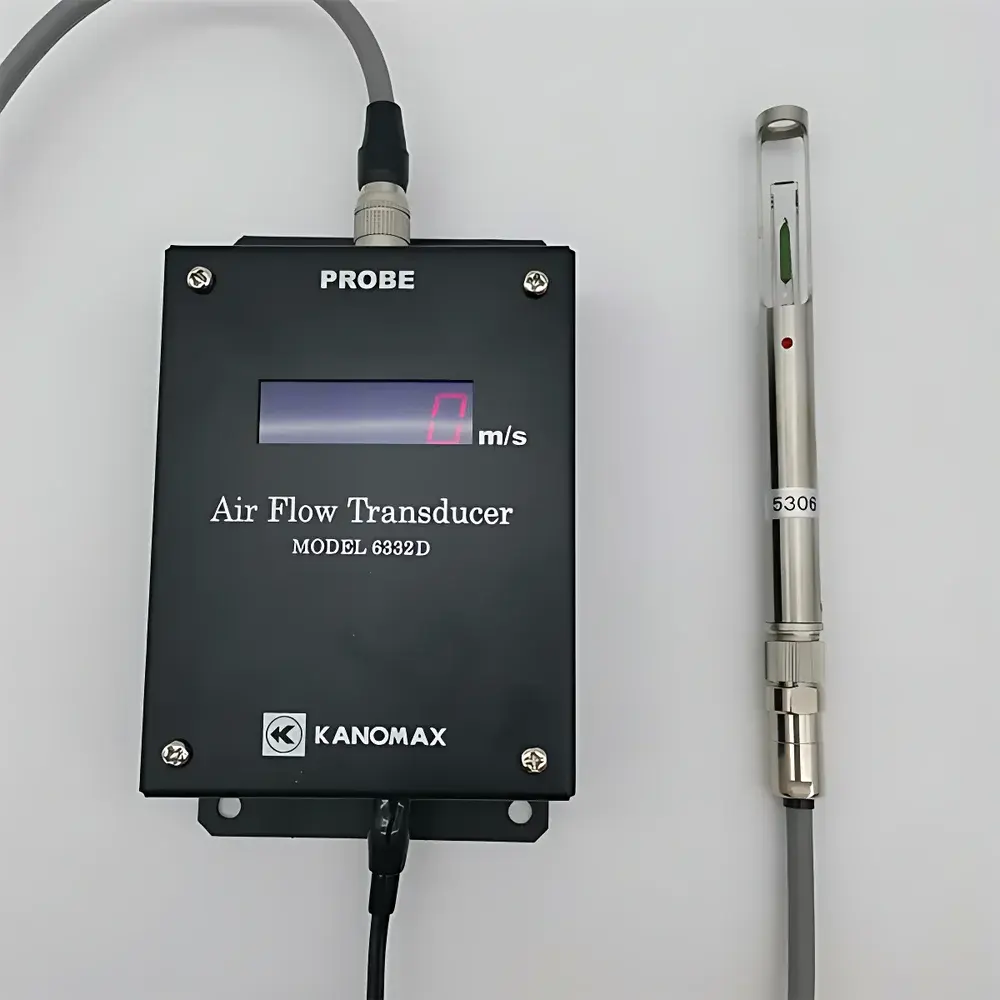
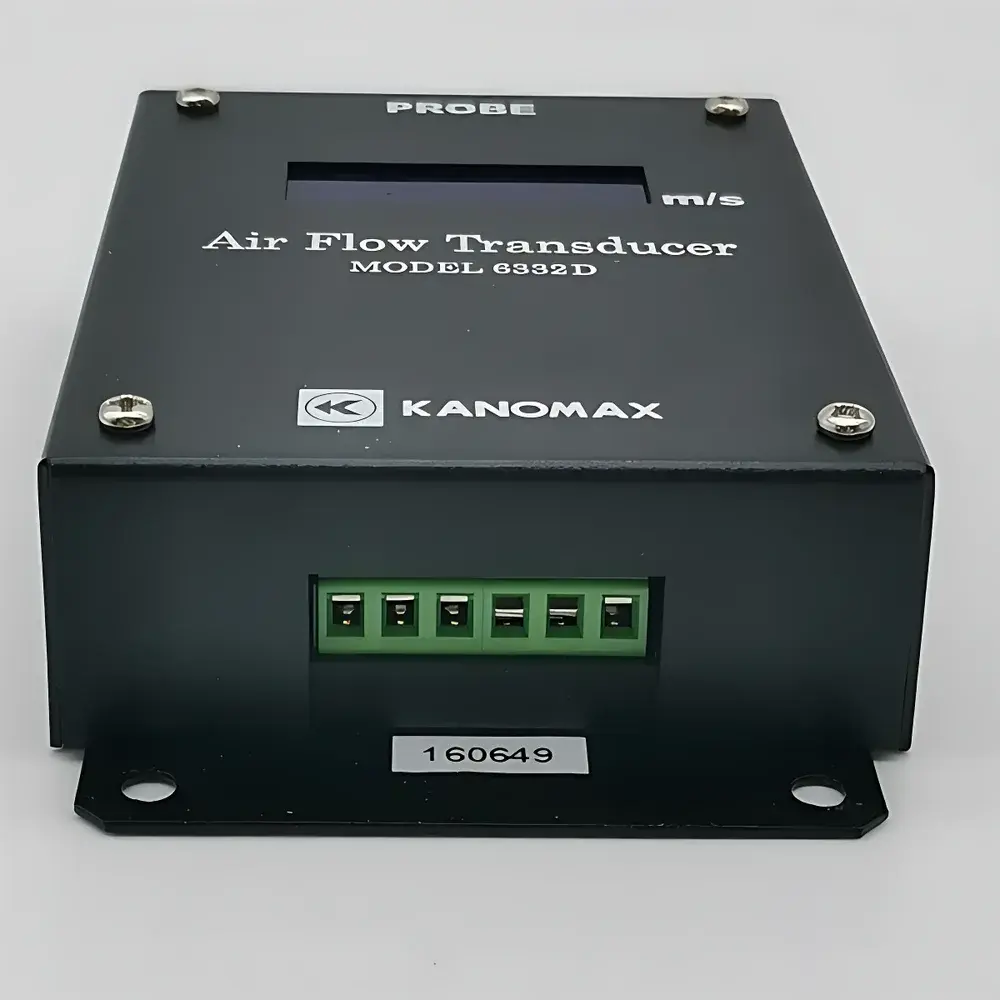
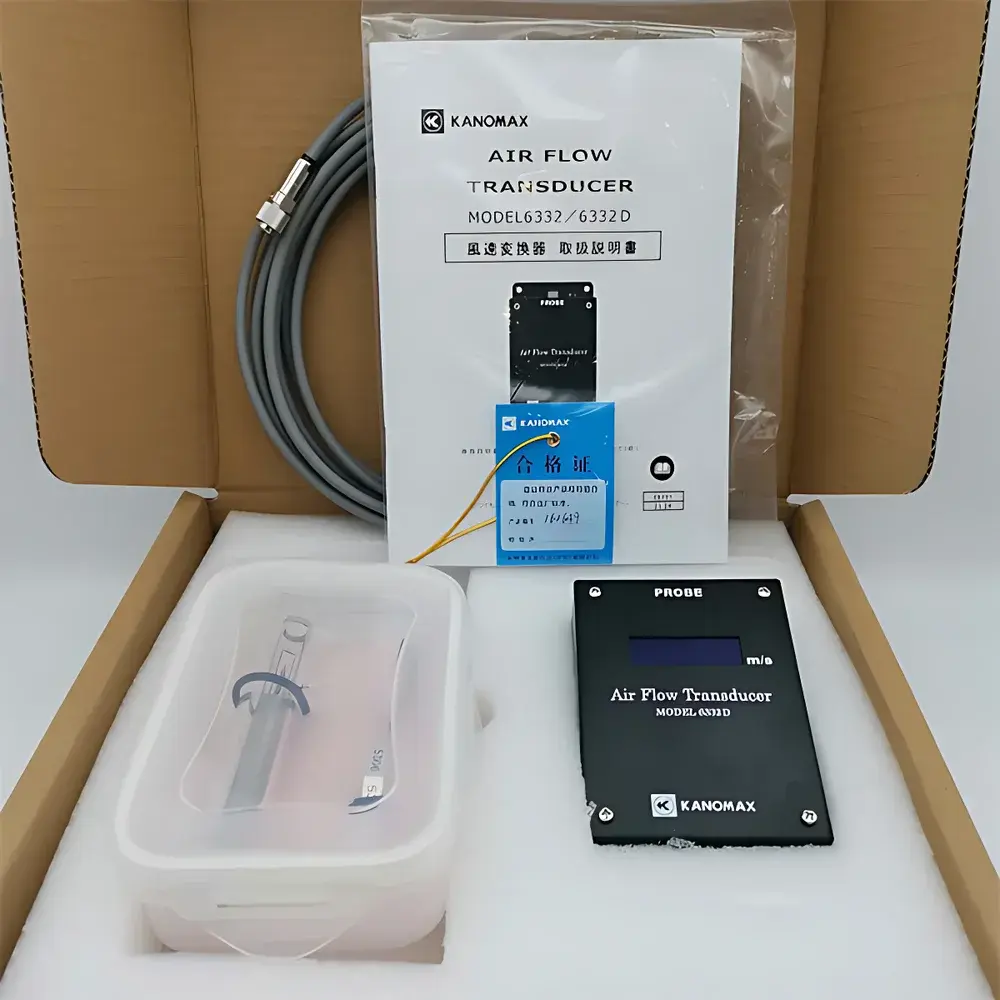
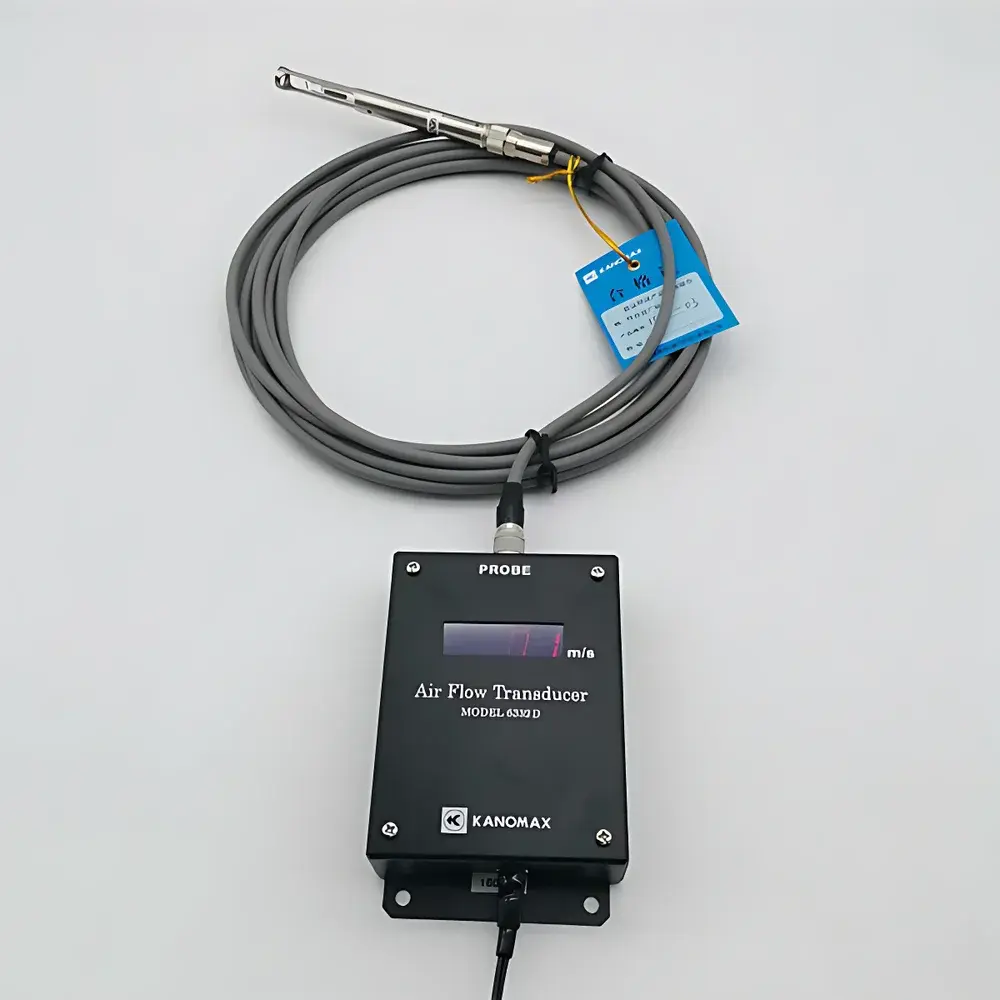
Kanomax 6332D Hot-Wire Anemometer Transmitter
| Brand | Kanomax |
|---|---|
| Origin | Liaoning, China (Manufactured under Kanomax Japan technical supervision) |
| Model | 6332D |
| Instrument Type | Hot-Wire Anemometer Transmitter |
| Resolution | 0.01 m/s (dependent on probe selection) |
| Measurement Range | 0.05–30 m/s (varies by interchangeable probe) |
| Display | Built-in LCD with real-time wind speed readout |
| Analog Output | 0–5 V DC or 4–20 mA (user-selectable) |
| Power Supply | DC 12 V ±2 V |
| Dimensions | 128 × 78 × 30 mm |
| Weight | 320 g |
| Probe Compatibility | 10 standardized hot-wire and thermal anemometry probes (e.g., KANOMAX 6331 series) |
| Multi-unit Cascading | Supported via RS-485 interface for synchronized multi-point airflow monitoring |
Overview
The Kanomax 6332D Hot-Wire Anemometer Transmitter is a precision-engineered environmental monitoring instrument designed for quantitative airflow characterization in controlled thermal and ventilation environments. It operates on constant-temperature anemometry (CTA) principles, where a heated platinum wire sensor maintains a fixed temperature differential relative to ambient air; convective heat loss is directly correlated to local air velocity via calibrated thermal transfer models. Unlike cup or vane anemometers, the 6332D delivers high-frequency response (up to 100 Hz bandwidth), low-flow sensitivity, and minimal flow disturbance—making it especially suitable for laminar and transitional flow regimes encountered in electronics thermal management validation, such as motherboard-level cooling assessment, heatsink airflow profiling, and chassis ventilation mapping. Its modular architecture centers on probe interchangeability, enabling adaptation across diverse test geometries without recalibration.
Key Features
- Modular probe interface supporting 10 standardized Kanomax hot-wire and thermal anemometry probes—including axial, omnidirectional, and micro-probe variants—for application-specific spatial resolution and flow orientation fidelity.
- Integrated backlit LCD display providing real-time wind speed readout with auto-ranging and unit selection (m/s, ft/min, knots).
- Dual analog output configuration: user-selectable 0–5 V DC or 4–20 mA current loop, compliant with industrial SCADA and DAQ systems for continuous process monitoring.
- RS-485 serial interface enabling daisy-chain connectivity of up to 32 units for scalable multi-channel airflow acquisition—critical for thermal uniformity studies across server racks or PCB-level airflow grids.
- Robust aluminum alloy housing (IP54-rated) with compact footprint (128 × 78 × 30 mm) and low mass (320 g), facilitating integration into test fixtures, wind tunnels, and automated thermal chambers.
- Stable DC 12 V ±2 V power input with reverse-polarity protection and low electromagnetic susceptibility—designed for operation in electrically noisy laboratory and production floor environments.
Sample Compatibility & Compliance
The 6332D is compatible with Kanomax’s full suite of NIST-traceable calibration probes, each individually certified per ISO/IEC 17025 requirements. Probe interchangeability preserves measurement traceability when switching between configurations (e.g., from 6331-01 axial probe for duct centerline measurement to 6331-10 micro-probe for component-level jet characterization). The transmitter complies with IEC 61000-4 electromagnetic compatibility standards and meets CE marking requirements for EMC and LVD directives. While not inherently FDA-regulated, its analog output and stable metrology support integration into GLP-compliant thermal validation protocols—particularly where airflow verification is part of IQ/OQ documentation for cleanroom HVAC or electronic manufacturing environmental controls.
Software & Data Management
The 6332D operates as a standalone transmitter but interfaces seamlessly with Kanomax’s optional KAN-LOG software (Windows-based) for time-synchronized data logging, statistical analysis (mean, RMS, min/max), and export to CSV or Excel formats. When deployed in multi-unit cascaded mode, the system supports timestamp-aligned acquisition across channels, enabling spatial velocity vector reconstruction and turbulence intensity calculation. All analog outputs are linearized per probe-specific calibration curves stored internally—eliminating post-processing corrections. Audit trails, user access control, and data integrity safeguards align with foundational elements of 21 CFR Part 11 readiness when paired with validated third-party DAQ platforms.
Applications
- Electronics thermal design validation: quantifying localized airflow velocity above CPU/GPU heatsinks, memory modules, and VRM regions during thermal stress testing.
- Server rack and data center airflow optimization: mapping inlet/outlet velocity profiles, identifying recirculation zones, and verifying ASHRAE TC 90.4-compliant cooling distribution.
- Automotive ECU and power electronics cooling assessment: measuring forced convection performance under vibration and thermal cycling conditions.
- HEPA filter face velocity verification and laminar flow bench certification per ISO 14644-3.
- Research-grade boundary layer studies in academic and industrial aerodynamics laboratories.
FAQ
Does the 6332D require periodic recalibration?
Yes—annual recalibration against NIST-traceable reference standards is recommended. Each probe carries its own calibration certificate; transmitter electronics are factory-calibrated to maintain linearity across probe swaps.
Can the 6332D measure temperature or humidity simultaneously?
No—the 6332D is a dedicated hot-wire anemometer transmitter. For combined measurements, Kanomax offers integrated instruments such as the 6705 Air Velocity & Temperature Meter or complementary sensors (e.g., 6162 Thermohygrometer) with synchronized logging via KAN-LOG.
Is the analog output isolated from the power supply?
Yes—the 4–20 mA and 0–5 V outputs feature galvanic isolation (1500 V AC) to prevent ground loops and ensure signal integrity in mixed-signal test environments.
What is the maximum cable length between the 6332D and a remote probe?
Up to 5 meters using shielded twisted-pair cable (Kanomax P/N 6332-CBL5); longer runs require active signal conditioning to maintain CTA bridge stability and noise immunity.
How does probe selection affect measurement uncertainty?
Uncertainty is probe-dependent: axial probes (e.g., 6331-01) specify ±(1.5% of reading + 0.03 m/s), while micro-probes (e.g., 6331-10) exhibit higher sensitivity but narrower dynamic range—full specifications are provided in individual probe datasheets.







