
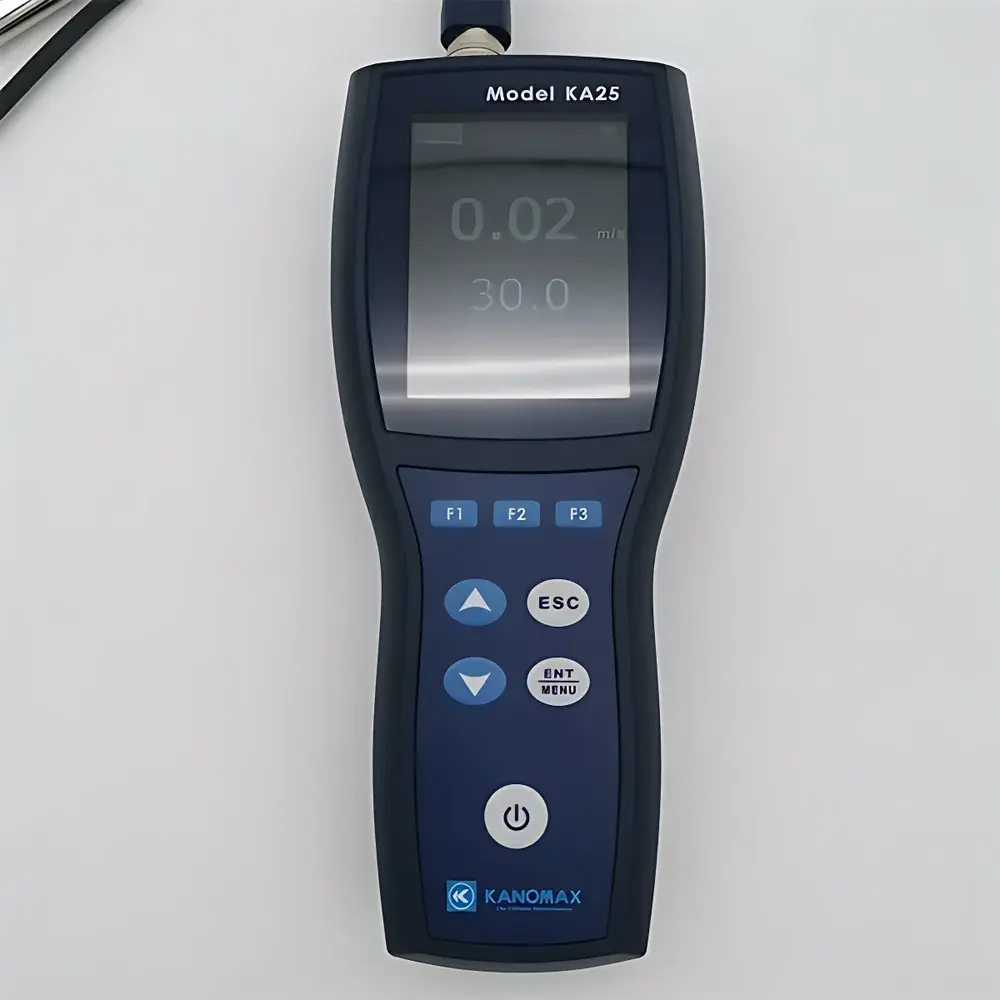
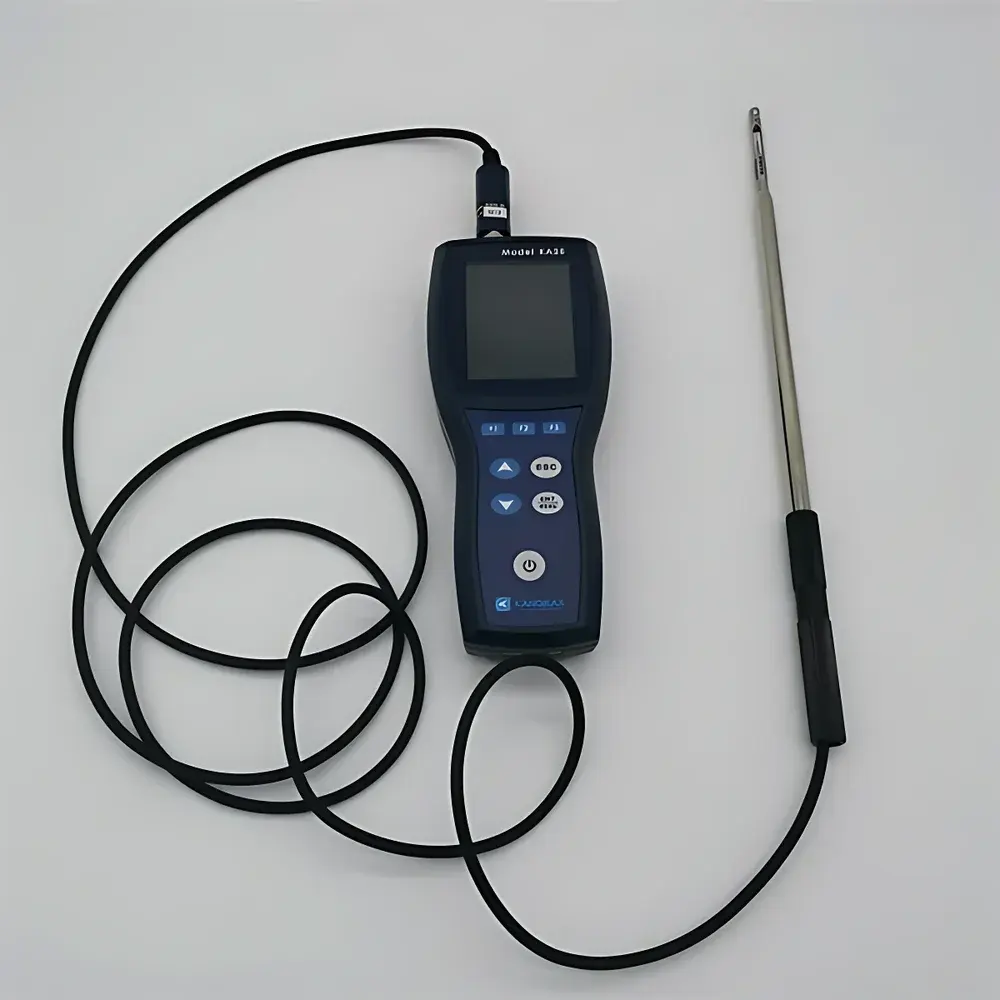
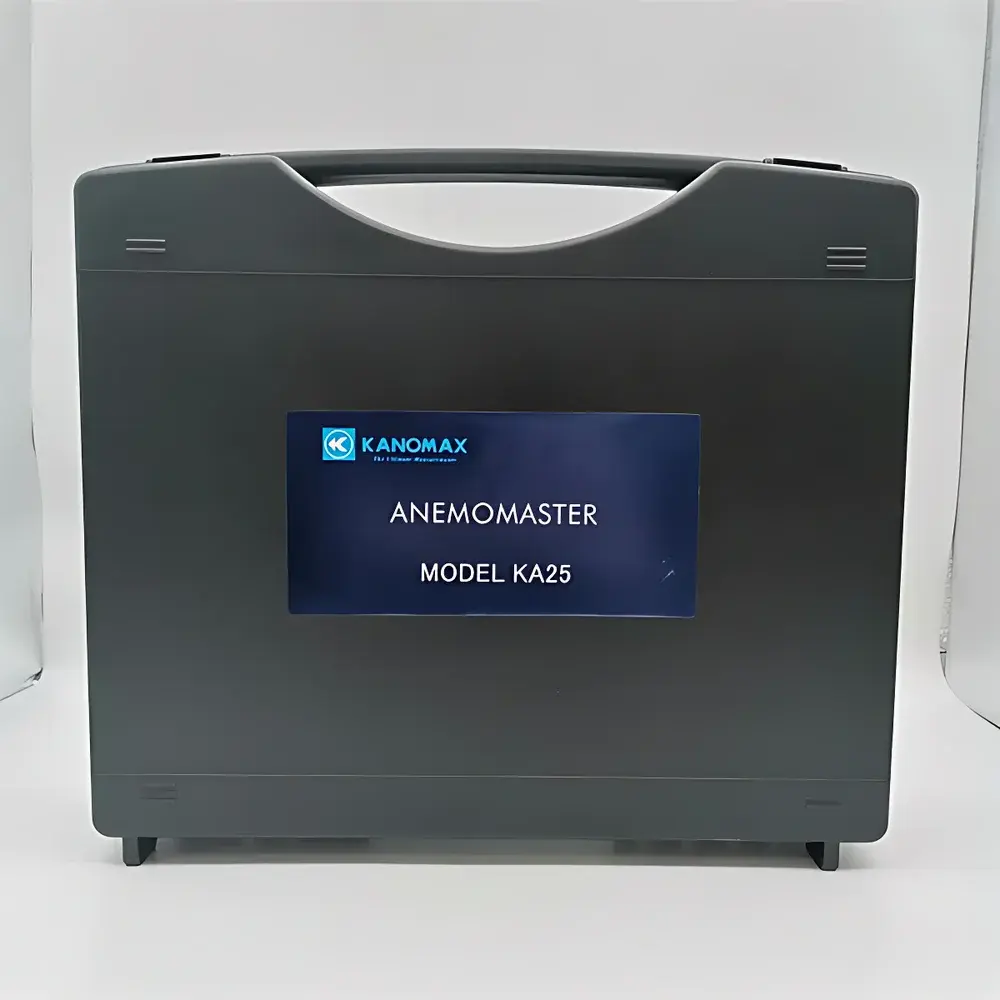
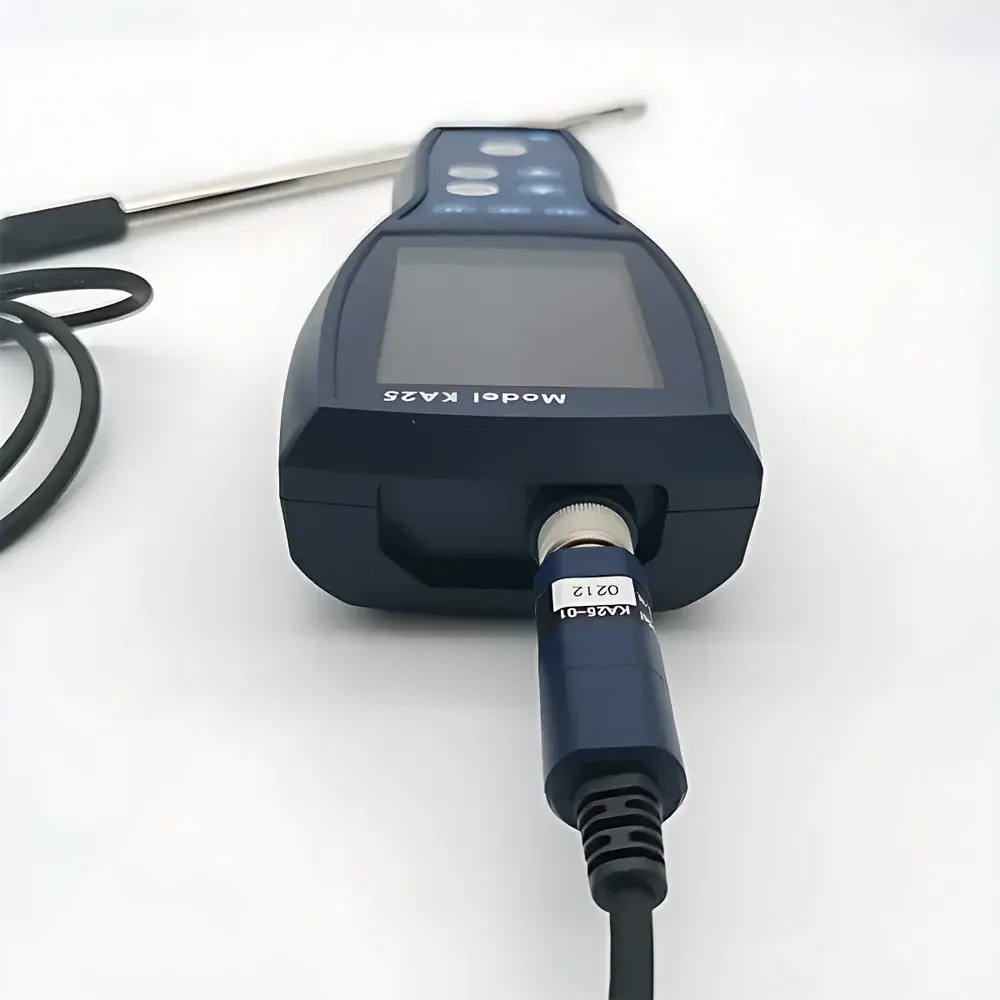
Kanomax KA25 Portable Thermal Anemometer
| Brand | Kanomax |
|---|---|
| Origin | Liaoning, China |
| Manufacturer Type | Authorized Distributor |
| Country of Origin | China |
| Model | KA25 |
| Instrument Type | Thermal Anemometer |
| Measurement Range | 0.01–20.0 m/s |
| Accuracy | ±(3% of reading + 0.03 m/s) |
| Resolution | 0.01 m/s |
| Temperature Range | −20 to 70 °C (probe), 5 to 40 °C (body) |
| Temperature Accuracy | ±0.5 °C (at v > 0.5 m/s) |
| Temperature Resolution | 0.1 °C |
| Response Time (90%) | ~1 s (velocity), ~30 s (temperature) |
| Air Volume Calculation | Yes (rectangular & circular ducts, 0.1–255.0 cm dimensions) |
| Data Logging Functions | Min/Max/Avg, Hold, Auto Power-Off (3/5/10 min), Adjustable Time Constant (1/5/10/20 s) |
| Display | 3-level backlight LCD |
| Power | 4 × AA alkaline batteries |
| Battery Life | ~15 h (1 m/s, 20 °C) |
| Dimensions (Body) | 200 × 85 × 40 mm |
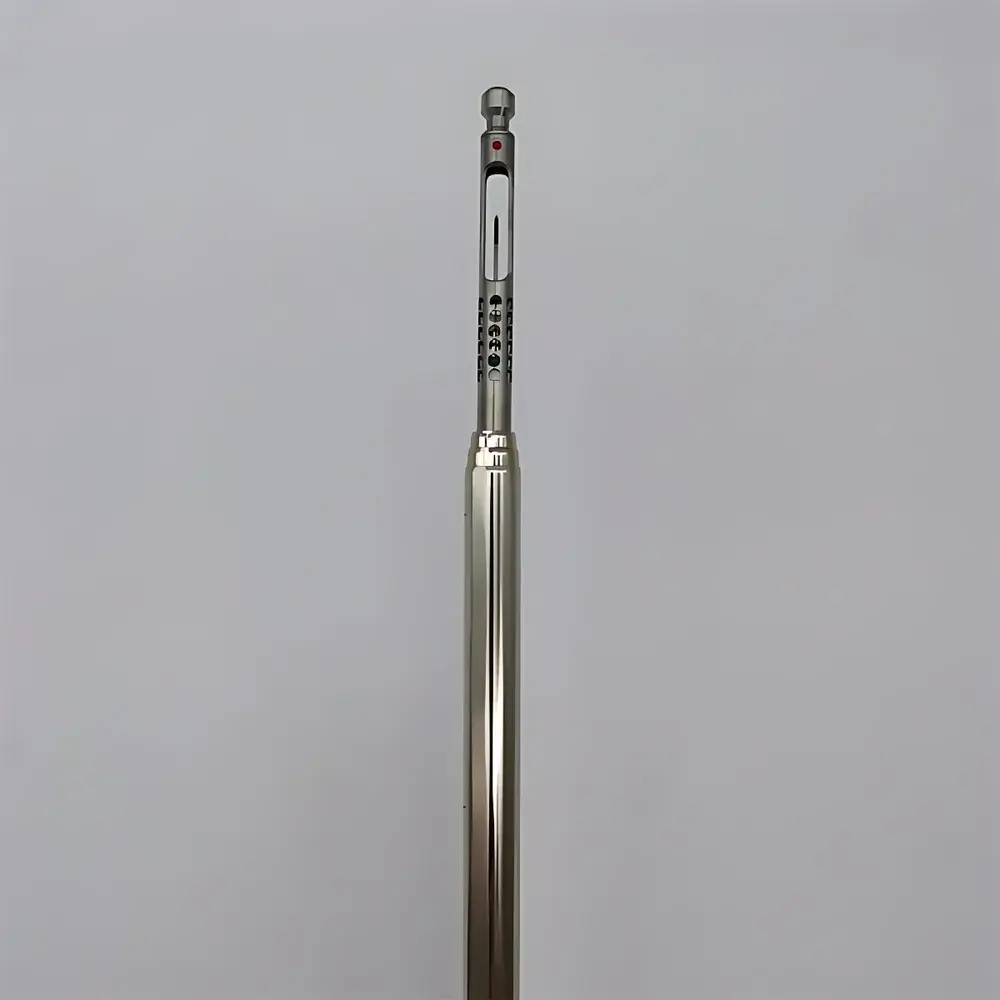
| Probe | Ø6 mm (sensor) / Ø14 mm (handle), 294–1060 mm telescopic & bendable |
| Cable Length | 2000 mm |
| Weight | ~220 g (without batteries) |
| Compliance | Designed for ISO 14644-3, ISO 14644-4, EU GMP Annex 1, and USP <1116> environmental monitoring workflows |
Overview
The Kanomax KA25 Portable Thermal Anemometer is a handheld, battery-powered instrument engineered for high-reproducibility air velocity and temperature measurement in controlled environments—particularly cleanrooms, HVAC validation zones, laminar flow hoods, and pharmaceutical manufacturing suites. It operates on constant-temperature anemometry (CTA) principle: a heated sensor element cools proportionally to airflow, enabling precise thermal dissipation-based velocity calculation across a wide dynamic range (0.01–20.0 m/s). Its compact form factor, telescopic and bendable probe, and integrated duct geometry input interface allow rapid, non-intrusive mapping of air distribution profiles without requiring external software or calibration rigs. Designed for compliance-critical applications, the KA25 delivers traceable measurements aligned with ISO 14644-3 (cleanroom testing), EU GMP Annex 1 (grade A/B/C/D air monitoring), and USP (microbiological environmental control).
Key Features
- Thermal anemometry sensor with 0.01 m/s resolution and ±(3% of reading + 0.03 m/s) accuracy—validated for low-velocity stability in laminar airflow verification.
- Simultaneous air velocity and temperature acquisition (−20 to 70 °C probe operating range; ±0.5 °C accuracy above 0.5 m/s).
- Integrated air volume computation engine supporting both rectangular and circular duct geometries (0.1–255.0 cm dimensions), eliminating manual cross-sectional area calculations.
- Telescopic and flexible probe (Ø6 mm sensing tip, Ø14 mm handle, 294–1060 mm extension range) enables access to confined grilles, HEPA filter outlets, and ceiling diffusers.
- Configurable time constant (1 s, 5 s, 10 s, 20 s) for adaptive response tuning—critical for capturing transient airflow events during door openings or equipment operation.
- On-device statistical functions: real-time min/max/average tracking, data hold, auto power-off (3/5/10 min), and battery level indicator with three-level backlight LCD for low-light cleanroom use.
Sample Compatibility & Compliance
The KA25 is validated exclusively for clean, dry, non-corrosive ambient air—consistent with ISO 14644-4 requirements for particle-free gas media in cleanroom instrumentation. It is not rated for humid, oily, or particulate-laden airstreams. Its mechanical and thermal specifications meet operational constraints defined in EU GMP Annex 1 (Section 4.32–4.35) for airflow qualification in grade A laminar flow devices and grade B background environments. The device supports audit-ready documentation through manual log recording and complies with GLP/GMP data integrity expectations when used with standardized SOPs. While it does not include built-in electronic audit trails or 21 CFR Part 11-compliant digital signature capability, its deterministic measurement output, stable calibration history, and fixed firmware architecture ensure consistent, defensible results during regulatory inspections.
Software & Data Management
The KA25 operates as a standalone field instrument with no embedded Bluetooth, USB, or wireless connectivity. All measurement data—including velocity, temperature, duct dimensions, computed air volume (m³/h), and statistical aggregates—are displayed and retained on-screen only during active use. Users must manually transcribe values into validated electronic lab notebooks (ELN) or CSV-compatible spreadsheets per site-specific data governance policies. The absence of onboard memory or export interfaces aligns with security-sensitive cleanroom protocols where uncontrolled data transfer is prohibited. For full traceability, Kanomax recommends pairing the KA25 with calibrated reference standards (e.g., NIST-traceable pitot tubes or ISO 14644-3-compliant reference anemometers) and maintaining a documented calibration schedule per ISO/IEC 17025 requirements.
Applications
- Cleanroom airflow uniformity mapping per ISO 14644-3 Section B.4 (point-by-point velocity profiling at filter outlets).
- Laminar flow hood certification (EN 12464-1, NSF/ANSI 49) including face velocity verification and turbulence assessment.
- HVAC system balancing and commissioning—supply/return air grilles, VAV box discharge verification.
- Pharmaceutical isolator and RABS environmental qualification under EU GMP Annex 1 (Sections 4.32–4.40).
- Biotechnology incubator and biosafety cabinet air curtain integrity checks.
- Validation of air shower performance and personnel gowning room airflow patterns.
FAQ
What is the recommended calibration interval for the KA25?
Kanomax recommends annual calibration against a NIST-traceable reference standard, or prior to each critical qualification campaign—whichever occurs first. Calibration should cover the full 0.01–20.0 m/s range with at least three points (low/mid/high), per ISO/IEC 17025 Clause 6.5.
Can the KA25 be used in high-humidity environments?
No. The thermal sensor is susceptible to condensation-induced drift. Use is restricted to dry, non-condensing air with relative humidity below 80% RH and no visible moisture—per ISO 14644-4 Annex D guidelines.
Does the KA25 support ISO 14644-3 compliant reporting formats?
The device itself does not generate reports. However, its direct air volume output (m³/h) and statistical functions (min/max/avg) align with ISO 14644-3 Table B.1 data requirements. Users must format outputs per their internal QA-approved templates.
Is the probe suitable for sterilization or autoclaving?
No. The probe is not autoclavable or chemically resistant to IPA/H₂O₂ vapor. Wipe disinfection with 70% isopropyl alcohol is permitted between uses.
How does the time constant setting affect measurement validity?
A shorter time constant (e.g., 1 s) captures rapid fluctuations but increases noise sensitivity; longer settings (e.g., 10–20 s) improve signal averaging for steady-state qualification—select based on application per ISO 14644-3 Annex C.3.
Related Products







