
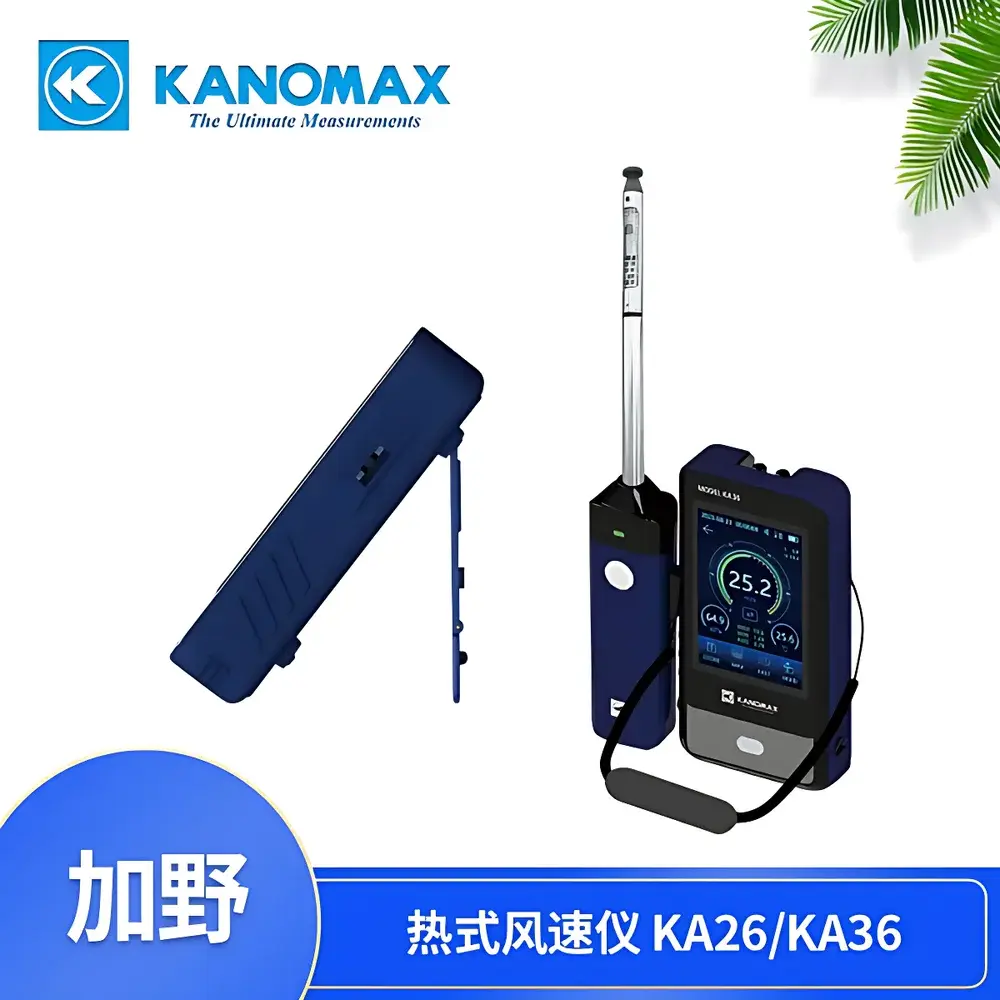
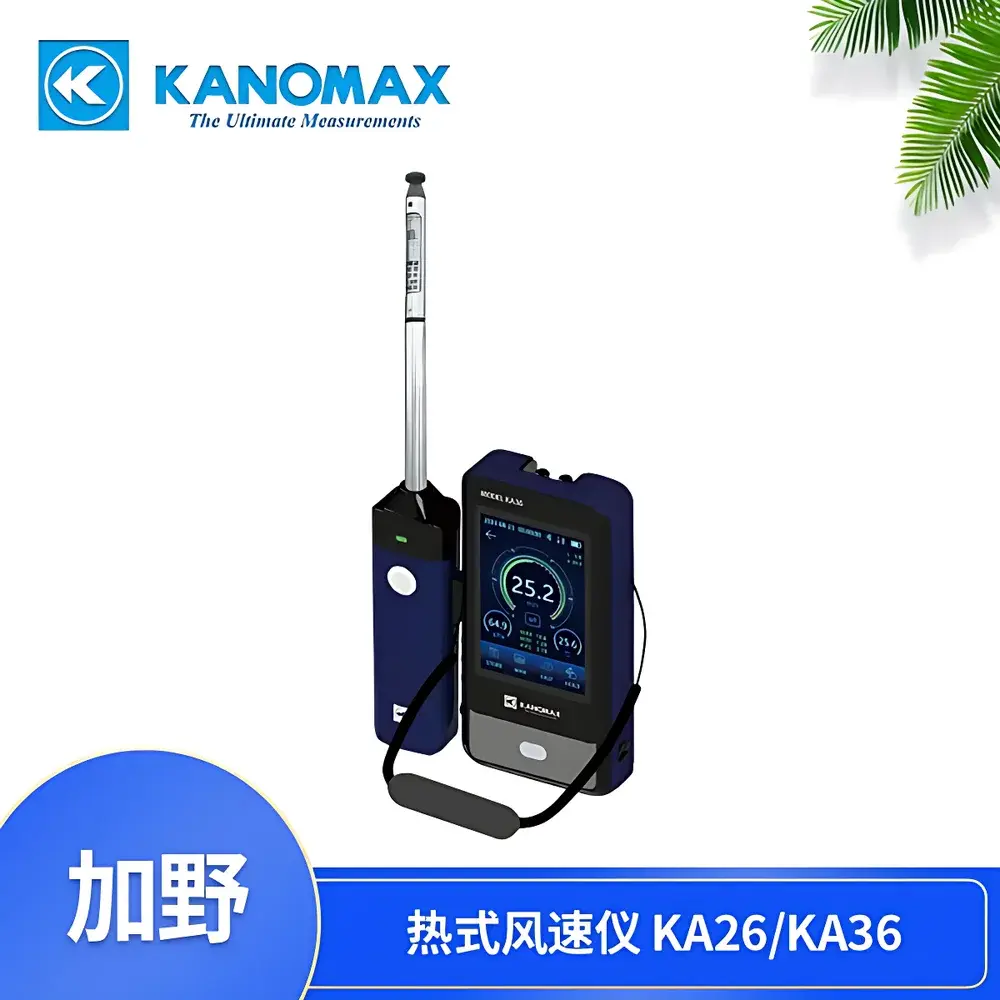
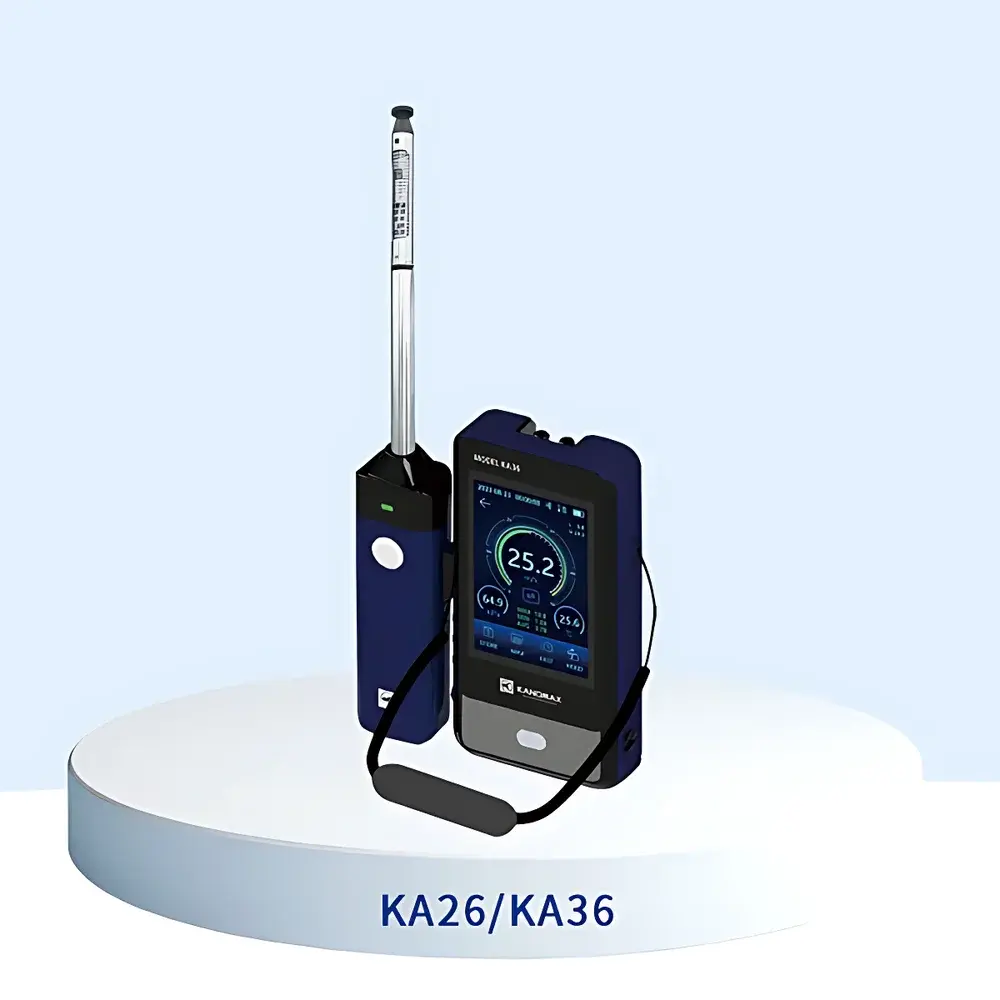
Kanomax KA26/KA36 Thermal Anemometer with Simultaneous Air Velocity, Temperature, and Differential Pressure Measurement
| Brand | Kanomax |
|---|---|
| Origin | Japan |
| Instrument Type | Thermal Anemometer |
| Velocity Range | 0.00–50.0 m/s |
| Velocity Resolution | 0.01 m/s (0.00–9.99 m/s), 0.1 m/s (10.0–50.0 m/s) |
| Velocity Accuracy | ±3% of reading or ±0.015 m/s, whichever is greater |
| Temperature Range | −20.0–100.0 °C |
| Temperature Resolution | 0.1 °C |
| Temperature Accuracy | ±0.3 °C (0–60 °C), ±0.5 °C (−20–0 °C and 60–100 °C) |
| Pressure Range | −5.00 to +5.00 kPa |
| Pressure Resolution | 0.01 kPa |
| Pressure Accuracy | ±0.1 kPa |
| Response Time | ~1 s (velocity & pressure), ~30 s (temperature) |
| Display | 3.5-inch resistive touchscreen |
| Data Storage | 5,000 records |
| Communication | Bluetooth 5.0, USB-C |
| Battery Life | ~10 hours (typical operation at 5 m/s, 20 °C) |
| Operating Environment (main unit) | 5–40 °C |
| (probe) | −20–100 °C |
| Storage Temperature | −30–60 °C |
| Weight | ~600 g |
| Probe Extension | Up to 1240 mm with included telescoping rod |
Overview
The Kanomax KA26/KA36 is a high-precision handheld thermal anemometer engineered for simultaneous, real-time measurement of air velocity, temperature, and differential pressure in demanding environmental and industrial applications. Utilizing constant-temperature anemometry (CTA) principles, the instrument maintains a heated sensor element at a fixed temperature above ambient and measures the convective heat loss—directly proportional to airflow velocity—ensuring stable, repeatable readings across turbulent and laminar flow regimes. Unlike cup or vane anemometers, its thermal sensing architecture enables low-end sensitivity down to 0.00 m/s and rapid dynamic response (~1 second), making it suitable for HVAC commissioning, cleanroom airflow validation, laboratory fume hood certification, and indoor air quality (IAQ) assessments per ISO 16814, ASHRAE Standard 110, and EN 13779. The integrated differential pressure transducer employs piezoresistive silicon diaphragm technology, calibrated for bidirectional measurement up to ±5.00 kPa—ideal for duct static pressure differentials, filter resistance testing, and room pressurization verification.
Key Features
- Triple-parameter acquisition: Synchronized capture of velocity (0.00–50.0 m/s), temperature (−20.0–100.0 °C), and differential pressure (−5.00 to +5.00 kPa) in a single measurement cycle.
- 3.5-inch resistive touchscreen display with dual-view mode: Simultaneous digital numeric readouts and analog bar-graph visualization for intuitive trend monitoring and transient event identification.
- Wireless probe-to-main-unit communication via Bluetooth 5.0: Eliminates cable constraints during duct traverses, ceiling diffuser surveys, or remote exhaust stack evaluations.
- Modular, bendable probe system: Interchangeable thermal probes with integrated 260–330 mm ergonomic handles and optional telescoping extension rods (up to 1240 mm total length); no external fixtures required.
- On-device data processing: Real-time statistical computation of minimum, maximum, and arithmetic mean values; hold function for snapshot capture; configurable alarm thresholds with visual highlight and audible alert.
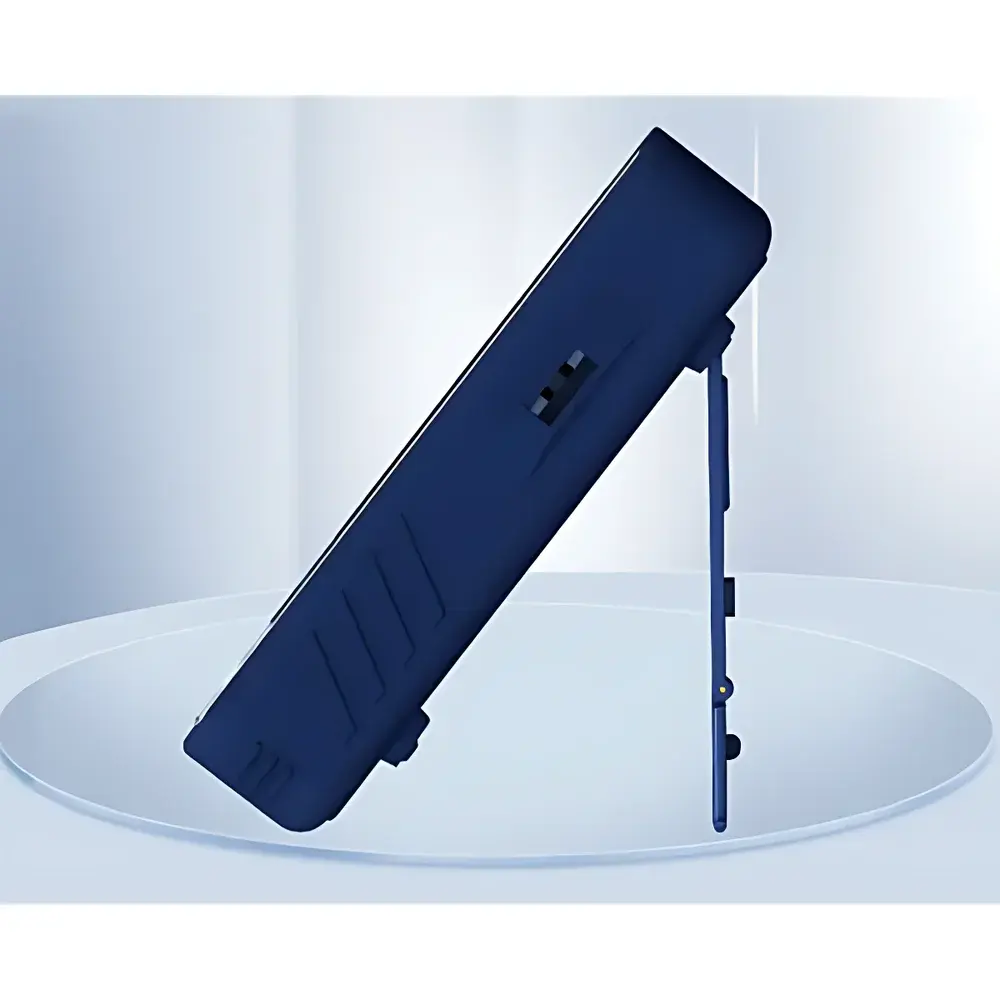
- Robust field ergonomics: Integrated desktop stand and chest-mount strap; compact main unit (160 × 80 × 32 mm); lightweight design (~600 g) with IP54-rated enclosure for dust and splash resistance.
Sample Compatibility & Compliance
The KA26/KA36 is validated for use with clean, dry air—non-corrosive, non-condensing, and free of particulate loading exceeding ISO 8573-1 Class 4. It is not rated for saturated, oily, or chemically aggressive airstreams. Its measurement methodology complies with fundamental metrological requirements outlined in ISO/IEC 17025 for in-field instrumentation, and supports traceable calibration against NIST-traceable standards. For regulated environments—including pharmaceutical cleanrooms (ISO 14644-3), hospital HVAC systems (ASHRAE 170), and GMP manufacturing facilities—the device facilitates documentation of airflow uniformity, face velocity, and pressure differentials required under FDA 21 CFR Part 211 and EU Annex 1. While the instrument itself does not provide electronic audit trails, its USB-C interface enables secure data export for integration into validated LIMS or QA databases.
Software & Data Management
Data is stored internally in non-volatile memory (5,000 records), timestamped with user-configurable date/time settings. Export is supported via USB-C to CSV format for post-processing in Excel, MATLAB, or statistical analysis platforms. Bluetooth connectivity allows live streaming to Kanomax’s companion PC application (Windows only), enabling synchronized multi-point logging, custom report generation (PDF/Excel), and graphical overlay of velocity vs. temperature vs. pressure profiles. Firmware updates are delivered through the same interface, ensuring continued alignment with evolving industry protocols. All stored records retain full metadata—including probe ID, measurement mode (normal/judgment), alarm status, and battery level—at time of capture.
Applications
- HVAC system balancing and commissioning per ASHRAE Guideline 1 and TAB best practices.
- Cleanroom classification (ISO 14644-1) and operational monitoring of unidirectional airflow velocity and uniformity.
- Fume hood face velocity verification and containment performance testing (ANSI/AIHA Z9.5).
- Industrial ventilation surveys: local exhaust system capture velocity, duct traverse mapping, and filter bank differential pressure trending.
- Indoor environmental quality (IEQ) studies: thermal comfort assessment (PMV/PPD modeling inputs), stratification analysis, and draft risk evaluation.
- Research and development labs: airflow characterization in wind tunnels, environmental chambers, and prototype enclosures.
FAQ
What is the difference between the KA26 and KA36 models?
The KA36 includes a calibrated differential pressure port and associated tubing (1.5 m silicone hose) as standard equipment; the KA26 omits this capability and functions as a dual-parameter (velocity + temperature) instrument.
Can the device measure absolute pressure or only differential pressure?
The KA26/KA36 measures differential pressure only (ΔP), referenced to ambient atmospheric pressure via the built-in vented sensor. It does not support absolute or gauge pressure measurement.
Is the probe suitable for high-temperature ducts?
The probe sensor tip is rated to 100.0 °C continuously; however, the handle and cable assembly are limited to 60 °C ambient exposure. Prolonged operation above 60 °C may affect long-term sensor stability and battery performance.
How is calibration traceability maintained?
Kanomax provides factory calibration certificates with NIST-traceable references for velocity and temperature. Users may perform field verification using calibrated reference anemometers or dry-well temperature calibrators; annual recalibration is recommended per ISO/IEC 17025 guidelines.
Does the device support GLP/GMP-compliant data integrity?
While the instrument lacks built-in 21 CFR Part 11 electronic signatures or user-access controls, its immutable timestamped CSV exports and deterministic measurement algorithms support ALCOA+ data integrity principles when managed within a validated procedural framework.
Related Products







