
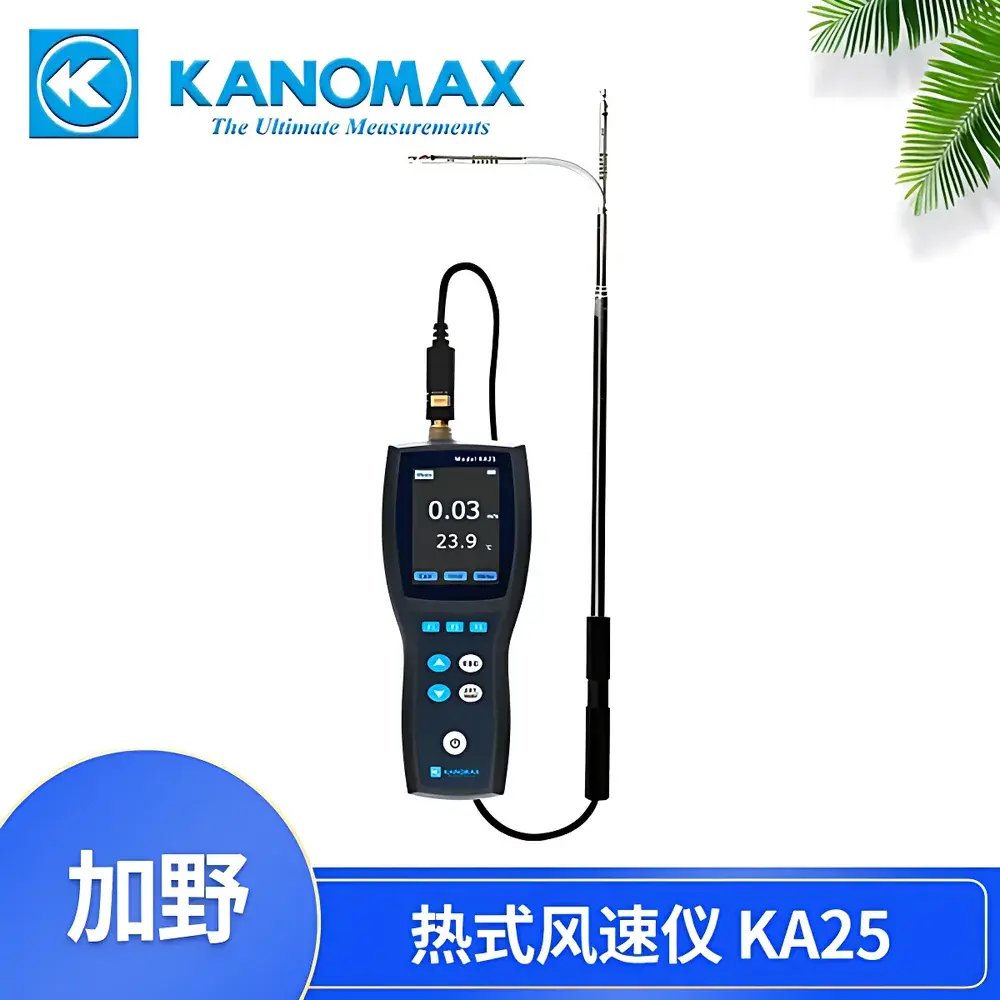
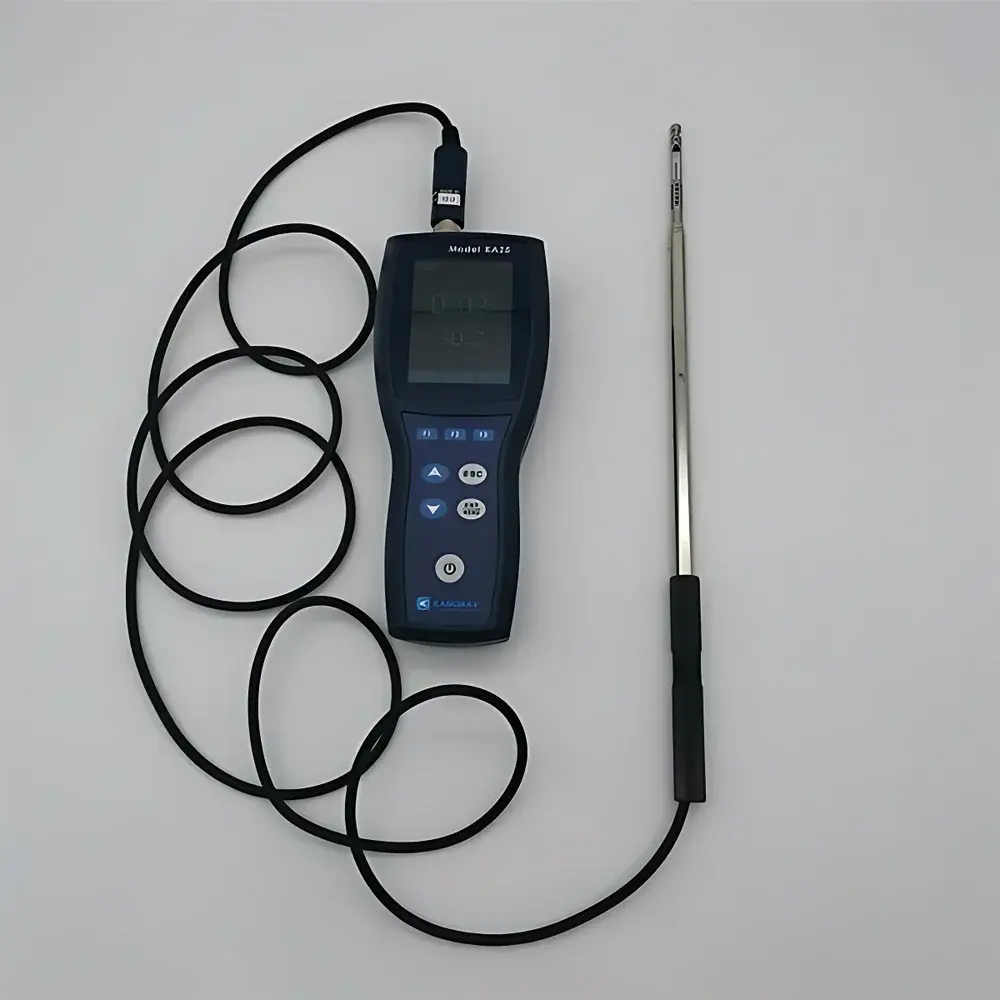
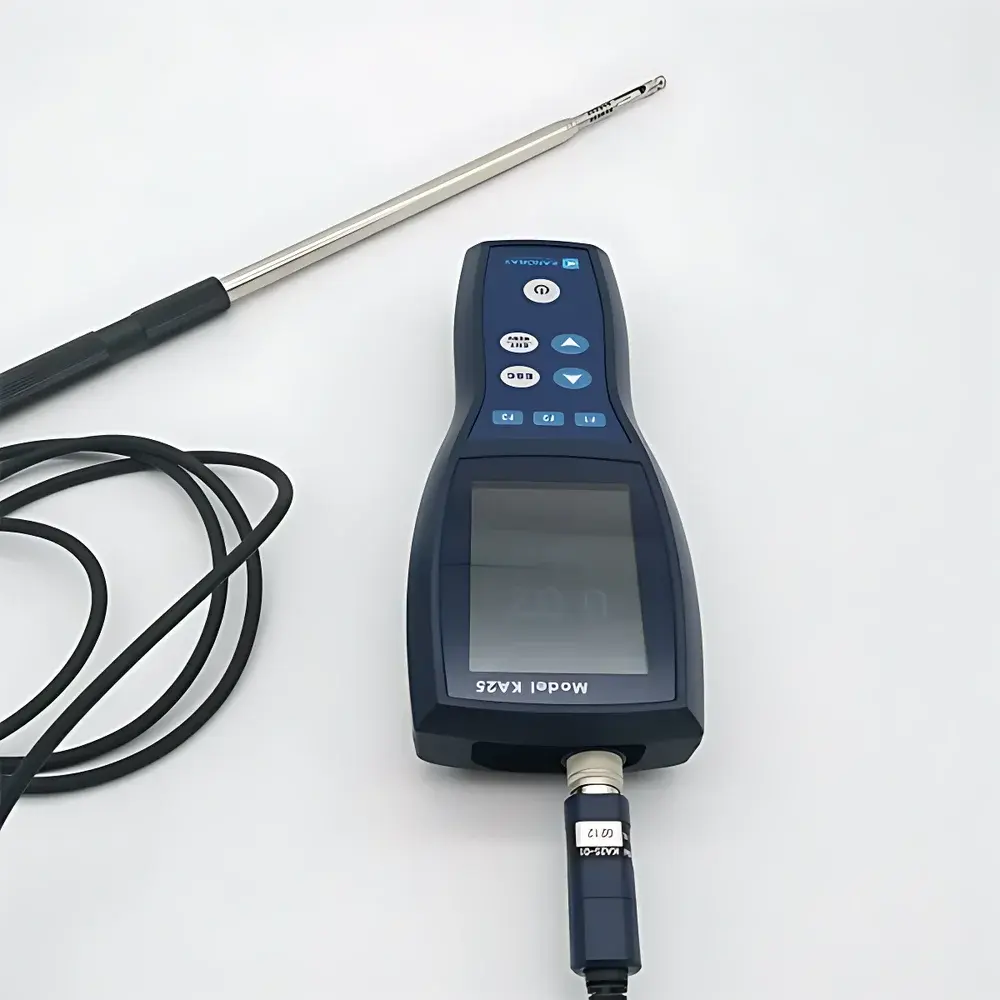
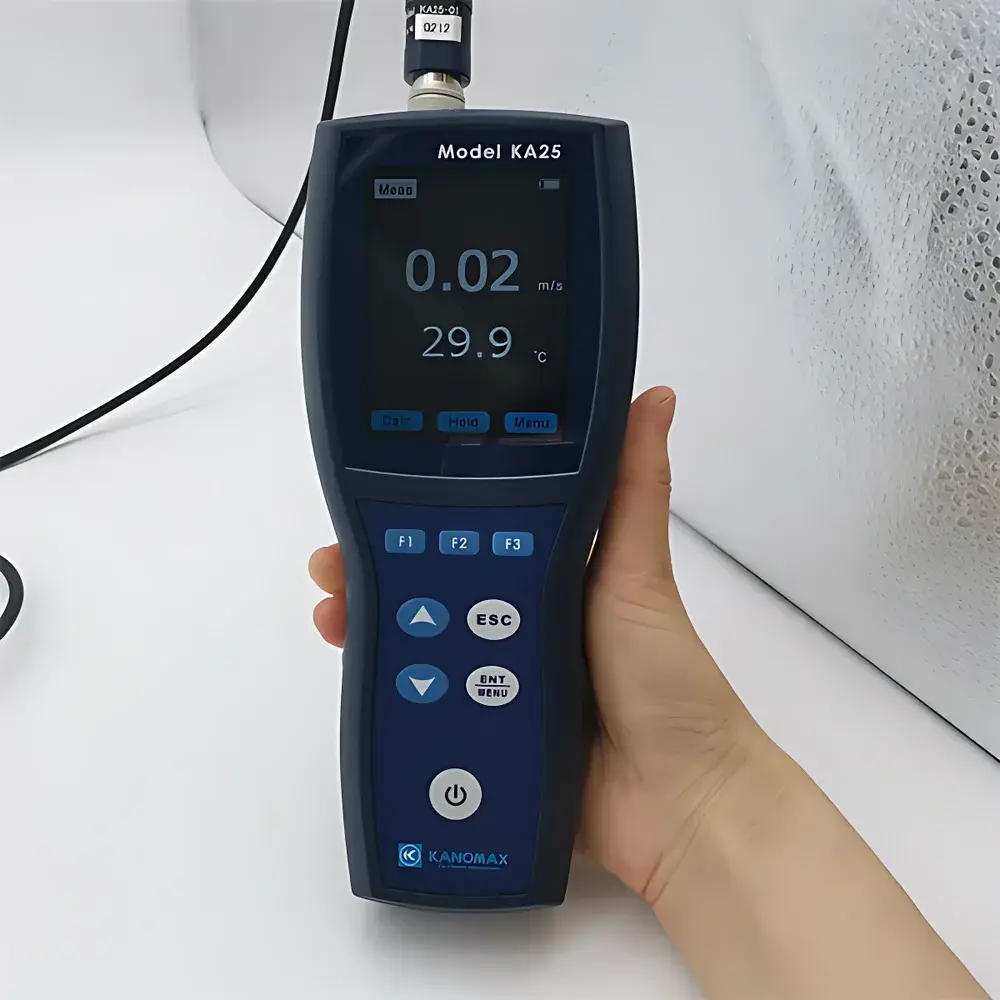
Kanomax KA25 Thermal Anemometer with Air Flow & Temperature Measurement
| Brand | Kanomax |
|---|---|
| Origin | Japan |
| Model | KA25 |
| Instrument Type | Thermal Anemometer |
| Resolution | 0.01 m/s (air velocity), 0.1 °C (temperature) |
| Measurement Range | 0.01–20.0 m/s (air velocity), −20.0–70.0 °C (temperature) |
| Accuracy | ±(3% of reading + 0.03 m/s) for air velocity |
| Operating Environment | −20–70 °C (probe), 5–40 °C (main unit) |
| Response Time | ~1 s (90% for velocity at 1 m/s), ~30 s (90% for temperature at 1 m/s) |
| Pipe Compatibility | Rectangular and circular ducts |
| Duct Dimension Input Range | 0.1–255.0 cm |
| Air Flow Calculation | Direct m³/h output based on user-entered cross-sectional area |
| Data Logging Features | Min/Max/Avg statistics, data hold, programmable time constant (1/5/10/20 s), auto power-off (3/5/10 min) |
| Display | 3-level backlight LCD |
| Power | 4 × AA alkaline batteries (~15 h operation at 1 m/s, 20 °C) |
| Dimensions | Main unit 200 × 85 × 40 mm |
| Cable | 2000 mm |
| Weight | ~220 g (without batteries) |
| Compliance | Designed for industrial HVAC, cleanroom, and laboratory airflow verification per ISO 14644-3, ASHRAE 110, and JIS B 8402 standards |
Overview
The Kanomax KA25 Thermal Anemometer is a handheld, battery-powered instrumentation system engineered for precise, real-time measurement of air velocity, ambient temperature, and volumetric air flow in ducted and open-air environments. Based on constant-temperature anemometry (CTA), the KA25 employs a fine-wire platinum sensor heated to a stable differential above ambient—enabling highly responsive detection of convective heat loss proportional to local air velocity. Unlike cup or vane anemometers, its thermal sensing principle delivers high sensitivity at low flow rates (down to 0.01 m/s) without mechanical inertia limitations. Integrated temperature compensation ensures velocity accuracy across wide thermal gradients (−20 to 70 °C probe operating range), while user-input duct geometry (rectangular or circular) enables direct calculation of volumetric flow rate (m³/h) without external computation. The instrument meets core metrological requirements for HVAC commissioning, cleanroom monitoring, fume hood validation, and environmental chamber qualification.
Key Features
- Thermal anemometry sensor with 0.01 m/s resolution and ±(3% rdg + 0.03 m/s) velocity accuracy—validated per JIS B 8402 and traceable to NMIJ (National Metrology Institute of Japan) reference standards
- Dual-parameter simultaneous display: air velocity (m/s) and temperature (°C) on a backlit LCD with three brightness levels for low-light ductwork inspection
- On-device air flow computation: enter duct dimensions (0.1–255.0 cm) to derive real-time m³/h output—supports both rectangular and circular cross-sections
- Configurable time constant (1 s / 5 s / 10 s / 20 s) to balance dynamic response and signal smoothing during turbulent or pulsating flow conditions
- Statistical data acquisition: automatic capture of minimum, maximum, and average values over user-defined intervals—critical for ISO 14644-3 cleanroom airflow uniformity testing
- Ergonomic telescoping probe (294–1060 mm) with flexible shaft and Ø6 mm sensor tip—designed for access into grilles, diffusers, and narrow ducts without compromising sensor alignment
- Auto power-off (3/5/10 min) and low-battery indicator extend operational reliability during extended field surveys
Sample Compatibility & Compliance
The KA25 is calibrated for use with clean, dry air—making it suitable for indoor environmental monitoring, HVAC balancing, laminar flow bench verification, and general industrial ventilation assessment. It is not intended for corrosive, abrasive, or high-particulate airstreams (e.g., exhaust stacks or spray booths). Its measurement performance conforms to international protocols including ASHRAE Guideline 12-2020 (for infectious aerosol control systems), ISO 14644-3 Annex B (cleanroom air velocity mapping), and JIS B 8402:2017 (anemometer performance specifications). While the device itself does not include electronic audit trail or 21 CFR Part 11 compliance features, its documented accuracy, repeatability, and calibration traceability support GLP/GMP-aligned documentation workflows when paired with controlled SOPs and manual logbook entries.
Software & Data Management
The KA25 operates as a standalone field instrument with no proprietary software dependency. All measurements—including min/max/avg statistics, hold values, and duct-derived flow rates—are displayed and retained in volatile memory until power cycle. Data export is manual: users record readings directly into field notebooks, spreadsheets, or validated LIMS templates. For regulatory reporting, the instrument’s stability and repeatability (verified via annual recalibration against NIST-traceable references) ensure consistency across shifts and operators. Optional accessories—including the Kanomax carrying case (model KC-25) and calibration certificate (NMIJ-traceable, issued upon request)—facilitate audit-ready deployment in pharmaceutical and semiconductor facilities.
Applications
- HVAC system commissioning and TAB (Testing, Adjusting, Balancing) per NEBB and AABC standards
- Cleanroom airflow velocity mapping and uniformity verification (ISO 14644-3 Class 5–8)
- Fume hood face velocity assessment (OSHA 1910.1200 & ANSI/AIHA Z9.5)
- Environmental chamber air exchange rate validation
- Industrial ventilation surveying—including local exhaust systems and supply air diffuser performance
- Educational laboratory experiments in fluid mechanics and thermal dynamics
FAQ
What is the recommended recalibration interval for the KA25?
Kanomax recommends annual recalibration using NMIJ-traceable standards. Field verification with a reference anemometer prior to critical measurements is advised.
Can the KA25 measure air velocity in high-humidity environments?
Yes—the probe is rated for 2–98% RH. However, condensation on the sensor surface may impair accuracy; avoid prolonged exposure to saturated air below dew point.
Does the KA25 support data logging to external storage?
No—it lacks USB, Bluetooth, or SD card interfaces. All data must be manually transcribed or captured via external imaging.
Is the probe interchangeable with other Kanomax models?
The KA25 probe uses a proprietary connector and is not compatible with KA32, KA41, or KA51 series instruments.
How does time constant setting affect measurement uncertainty?
A shorter time constant (e.g., 1 s) increases responsiveness but amplifies noise in turbulent flows; a longer setting (e.g., 20 s) improves averaging fidelity at the expense of transient capture—select based on flow stability per ISO 14644-3 guidance.







