
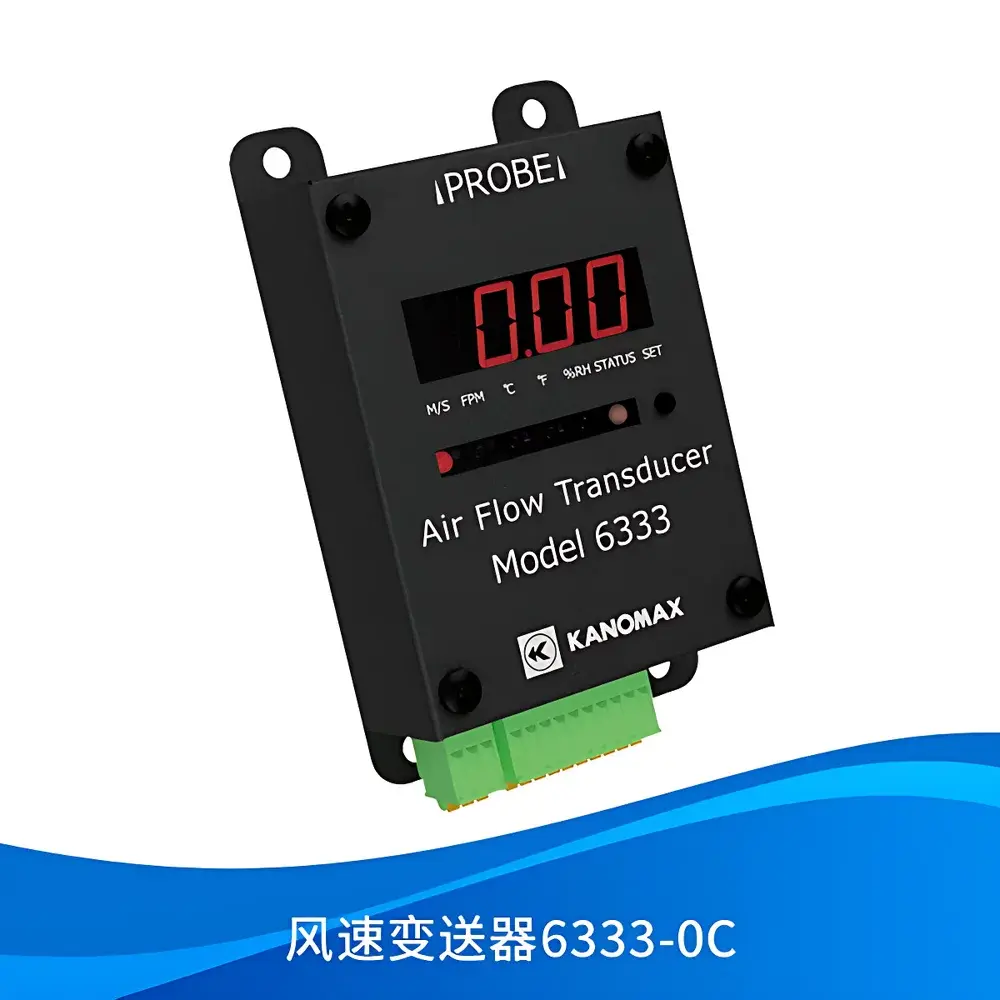
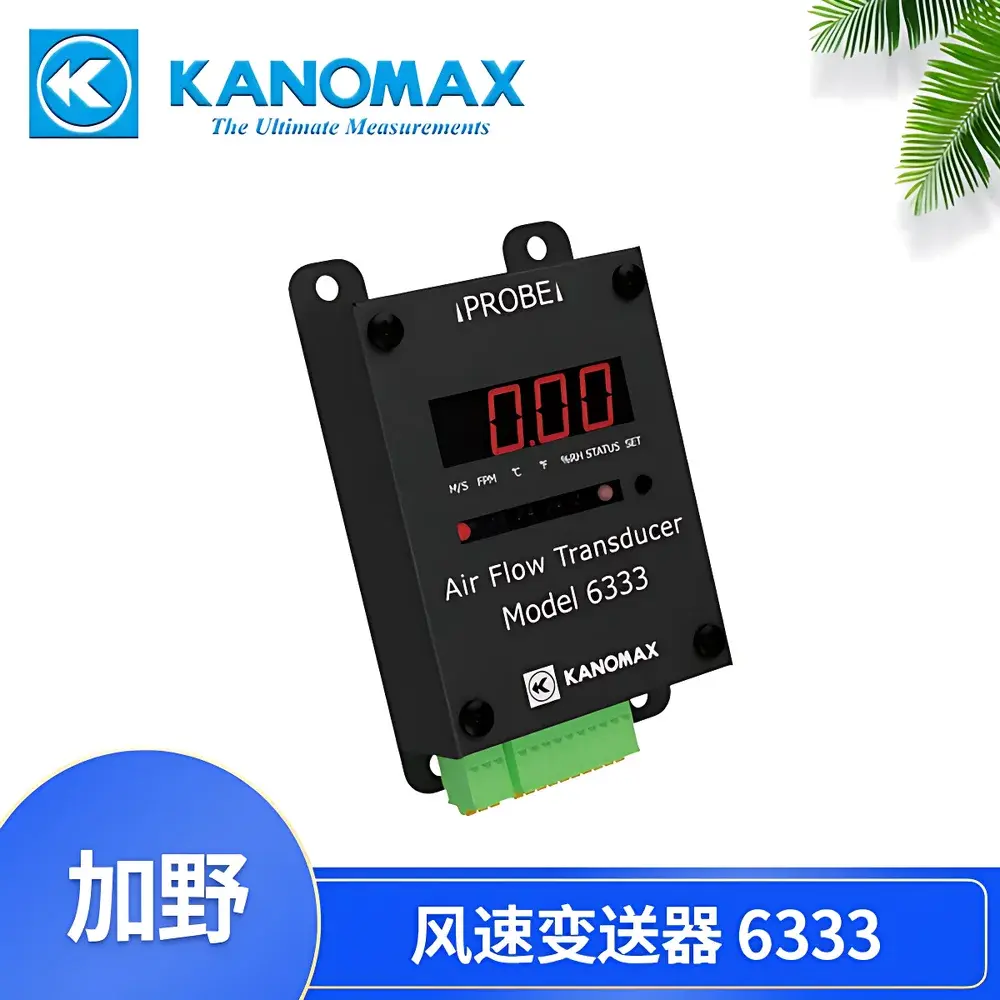
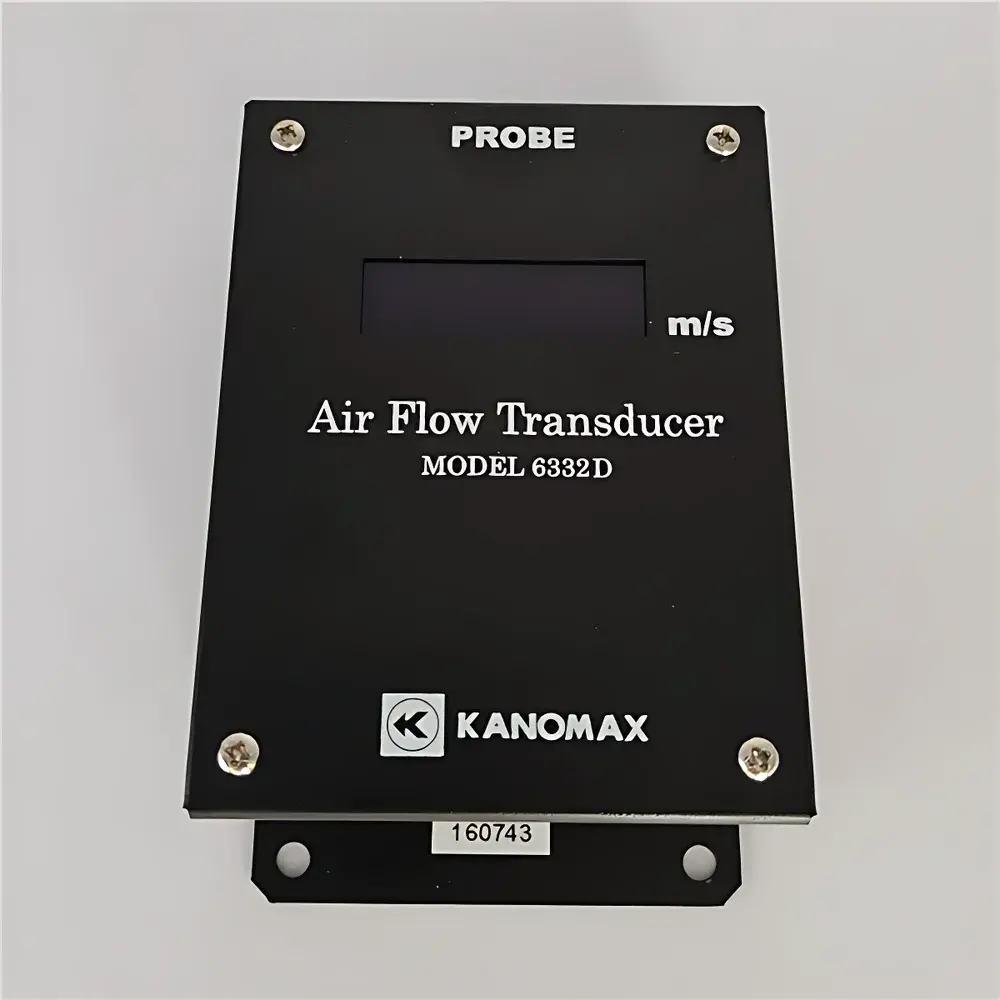
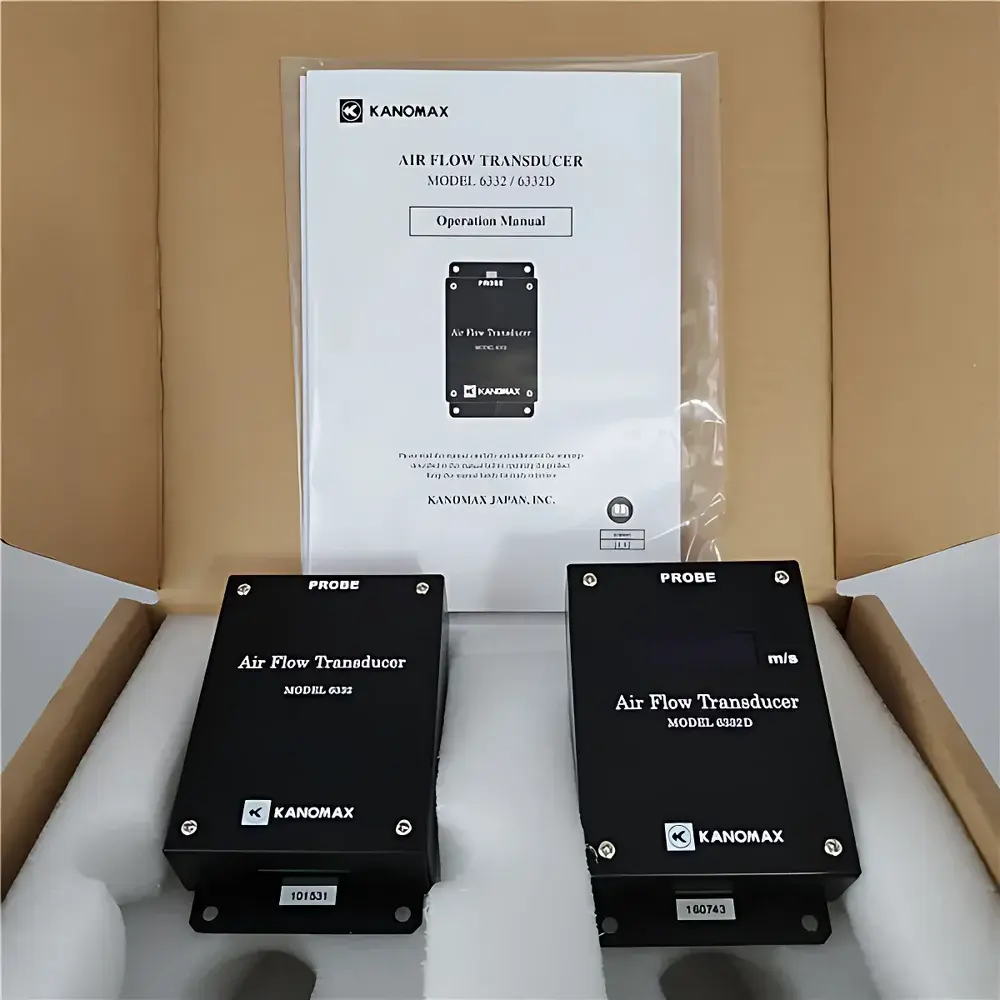
Kanomax 6333-0C Thermal Anemometer Transmitter for ECU Thermal Management
| Brand | Kanomax |
|---|---|
| Origin | Japan |
| Instrument Type | Thermal Anemometer |
| Measurement Range | 0.01–50.0 m/s |
| Resolution | 0.01 m/s (0.01–9.99 m/s), 0.1 m/s (10.0–50.0 m/s) |
| Accuracy | ±2% of reading or ±0.02 m/s (whichever is greater) |
| Operating Temperature | 0–60 °C |
| Operating Humidity | 2–98% RH (non-condensing) |
| Analog Output | 4–20 mA or 0–5 V (DIP-switch configurable) |
| Digital Output | RS-485 |
| Power Supply | AC 100–240 V / DC 12–24 V |
| Dimensions | 100 × 60 × 25 mm |
| Weight | 200 g |
| Probe Compatibility | 15 interchangeable probe models (e.g., 0972-00, 0975-31, 0976-05) with temperature/humidity sensing options |
Overview
The Kanomax 6333-0C Thermal Anemometer Transmitter is an industrial-grade, multi-parameter environmental monitoring instrument engineered for precision air velocity, temperature, and relative humidity (RH) measurement in demanding thermal management applications—particularly in automotive ECU cooling validation, HVAC commissioning, cleanroom airflow verification, and electronics thermal design testing. Utilizing constant-temperature anemometry (CTA), the system maintains a heated sensor element at a fixed temperature differential above ambient; convective heat loss from airflow is converted into a calibrated velocity signal with high linearity and low drift. Unlike cup or vane anemometers, CTA technology enables sub-0.1 m/s resolution and rapid dynamic response—critical for transient airflow analysis in ducts, heat sinks, and enclosure ventilation paths. The transmitter’s modular architecture decouples signal processing (6333-0C main unit) from sensing (15 field-replaceable probe variants), enabling application-specific configuration without hardware redesign.
Key Features
- Modular probe interface supporting 15 interchangeable thermal anemometer probes—including directional (e.g., 0972-00) and omnidirectional (e.g., 0975-00) configurations—with selectable temperature and RH sensing capabilities.
- Ultra-low velocity detection down to 0.01 m/s, validated per ISO 16813 and ASTM D1078 for low-flow thermal environment characterization.
- High-temperature probe variants (e.g., 0976-05) rated up to 120 °C, enabling stable operation in engine bay proximity tests and exhaust duct monitoring.
- Compact transmitter housing (100 × 60 × 25 mm, 200 g) designed for panel mounting, DIN-rail integration (optional 6333-70 kit), or mobile deployment—including in-vehicle ECU thermal mapping.
- Dual-output architecture: analog (4–20 mA or 0–5 V, DIP-switch selectable) for PLC/SCADA integration, plus RS-485 Modbus RTU for digital data logging and networked multi-point systems (up to 4 units daisy-chained).
- Onboard temperature compensation across all probe types ensures ±2% full-scale accuracy over 0–60 °C ambient, meeting IEC 60751 Class B tolerance requirements for integrated Pt1000 RTD elements.
Sample Compatibility & Compliance
The 6333-0C supports heterogeneous sampling environments through its probe ecosystem: micro-probes (e.g., 0975-31, Ø3.2 mm) enable insertion into narrow PCB gaps or heat sink fins; high-velocity probes (0972-00) maintain stability at 50 m/s in wind tunnel calibration; and combined thermo-hygrometric probes (0975-31) deliver simultaneous air velocity, temperature (±0.5 °C), and RH (±3% RH at 5–80% RH) measurements. All probes comply with IP54 ingress protection when mated with standard connectors. The system meets CE marking requirements under EMC Directive 2014/30/EU and Low Voltage Directive 2014/35/EU. For regulated industries, analog output traces support FDA 21 CFR Part 11-compliant audit trails when paired with validated data acquisition software (e.g., optional 6333-40).
Software & Data Management
The optional Kanomax 6333-40 Windows 10-compatible software provides real-time multichannel visualization (velocity, temperature, RH), time-series charting, statistical summary (min/max/avg/std dev), and export to CSV or Excel formats. Language switching (English/Japanese/Chinese) facilitates multinational lab operations. Raw RS-485 data streams support custom integration via Modbus register mapping—enabling synchronization with thermal imaging cameras or CFD validation platforms. The software implements GLP-compliant metadata tagging (operator ID, timestamp, probe serial number, calibration due date) and supports password-protected configuration lockdown for QA/QC workflows.
Applications
- Automotive ECU thermal management: Quantifying airflow across heatsinks, verifying fan performance curves, and validating thermal shutdown thresholds under simulated driving cycles.
- Electronics cooling R&D: Measuring local velocity gradients inside server chassis, GPU enclosures, and power supply modules to inform thermal interface material selection.
- HVAC system commissioning: Mapping supply/return air velocities in ductwork, diffusers, and VAV boxes per ASHRAE Guideline 12-2020.
- Cleanroom ISO 14644-3 certification: Monitoring unidirectional airflow uniformity and recovery time at critical workstations.
- Industrial process monitoring: Continuous airflow surveillance in drying ovens, paint booths, and semiconductor fab mini-environments.
FAQ
Can the 6333-0C measure both velocity and temperature simultaneously?
Yes—when equipped with dual-sensor probes (e.g., 0975-31 or 0976-15), the transmitter outputs synchronized velocity, temperature, and RH values via analog or RS-485.
Is probe calibration traceable to NIST or JCSS standards?
All Kanomax probes ship with individual calibration certificates traceable to JCSS-accredited laboratories; NIST-traceable calibration services are available upon request.
What is the maximum cable length between probe and transmitter?
Standard shielded cables support up to 40 m (model 1580-35); extended runs require active signal conditioning to maintain noise immunity in electrically noisy environments.
Does the system support alarm thresholds and relay outputs?
No—the 6333-0C is a measurement-only transmitter; external PLCs or SCADA systems must implement logic-based alarms using its analog or digital outputs.
How often should the probe be recalibrated?
Kanomax recommends annual recalibration for ISO/IEC 17025 compliance; frequency may increase in high-dust or corrosive gas environments per internal quality procedures.







