
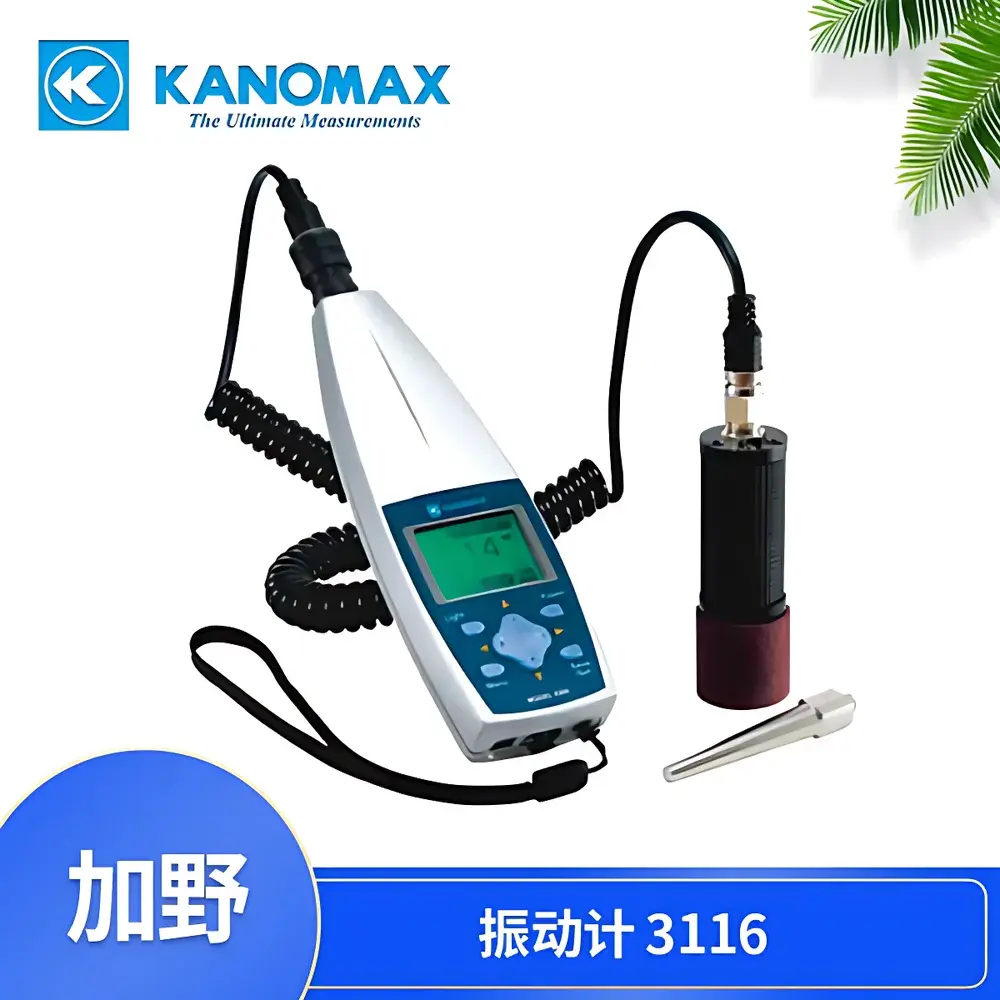
Kanomax 3116 Portable Digital Vibration Meter
| Brand | Kanomax |
|---|---|
| Origin | Japan |
| Model | 3116 |
| Acceleration Range | 0.02–200 m/s² RMS |
| Velocity Range | 0.02–200 mm/s RMS |
| Displacement Range | 2–2000 µm EQp-p |
| Accuracy | ±5% |
| Frequency Range (Acceleration) | 3 Hz–10 kHz |
| Frequency Range (Velocity) | 10 Hz–1 kHz (compliant with JIS B 0907:1989) |
| Frequency Weighting | 10–400 Hz band-limited for vibration severity evaluation |
| AC Output | 1 Vrms (full scale) |
| Headphone Output | Yes, with volume control |
| Communication Interface | RS-232C |
| Power Supply | Two AAA batteries or optional AC adapter |
| Dimensions | 145 mm (H) × 48 mm (W) × 23 mm (D) |
| Weight | Approx. 130 g |
Overview
The Kanomax 3116 Portable Digital Vibration Meter is a compact, hand-held instrument engineered for field and industrial maintenance personnel to perform rapid, reliable vibration assessments on rotating and reciprocating machinery. Based on piezoelectric acceleration sensing technology, the device measures mechanical vibration in three fundamental physical domains—acceleration, velocity, and displacement—each derived from time-domain signal processing of the transducer output. Its design adheres to the metrological requirements outlined in JIS B 0907:1989 (Vibration Measurement Methods for Machinery), ensuring compatibility with standard vibration severity evaluation practices used in predictive maintenance programs across manufacturing, power generation, and HVAC sectors. The integrated magnetic base and optional contact probe enable stable coupling to metallic surfaces without requiring permanent mounting, while its low-mass housing minimizes mass-loading effects on lightweight components.
Key Features
- Triple-parameter measurement capability: simultaneous real-time display of acceleration (m/s² RMS), velocity (mm/s RMS), and displacement (µm EQp-p) — all traceable to SI units via internal calibration algorithms.
- Frequency-selective analysis: configurable bandpass filtering (10–400 Hz) optimized for ISO 10816-3 vibration severity assessment of industrial machines under normal operating conditions.
- High-fidelity analog signal conditioning: low-noise amplifier stage with 1 Vrms AC output enables direct connection to oscilloscopes, data loggers, or FFT analyzers for spectral verification.
- Integrated headphone monitoring: allows audible diagnosis of bearing defects, gear mesh anomalies, or imbalance signatures without external equipment.
- RS-232C serial interface: supports bidirectional communication for remote configuration, firmware updates, and batch data export compliant with CSV and ASCII protocols.
- Ultra-portable form factor: dimensions of 145 × 48 × 23 mm and weight of only 130 g ensure ergonomic operation during extended shift-based inspections.
Sample Compatibility & Compliance
The Kanomax 3116 is intended for non-invasive surface vibration measurements on rigid metallic structures including motor housings, pump casings, gearbox flanges, compressor frames, and fan pedestals. It is not designed for soft materials, high-temperature surfaces (>60°C), or environments with strong electromagnetic interference exceeding IEC 61000-4-3 Level 3. The instrument complies with JIS B 0907:1989 for vibration measurement methodology and meets CE marking requirements for electromagnetic compatibility (EMC Directive 2014/30/EU) and low-voltage safety (LVD Directive 2014/35/EU). While not certified to ISO/IEC 17025, its factory calibration certificate includes uncertainty statements referenced to NMIJ (National Metrology Institute of Japan) standards.
Software & Data Management
Data acquisition and reporting are supported through Kanomax’s proprietary PC application, compatible with Windows 10/11. The software enables time-stamped logging, customizable pass/fail thresholds per machine type, trend graphing over multiple inspection cycles, and PDF report generation with embedded metadata (operator ID, location tag, sensor coupling method). All stored records include audit trail timestamps and user authentication logs, supporting GLP-aligned documentation workflows. Raw RS-232C output is fully compatible with third-party platforms such as LabVIEW, MATLAB, and Python-based analysis scripts using standard pySerial libraries.
Applications
- Routine vibration screening of electric motors, centrifugal pumps, and air compressors per ISO 20816-1 baseline thresholds.
- Troubleshooting mechanical looseness, misalignment, and rolling-element bearing degradation using velocity amplitude trends in the 10–1 kHz band.
- Verification of vibration isolation effectiveness after installation of resilient mounts or inertia bases.
- Pre-commissioning checks of newly installed rotating equipment prior to load testing.
- Educational use in mechanical engineering laboratories for teaching vibration fundamentals, transducer physics, and frequency domain interpretation.
FAQ
What is the recommended recalibration interval for the Kanomax 3116?
Annual recalibration is recommended for routine industrial use; more frequent verification (e.g., before critical inspections) can be performed using a certified shaker reference source or portable calibrator meeting ISO 16063-21 specifications.
Can the 3116 measure vibration on non-ferrous surfaces?
Yes — though the magnetic base requires ferromagnetic material for attachment, the included contact probe with spring-loaded tip enables measurements on aluminum, stainless steel, and composite housings when manually held with consistent pressure.
Does the device support ISO 5347-compliant transducer calibration?
No — the 3116 is a self-contained meter with an integrated sensor; it does not accept external accelerometers nor provide charge output. Calibration applies exclusively to the built-in piezoelectric element.
Is battery life affected by headphone usage or RS-232 transmission?
Continuous headphone monitoring increases current draw by ~15%; active RS-232 communication adds negligible load. Under typical intermittent use (5 min/hour), two AAA alkaline cells sustain operation for ≥120 hours.
How is traceability maintained for field measurements?
Each unit ships with a NMIJ-traceable calibration certificate listing sensitivity values at 160 Hz and 1 kHz, along with temperature-dependent drift coefficients documented per JIS Z 8015.
Related Products







