
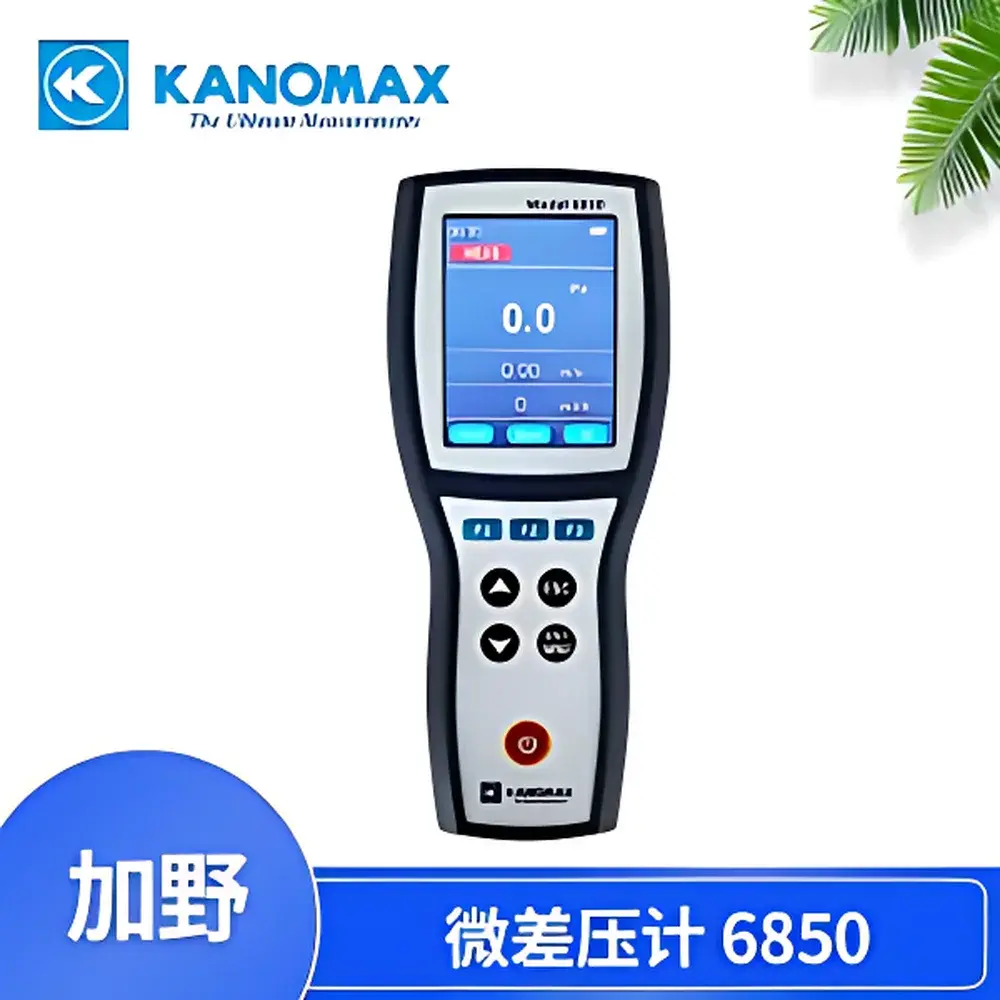
KANOMAX Model 6850 Digital Micro Differential Pressure Meter
| Brand | KANOMAX |
|---|---|
| Origin | Japan |
| Model | 6850 |
| Differential Pressure Range | –2500 to +2500 Pa |
| Accuracy | ±0.5% of reading ±1 Pa |
| Resolution | 0.1 Pa |
| Air Velocity Range | 0.20–60.0 m/s |
| Velocity Accuracy | ±1.5% of reading (at 10.0 m/s) |
| Velocity Resolution | 0.01 m/s |
| Airflow Volume Range | 0–999999 m³/h |
| Volume Resolution | 1 m³/h |
| Operating Temperature | 0–60 °C (non-condensing) |
| Storage Temperature | –20–70 °C (non-condensing) |
| Power Supply | 4 × AA batteries or DC 5 V AC adapter |
| Battery Life | >15 hours |
| Weight (incl. batteries) | ~360 g |
| Data Storage Capacity | 10,000 records |
| Data Export | USB flash drive support |
Overview
The KANOMAX Model 6850 Digital Micro Differential Pressure Meter is a precision-engineered handheld instrument designed for high-accuracy measurement of differential pressure, air velocity, and volumetric airflow in HVAC commissioning, cleanroom validation, fume hood performance testing, and industrial ventilation system audits. Based on piezoresistive silicon pressure sensor technology with temperature compensation, the device delivers stable, repeatable readings across its full –2500 to +2500 Pa differential pressure range. When connected to a calibrated pitot tube (e.g., KANOMAX 6162 or equivalent), it calculates true air velocity using the standard Bernoulli-derived equation (v = √(2ΔP/ρ)), where density ρ is automatically compensated based on ambient temperature and pressure inputs. Its integrated real-time computation engine supports simultaneous display of differential pressure, derived velocity, and calculated volumetric flow — enabling field technicians to assess system performance without external conversion tools.
Key Features
- True-color backlit LCD display showing differential pressure, air velocity, and volumetric airflow concurrently in selectable units (Pa, mmH₂O, inH₂O, m/s, ft/min, m³/h, CFM)
- High-resolution pressure sensing with 0.1 Pa resolution and accuracy of ±0.5% of reading ±1 Pa — traceable to JIS Z 8001-1 and ISO/IEC 17025-accredited calibration standards
- Dual-mode operation: direct differential pressure measurement via built-in ports, or velocity/flow calculation via external pitot tube connection with automatic dynamic pressure compensation
- Onboard data logger storing up to 10,000 timestamped records with user-defined intervals; supports manual trigger and auto-start functions
- USB mass storage mode for direct export of CSV-formatted datasets to USB flash drives — no proprietary software required for basic data retrieval
- Rugged ergonomic housing rated IP42 for dust and splash resistance; operating range maintained from 0 to 60 °C at non-condensing humidity levels ≤80% RH
- Low-power architecture enabling >15 hours of continuous operation on four AA alkaline cells; optional DC 5 V AC adapter included for extended bench use
Sample Compatibility & Compliance
The Model 6850 is compatible with standard stainless-steel pitot tubes (e.g., Type S, Prandtl, or KANOMAX 6162) and flexible PVC or nylon pressure tubing (ID 4–6 mm). It meets IEC 61000-4-2 (ESD immunity) and IEC 61000-4-3 (radiated RF immunity) requirements for industrial environments. While not certified for hazardous locations, its design conforms to general safety principles outlined in IEC 61010-1 for electrical measurement equipment. Data integrity aligns with GLP and GMP documentation expectations: each stored record includes date/time stamp, sensor ID (if configured), measurement mode, and environmental conditions (ambient temperature). Audit trails are preserved during USB export, supporting compliance with internal quality procedures and ISO 14644-3 cleanroom certification workflows.
Software & Data Management
The instrument operates autonomously without host software, but exported CSV files are fully compatible with Microsoft Excel, MATLAB, Python (pandas), and industry-standard HVAC analysis platforms such as Trane TRACE™ or Carrier Hourly Analysis Program (HAP). Each dataset includes column headers specifying parameter type, unit, timestamp (YYYY-MM-DD HH:MM:SS), and instrument serial number — facilitating traceability in regulated environments. Statistical post-processing (min/max/mean, trend plotting, pass/fail flagging against ASHRAE 110 or ISO 14644-3 acceptance criteria) can be performed directly within spreadsheet applications. No cloud connectivity or firmware updates are required; all configuration is managed via intuitive on-device menu navigation with tactile keypad feedback.
Applications
- HVAC system balancing and duct leakage verification per SMACNA and ASHRAE Guideline 12
- Cleanroom differential pressure monitoring across classified zones (ISO 14644-1 Class 5–8)
- Fume hood face velocity validation per ANSI/ASHRAE 110 and UK HSE Guidance Note EH40
- Filter efficiency testing via upstream/downstream pressure drop tracking
- Building envelope air infiltration assessment using blower door techniques (paired with compatible manometer)
- Industrial exhaust stack velocity profiling for EPA Method 1/2/3 compliance pre-screening
FAQ
What types of pitot tubes are compatible with the Model 6850?
The instrument accepts any standard pitot tube with 4–6 mm OD tubing connections and a dynamic/static port configuration aligned with ISO 10780 or ASTM D2513 specifications. KANOMAX 6162 and TSI 8465 models are validated for use.
Does the device support real-time data logging to a PC?
No — the Model 6850 does not feature RS-232, Bluetooth, or USB-CDC communication. Data transfer occurs exclusively via USB mass storage mode to flash drives.
Can calibration certificates be provided with traceability to NMIJ?
Yes — optional factory calibration with NMIJ-traceable certificate (JCSS-accredited) is available upon order; calibration interval recommendation is 12 months under normal use conditions.
Is the battery compartment sealed against dust ingress?
The battery cover uses a silicone gasket and captive screw, achieving IP42-rated protection against vertically falling drops and limited dust exposure — suitable for most indoor technical environments but not outdoor or high-particulate settings.
How is air density compensated during velocity calculation?
The device measures ambient temperature via an internal thermistor and applies the ideal gas law to compute local air density; users may override default atmospheric pressure (101.325 kPa) if operating at altitude or controlled barometric conditions.
Related Products







