
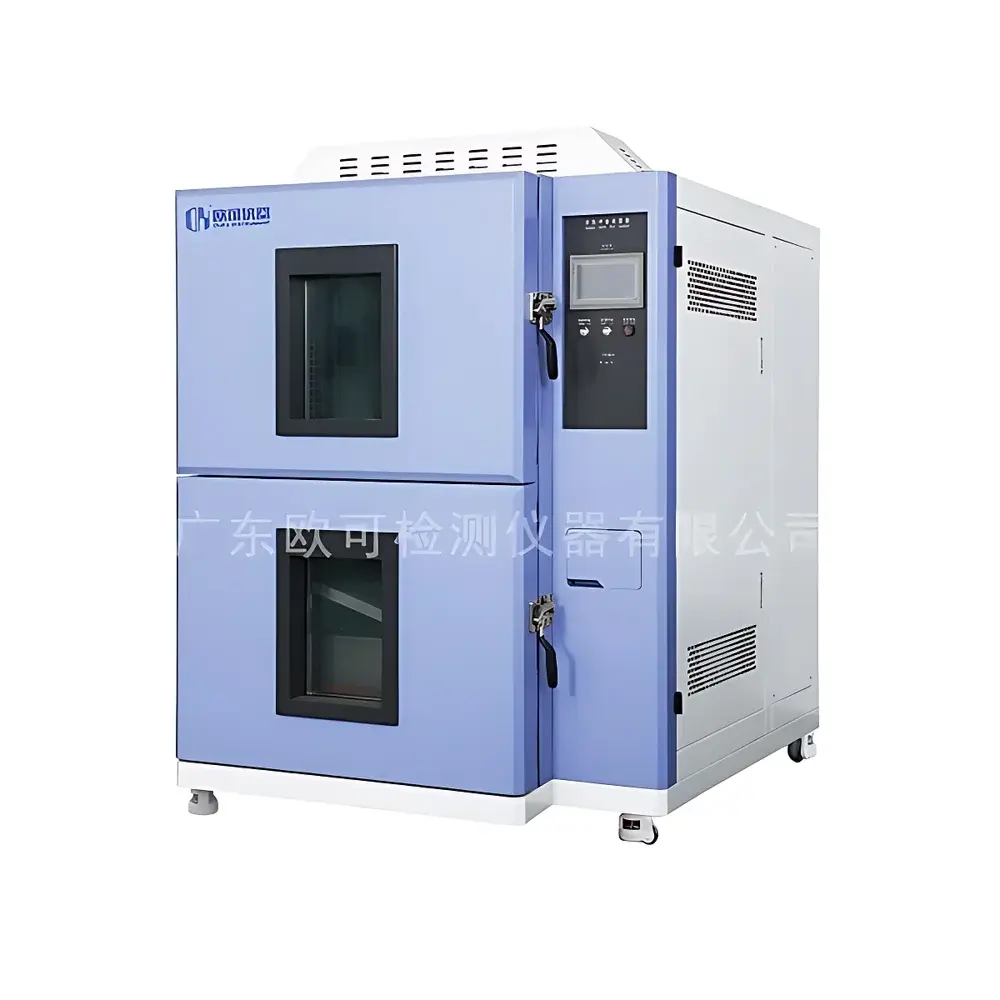
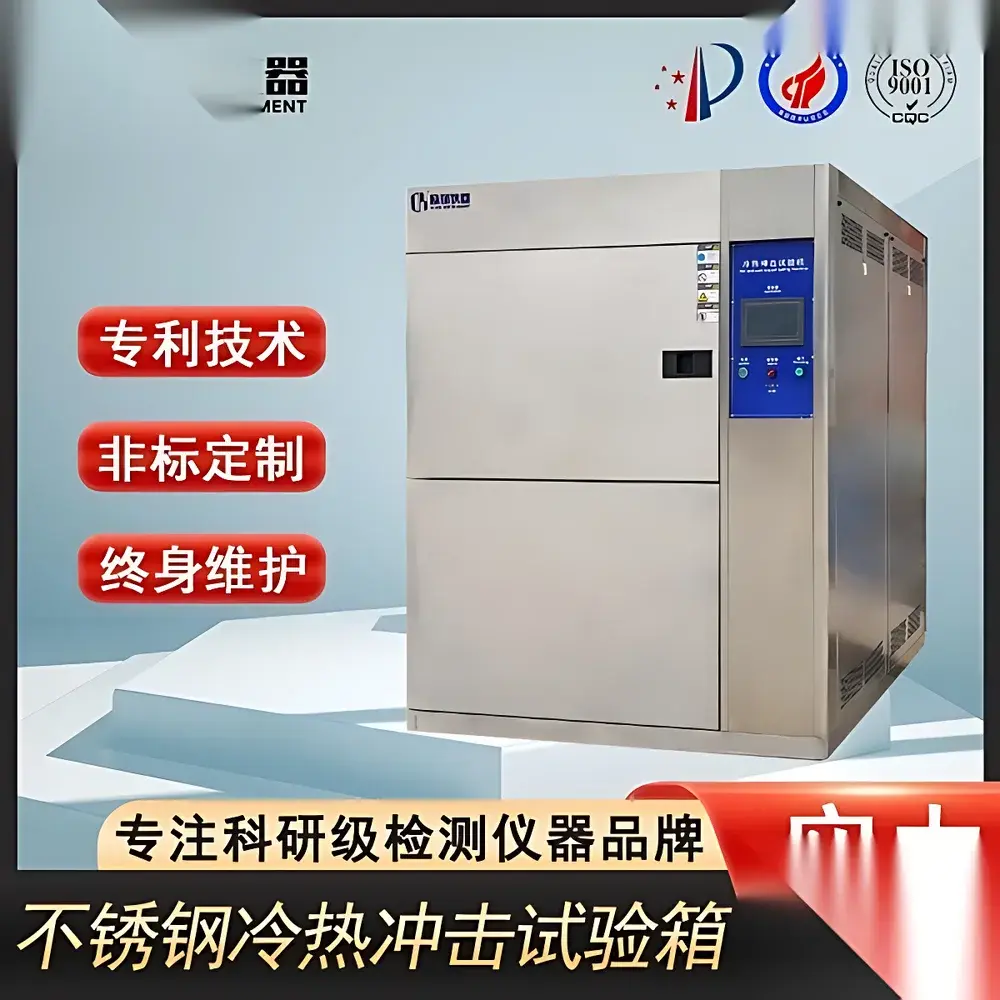
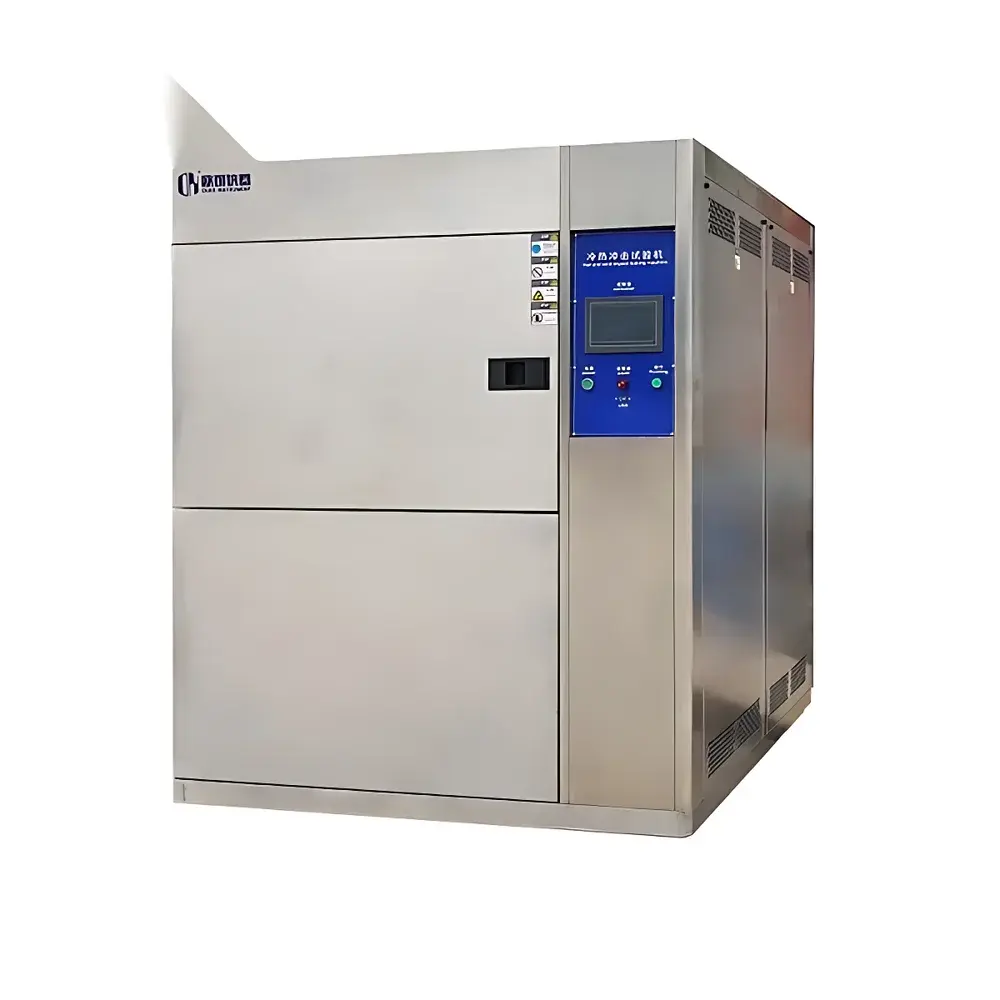
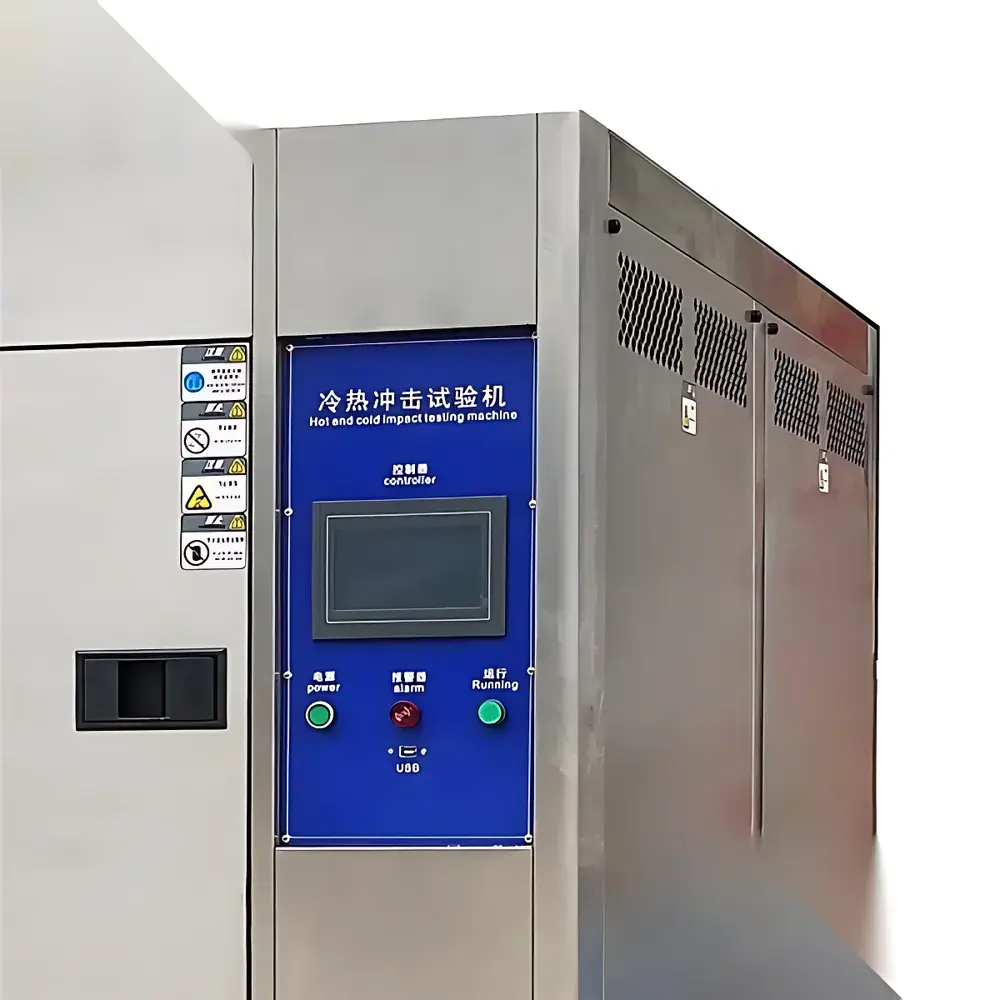
Thermal Shock Test Chamber – Standard Series with Programmable Controller and Dual-Zone Rapid Temperature Transition Capability
| Key Features | Programmable 7-inch color touchscreen controller (Chinese UI) |
|---|---|
| Temperature Range | -30°C to +150°C / -50°C to +150°C / -65°C to +150°C |
| Temperature Uniformity | ±2.0°C |
| Temperature Stability | ±0.5°C |
| Heating Rate | up to 20°C/min (non-linear average) |
| Cooling Rates | 3 / 5 / 10 / 15°C/min (non-linear average) |
| Refrigeration System | Semi-hermetic or hermetic compressors (European/American origin) |
| Refrigerants | R404A, R23 |
| Insulation | High-density polyurethane foam or ultra-fine glass wool |
| Interior Material | SUS304/2B stainless steel with radius-corner design |
| Exterior Finish | Powder-coated cold-rolled steel |
| Safety Protections | Over-temperature, over-pressure, phase-loss, motor overload, earth leakage, compressor high-temp/overcurrent, grounding terminal |
| Compliance | GB/T 2423.1–1989, GB/T 2423.2–1989, GB/T 2423.34–1993, IEC 60068-2-30 |
Overview
The Thermal Shock Test Chamber – Standard Series is an engineered environmental simulation system designed for accelerated reliability evaluation of electronic components, automotive modules, aerospace materials, and packaging systems under extreme thermal transition conditions. It operates on the principle of rapid dual-zone thermal shock—utilizing independent high-temperature and low-temperature chambers with a mechanical lift-and-transfer mechanism to subject test specimens to abrupt temperature transitions within seconds. This methodology conforms to established thermal stress acceleration models used in HALT (Highly Accelerated Life Testing) pre-screening and qualification protocols. Unlike single-chamber thermal cycling systems, this chamber delivers repeatable, high-fidelity shock profiles essential for detecting latent defects such as solder joint fatigue, delamination in multilayer PCBs, sealant cracking, and coefficient-of-thermal-expansion (CTE) mismatch failures.
Key Features
- Programmable 7-inch true-color LCD touchscreen controller with intuitive Chinese-language interface, supporting PID auto-tuning, multi-segment ramp-soak profiles, and real-time curve visualization.
- Dual independent chamber architecture with rapid transfer shuttle—enabling transition times ≤15 seconds between extreme setpoints (e.g., -65°C ↔ +150°C).
- Robust refrigeration system configured with semi-hermetic or fully hermetic compressors sourced from European and North American manufacturers; compatible with R404A (standard) and R23 (ultra-low temp option) refrigerants.
- High-efficiency insulation using either closed-cell polyurethane foam (≥100 mm thickness) or ultra-fine glass wool, minimizing thermal leakage and ensuring long-term energy stability.
- Corrosion-resistant interior constructed from brushed-finish SUS304/2B stainless steel with seamless radius-corner welding—facilitating cleaning, reducing contamination risk, and meeting cleanroom-compatible maintenance standards.
- Integrated safety architecture including dual-stage over-temperature cutoff, compressor discharge pressure monitoring, three-phase power anomaly detection, and dedicated equipment grounding terminals compliant with IEC 61000-4 immunity requirements.
Sample Compatibility & Compliance
This chamber accommodates standard industrial sample configurations—including JEDEC trays, PCB assemblies up to 60 × 80 × 85 cm (W × D × H), automotive control units, and sealed consumer electronics enclosures. The chamber meets structural and operational alignment with multiple international test standards: GB/T 2423.1–1989 (cold testing), GB/T 2423.2–1989 (dry heat), GB/T 2423.34–1993 (damp heat, cyclic), and IEC 60068-2-30 (cyclic damp heat with rapid temperature change). While not certified to MIL-STD-810 or AEC-Q200 out-of-the-box, its performance envelope supports derivation of custom test plans aligned with those specifications when validated per customer-defined protocols.
Software & Data Management
The embedded controller logs temperature data at user-selectable intervals (1–60 sec) for up to 100 days, storing timestamped records internally with automatic overwrite protection. USB host functionality enables direct export of CSV-formatted datasets to external PCs for post-test statistical analysis (e.g., Cp/Cpk, Weibull modeling). Although native network connectivity (Ethernet/Wi-Fi) is not included, optional RS-485 or Modbus RTU interfaces support integration into centralized lab management platforms. Audit trail capabilities comply with GLP-aligned documentation practices, including operator ID tagging, parameter modification timestamps, and event-triggered alarm logging—though full 21 CFR Part 11 compliance requires third-party validation and digital signature add-ons.
Applications
- Qualification testing of printed circuit board assemblies (PCBAs) per IPC-J-STD-004 and IPC-A-610 prior to high-volume manufacturing release.
- Validation of adhesive bond integrity and encapsulant performance in LED modules and power semiconductor packages.
- Stress screening of MEMS sensors, automotive ECUs, and battery management systems (BMS) under thermal gradient extremes.
- Material compatibility assessment for medical device housings exposed to sterilization cycles followed by ambient storage conditions.
- Failure mode identification in plastic housing components subjected to repeated expansion/contraction cycles during field deployment.
FAQ
What is the typical transfer time between temperature zones?
Transfer time is ≤15 seconds for standard configurations (40 × 40 × 45 cm working volume); larger chambers may require up to 25 seconds depending on payload mass and thermal inertia.
Can the chamber operate in single-zone mode for static high- or low-temperature testing?
Yes—the system supports standalone high-temperature soak (up to +150°C) and ultra-low-temperature dwell (down to -65°C) without activation of the shuttle mechanism.
Is calibration traceability provided with delivery?
Each unit ships with a factory calibration report referencing NIST-traceable reference probes; ISO/IEC 17025-certified field calibration services are available upon request.
What maintenance intervals are recommended for the refrigeration system?
Compressor oil and filter-drier replacement is advised every 24 months under continuous operation; condenser coil inspection and cleaning should occur quarterly in non-climate-controlled lab environments.
Are custom modifications available for special voltage requirements or hazardous area certification?
Custom electrical configurations (e.g., 208V/3φ/60Hz, 380V/3φ/50Hz) are supported; ATEX or IECEx certification requires structural redesign and is offered as a separate engineering project.



