
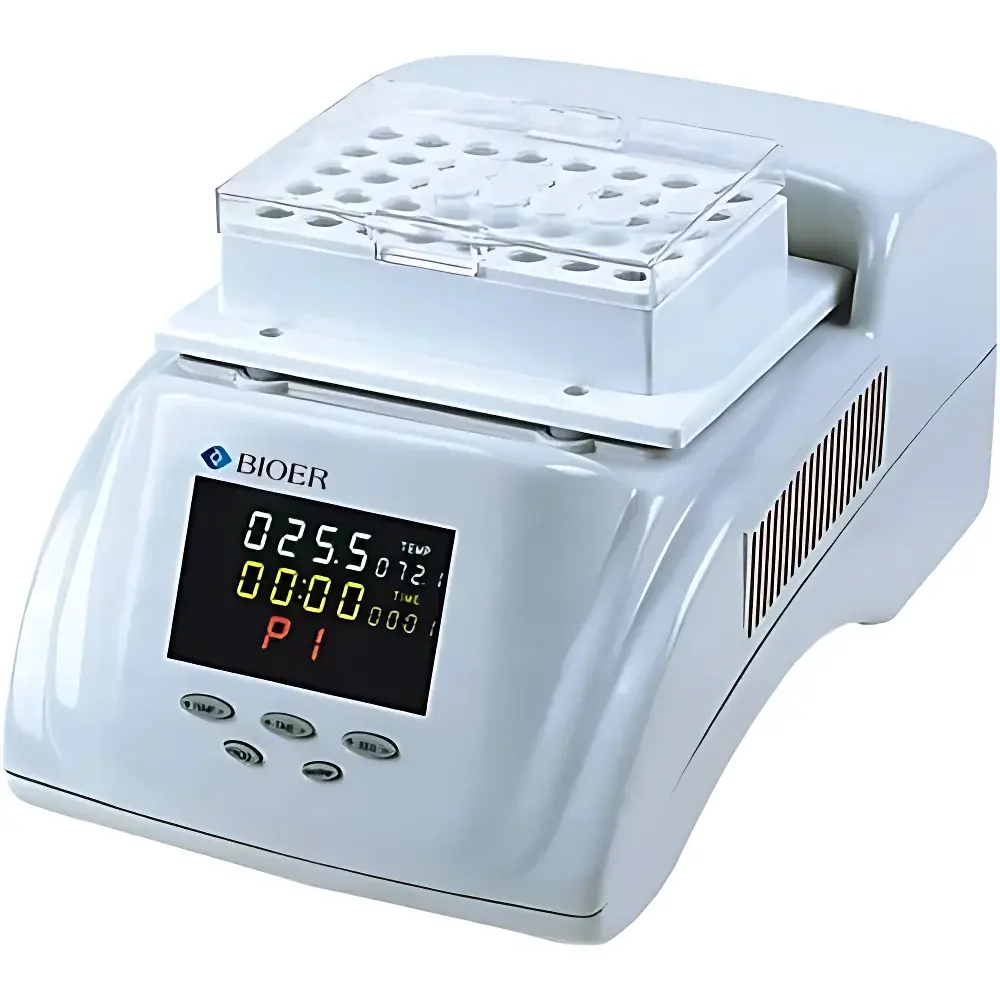
Bioer ThermoCell HB-202 Advanced Peltier-Controlled Metal Block Heater
| Brand | Bioer |
|---|---|
| Origin | Zhejiang, China |
| Model | HB-202 |
| Temperature Range | 10–105°C |
| Temperature Accuracy | ≤ ±0.5°C |
| Heating Time | ≤12 min (20°C → 100°C) |
| Dimensions (L×W×H) | 300 × 200 × 160 mm |
| Net Weight | 2.8 kg |
| Power Supply | 220 V~, 50 Hz, 120 W |
| Temperature Uniformity Across Block | ≤ ±0.5°C |
| Timer Range | 1 min – 99 h 59 min |
| Cooling Method | Peltier (TE) element |
| Heating Method | Resistive heating element |
| Standard Block Configurations | A (40 × 1.5 mL), B (54 × 0.5 mL), C (96 × 0.2 mL), D (24 × φ15 mm), H (40 × 2.0 mL), G (26 × 0.5 mL + 24 × 1.5 mL), J (96-well microplate), E (115 × 73 × 38 mm water bath insert) |
Overview
The Bioer ThermoCell HB-202 is a compact, Peltier-based metal block heater engineered for precise thermal control in molecular biology, clinical diagnostics, and quality control laboratories. Unlike conventional dry baths relying solely on resistive heating, the HB-202 integrates thermoelectric (TE) cooling and heating within a single aluminum alloy block architecture—enabling bidirectional temperature regulation from 10°C up to 105°C with high reproducibility and minimal overshoot. Its microprocessor-controlled PID algorithm continuously monitors block surface temperature via embedded platinum resistance sensors (PT100), delivering stable setpoint maintenance within ±0.5°C across the entire working range. Designed for walk-away operation, the unit supports extended incubation protocols (up to 99 hours 59 minutes), making it suitable for applications requiring strict thermal history compliance under GLP or ISO/IEC 17025 frameworks.
Key Features
- Peltier (TE)-assisted dual-mode thermal regulation: enables both rapid heating (<12 min from 20°C to 100°C) and active cooling (down to 10°C ambient-independent)
- High-uniformity aluminum heating block with precision-machined wells; temperature deviation across all positions ≤ ±0.5°C at steady state
- Modular interchangeability: supports eight standardized block configurations—including 96-well PCR plates, enzyme assay microplates, and tube formats (0.2 mL to 2.0 mL)—without tooling
- Digital interface with intuitive rotary encoder and LCD display: real-time monitoring of setpoint, actual block temperature, remaining time, and system status
- Over-temperature and dry-run protection circuits compliant with IEC 61010-1 safety standards for laboratory electrical equipment
- Low-power consumption (120 W max) and silent operation—no fans or moving parts—ideal for laminar flow hoods and shared benchtop environments
Sample Compatibility & Compliance
The HB-202 accommodates diverse sample containers through its field-replaceable block system, supporting common labware including thin-walled PCR tubes, skirted and non-skirted 96-well plates, cryovials, and 15 mm diameter test tubes. All blocks are CNC-machined from anodized aluminum to ensure chemical resistance and long-term dimensional stability. The device meets CE marking requirements per Directive 2014/30/EU (EMC) and 2014/35/EU (LVD). While not certified for use in FDA-regulated GMP manufacturing environments as standalone equipment, its programmable timer, non-volatile temperature logging (via optional RS232/USB data export), and audit-ready parameter retention support 21 CFR Part 11-aligned workflows when integrated into validated laboratory information management systems (LIMS).
Software & Data Management
The HB-202 operates autonomously without proprietary software; however, optional serial communication (RS232) or USB-to-serial adapters enable integration with third-party lab automation platforms or custom Python/Matlab scripts for remote scheduling, batch logging, and thermal profile validation. Timestamped temperature readings can be exported in CSV format for traceability during method qualification (e.g., ISO 15197 for diagnostic reagent stability testing). Firmware supports user-defined calibration offsets per block type, facilitating periodic verification against NIST-traceable reference thermometers—a requirement for ISO/IEC 17025 accredited testing laboratories.
Applications
- Thermal denaturation and renaturation of nucleic acids and proteins prior to electrophoresis or sequencing library prep
- Enzyme activity assays requiring precise pre-incubation at defined temperatures (e.g., restriction digests, ligations, reverse transcription)
- Controlled serum coagulation studies in clinical hematology labs
- Pre-heating of reagents and substrates in ELISA and lateral flow assay development
- Stabilization of thermolabile compounds during extraction protocols (e.g., RNA isolation kits)
- Temperature ramping simulations for accelerated stability testing per ICH Q1A(R2)
FAQ
Does the HB-202 support cooling below ambient temperature?
Yes—the integrated Peltier module enables active cooling down to 10°C regardless of ambient conditions, provided adequate ventilation is maintained.
Can multiple temperature zones be controlled simultaneously?
No—the HB-202 regulates a single uniform temperature across the entire block surface; multi-zone control requires separate units or alternative instrumentation such as gradient thermal cyclers.
Is block calibration required before first use?
Factory calibration is performed using traceable standards; users may perform optional offset adjustment via the front-panel menu if verifying against an independent reference thermometer.
What maintenance is recommended for long-term accuracy?
Annual verification of temperature uniformity and accuracy using a calibrated probe array is advised; cleaning of block wells with ethanol and lint-free wipes prevents thermal contact degradation.
Are replacement blocks available for custom tube formats?
Yes—Bioer offers OEM block design services for non-standard geometries under NDA; standard replacements ship globally with lead times under two weeks.



