
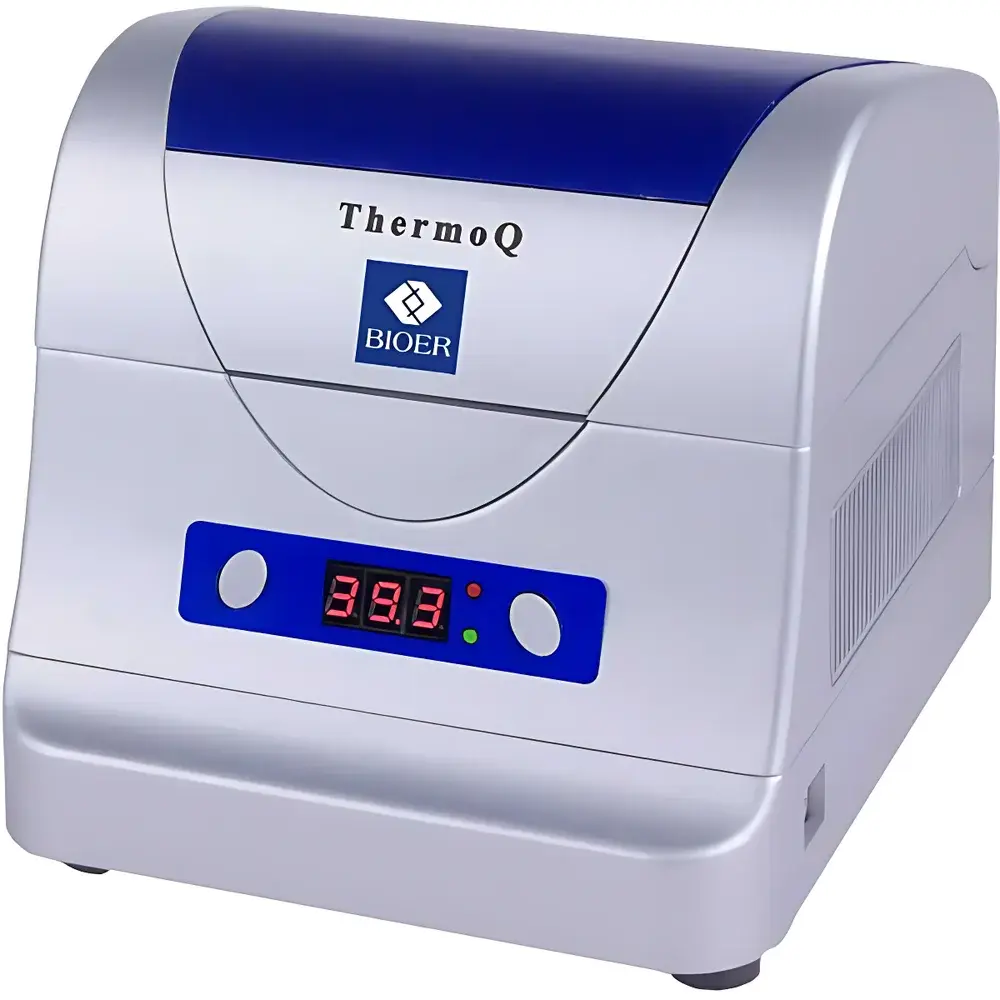
Bioer ThermoQ HB-T1 Advanced Programmable Metal Block Heater
| Brand | Bioer |
|---|---|
| Model | HB-T1 |
| Type | Programmable Metal Block Heater |
| Temperature Range | Ambient +5°C to 100°C |
| Temperature Accuracy | ±0.2°C |
| Temperature Uniformity | ≤±0.5°C |
| Temperature Stability (Fluctuation) | ≤±0.1°C |
| Temperature Resolution | 0.1°C |
| Heating Time | ≤10 min (from 20°C to 100°C) |
| Cooling Time | ≤8 min (from 100°C to 4°C) |
| Programmable Timer | 0–99 h 59 min or ∞ |
| Max. Program Steps | 9 |
| Max. Cycles | 99 |
| Heat Lid Temp | ≥ Block Temp +10°C (disabled if block <15°C) |
| Heat Lid Heating Time | ≤10 min (to 110°C) |
| Heat Lid Design | Removable, pressure-capable without heating element |
| Power Supply | AC 100–220 V, 50–60 Hz (via universal 24 V DC adapter) |
| Interface | USB-B for PC connectivity |
| Display | 3-digit LED |
| Status Indication | Tri-color LED (red = heating, yellow = holding, green = cooling) |
| Safety Features | Dual independent over-temperature protection (block & heat lid), sensor fault buzzer alarm |
| Dimensions (L×W×H) | 150 × 170 × 145 mm |
| Net Weight | ≤1.8 kg (varies by module) |
Overview
The Bioer ThermoQ HB-T1 is a high-precision, programmable metal block heater engineered for consistent thermal control in molecular biology, clinical diagnostics, and pharmaceutical QC workflows. Unlike traditional water baths, the HB-T1 employs solid-state aluminum alloy heating blocks with optimized thermal mass and conductive geometry to deliver rapid, uniform, and contamination-free temperature regulation across multiple sample formats. Its core operation relies on PID-controlled resistive heating combined with real-time feedback from high-stability platinum RTD sensors embedded directly into the block surface—ensuring traceable accuracy within ±0.2°C and minimal spatial variation (≤±0.5°C across the entire block). Designed for ISO/IEC 17025-compliant laboratories, the HB-T1 supports GLP/GMP documentation requirements through its integrated audit trail functionality, time-stamped event logging, and QC report generation.
Key Features
- Modular Interchangeability: Supports five standardized interchangeable aluminum blocks (A–E), accommodating tubes ranging from 0.2 mL PCR strips to 2 mL centrifuge tubes—enabling seamless transition between DNA amplification, enzyme assays, and sample thawing protocols.
- Removable Heat Lid System: The thermally insulated lid features independent PID control and auto-disable logic: heating activates only when block temperature exceeds 15°C and maintains a fixed +10°C offset (±3°C), preventing condensation while minimizing evaporation in low-volume reactions.
- Advanced Programmability: Up to 9-step programs with 99-cycle repetition, infinite hold mode, and automatic power-on resume after interruption—ideal for overnight incubations or multi-stage enzymatic digestions.
- Dual-Safety Architecture: Redundant over-temperature cutoffs operate independently on both block and heat lid circuits, certified to IEC 61010-1 safety standards; sensor failure triggers audible alarm and immediate thermal shutdown.
- PC Integration & Traceability: USB-B interface enables bidirectional communication with Bioer’s validated ThermoQ Control Software (v3.2+), supporting FDA 21 CFR Part 11–compliant electronic signatures, user access levels, and exportable CSV logs with timestamps, operator ID, and parameter history.
- Compact Ergonomics: Benchtop footprint of 150 × 170 × 145 mm and weight ≤1.8 kg facilitate placement in biosafety cabinets, cold rooms, or mobile lab setups without compromising stability or thermal performance.
Sample Compatibility & Compliance
The HB-T1 accommodates standard microcentrifuge tube formats (0.2 mL, 0.5 mL, 1.5 mL, 2.0 mL) and 96-well PCR plates via dedicated block configurations. All aluminum blocks are anodized per ASTM B580 Class 2 for corrosion resistance and cleaned using ISO 14644-1 Class 5 cleanroom protocols prior to packaging. Device compliance includes CE marking (2014/30/EU EMC Directive, 2014/35/EU LVD), RoHS 2011/65/EU, and conformity to ISO 13485:2016 for in vitro diagnostic support equipment. Validation documentation (IQ/OQ/PQ templates) and calibration certificates (NIST-traceable RTD verification) are available upon request for regulated environments.
Software & Data Management
ThermoQ Control Software provides full remote configuration, real-time monitoring, and automated reporting. Users define temperature ramps, dwell times, and cycle logic via intuitive drag-and-drop sequencing. Each run generates a tamper-evident PDF QC report including start/end timestamps, maximum deviation from setpoint, total energy consumption, and operator authentication hash. Audit trails record all parameter changes, user logins, and system alerts—retained for ≥36 months per internal retention policy. Software validation packages include installation qualification (IQ), operational qualification (OQ), and performance qualification (PQ) protocols aligned with USP Analytical Instrument Qualification guidelines.
Applications
- PCR pre-incubation and post-amplification hold stages
- Enzyme-linked immunosorbent assay (ELISA) plate incubation at 37°C
- Restriction enzyme digestion (30–65°C), ligase reactions (16°C), and dephosphorylation (56°C)
- Cell lysis buffer equilibration and antibody dilution warming
- Stability testing of biologics under accelerated thermal conditions
- QC release testing of raw materials requiring precise thermal conditioning per pharmacopeial monographs (e.g., USP , EP 2.2.43)
FAQ
Is the HB-T1 suitable for GMP-regulated environments?
Yes—the device meets key requirements for analytical instrument qualification per USP , supports 21 CFR Part 11 compliance via software controls, and includes factory-calibrated RTD sensors with NIST-traceable certificates.
Can the heat lid be used without active heating?
Yes—the mechanical lid remains fully functional as a physical seal even when disengaged from thermal control, maintaining tube alignment and minimizing evaporation during ambient-temperature protocols.
What is the expected service life of the heating block under continuous operation?
Rated for >50,000 cycles or 5 years of daily use at 100°C, based on accelerated life testing per IEC 60068-2-2 (dry heat).
Does the HB-T1 support external temperature probes for chamber validation?
No—temperature measurement is internal only; however, optional calibrated PT100 probe kits (sold separately) allow parallel validation against block-set values per ISO/IEC 17025 clause 5.10.
How is firmware updated?
Firmware updates are performed via USB using Bioer’s signed update utility; each release undergoes regression testing and includes version-locked cryptographic checksums to prevent unauthorized modification.



