
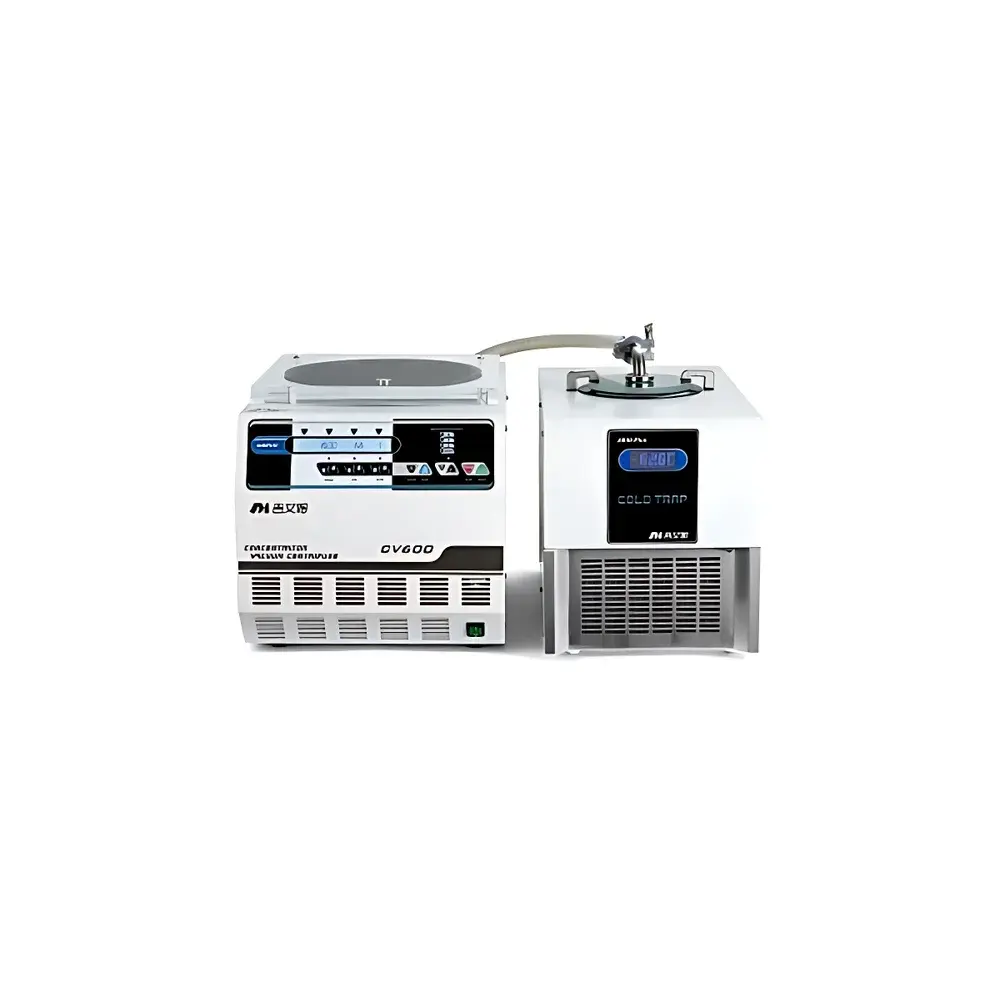
GiAim CV600 Vacuum Centrifugal Concentrator
| Brand | GiAim |
|---|---|
| Model | CV600 |
| Instrument Type | Vacuum Centrifugal Concentrator |
| Temperature Range | −5 °C to 80 °C (Cold Trap: −60 °C) |
| Sample Capacity | 2000 mL |
| Rotational Speed | 300–1800 rpm |
| Max RCF | ≥430 ×g |
| Timer Range | 0–9999 min |
| Ultimate Vacuum | ≤30 Pa |
| Noise Level | ≤60 dB(A) |
| Power Consumption | 1500 W (Main Unit) + 500 W (JM50-Plus Cold Trap) |
| Dimensions (L×D×H) | 600×370×330 mm (Main Unit) |
| Weight | 76 kg (Main Unit) |
| Construction | 304 Stainless Steel with PTFE Coating |
| Compliance | Designed for GLP-compliant laboratories |
Overview
The GiAim CV600 Vacuum Centrifugal Concentrator is an integrated, benchtop system engineered for precise, reproducible solvent removal from biological and chemical samples under controlled low-temperature vacuum conditions. It combines simultaneous centrifugation, refrigerated condensation, and high-efficiency vacuum generation to prevent sample foaming, oxidation, or thermal degradation—critical for nucleic acid purification, metabolite recovery, and pharmaceutical sample preparation. Unlike conventional rotary evaporators or nitrogen blow-down systems, the CV600 employs a Couette-flow-based centrifugal vacuum principle: rotational force drives liquid toward tube walls while vacuum lowers solvent vapor pressure, and the integrated −60 °C cold trap (JM50-Plus) captures volatile condensates—including acetonitrile, methanol, ethanol, chloroform, and ethyl acetate—with >95% recovery efficiency. Its modular architecture separates the centrifugal chamber, vacuum manifold, and cryogenic trap into independently serviceable units, enabling field-replaceable maintenance without system downtime.
Key Features
- Intelligent vacuum sequencing: Built-in delay logic initiates vacuum draw only after rotor reaches preset speed—preventing tube collapse or aerosol formation during acceleration.
- Real-time visual monitoring: Integrated stroboscopic LED illumination synchronized with rotor frequency enables safe, non-invasive observation of sample meniscus recession without interrupting operation.
- Corrosion-resistant construction: Centrifuge chamber and cold trap body fabricated from seamless 304 stainless steel with high-adhesion PTFE coating; all wetted seals use dual-stage fluorocarbon elastomers; fluid pathways employ FEP-lined tubing and European-sourced PTFE diaphragm valves.
- Thermal precision and stability: PID-controlled heating/cooling system delivers ±0.5 °C temperature uniformity across the rotor chamber; cold trap achieves −60 °C in ≤25 minutes using a hermetically sealed, oil-free R290 refrigerant compressor and optimized tubular heat exchanger.
- Operational flexibility: Parameter adjustment—including speed, temperature, vacuum setpoint, and timer—is permitted at any stage of runtime via LCM segment LCD interface with tactile feedback buttons.
- Safety-critical fail-safes: Automatic vacuum venting upon power loss or door interlock activation; over-temperature cutoff; rotor imbalance detection with immediate deceleration; acoustic and visual fault alerts per IEC 61000-6-2 EMC standards.
Sample Compatibility & Compliance
The CV600 accommodates standard microcentrifuge tubes (0.2–2.0 mL), PCR strips, deep-well plates (96- and 384-well), and custom rotors up to 90 × 1.5 mL (dual-layer configuration). Its −5 °C to 80 °C operational range supports both cryo-concentration of thermolabile proteins and accelerated evaporation of high-boiling-point solvents. The system complies with key regulatory frameworks for analytical laboratories: vacuum control accuracy meets ASTM E2654-20 requirements for residual solvent quantification; data integrity features—including user-access logs, parameter change timestamps, and audit-trail-enabled firmware—support FDA 21 CFR Part 11 readiness when paired with validated LIMS integration. All electrical components conform to IEC 61010-1 safety standards; PTFE-wetted surfaces satisfy USP extractables testing criteria for Class VI plastics.
Software & Data Management
While the CV600 operates autonomously via its embedded microcontroller, optional RS-232/USB connectivity enables bidirectional communication with laboratory information management systems (LIMS) or ELN platforms. Firmware supports CSV export of full run metadata—including time-stamped speed, temperature, vacuum pressure, and rotor status—formatted for traceability in GLP/GMP audits. No proprietary software installation is required; exported logs are natively readable in Excel or Python pandas environments. Remote monitoring is achievable via optional Ethernet module (sold separately), supporting SNMP v3 and TLS 1.2 encryption for secure network deployment in regulated facilities.
Applications
- Genomic sample preparation: Concentration of fragmented DNA prior to library construction without shearing or adduct formation.
- Metabolomics: Recovery of volatile organic metabolites (e.g., short-chain fatty acids, aldehydes) from plasma or urine extracts under sub-zero condensation conditions.
- Pharmaceutical QC: Solvent exchange of synthetic intermediates prior to HPLC analysis; residual solvent removal per ICH Q3C guidelines.
- Proteomics: Gentle concentration of digested peptides while preserving labile post-translational modifications (e.g., phosphorylation, glycosylation).
- Environmental analysis: Pre-concentration of aqueous pesticide extracts prior to GC-MS detection.
FAQ
What vacuum level is required for efficient removal of acetonitrile?
Acetonitrile (bp 82 °C) achieves effective evaporation below 30 Pa at 25 °C; the CV600’s ≤30 Pa ultimate vacuum ensures consistent performance across batch loads.
Can the system handle acidic or basic hydrolysis samples?
Yes—PTFE-coated chambers, FEP tubing, and fluorocarbon seals provide full resistance to pH 0–14 solutions, including 6 M HCl and 8 M NaOH.
Is rotor calibration traceable to NIST standards?
Each CV600 rotor includes a factory-certified calibration report referencing ISO 17025-accredited torque and RCF verification; recalibration services are available annually.
How often does the cold trap require manual defrosting?
Under typical usage (≤4 hrs/day, 20 mL total solvent load), defrosting is required every 7–10 days; automated defrost cycle is initiated via front-panel command.
Does the system support 21 CFR Part 11 compliance out-of-the-box?
Electronic signatures, audit trails, and role-based access control require optional firmware upgrade and documented validation protocol execution by the end user—consistent with FDA guidance on legacy instrument qualification.
Related Products



