
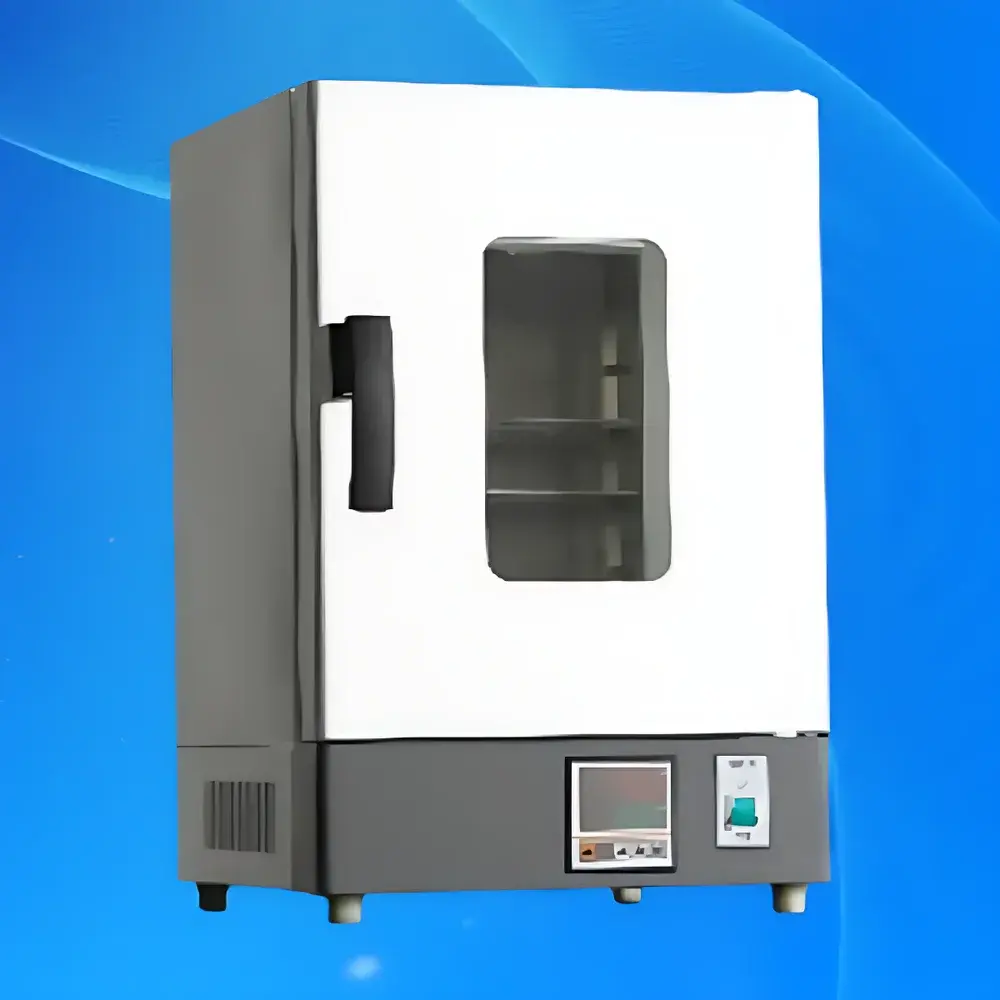
Zuofei DHG-9240A Forced-Air Constant-Temperature Drying Oven
| Brand | Zuofei |
|---|---|
| Origin | Shanghai, China |
| Manufacturer Type | Direct Manufacturer |
| Product Category | Domestic |
| Model | DHG-9240A |
| Instrument Type | General-Purpose Forced-Air Oven |
| Temperature Range | RT+10 °C to 250 °C |
| Temperature Fluctuation | ±1.0 °C |
| External Dimensions (W×D×H) | 69 cm × 81 cm × 114 cm |
| Internal Chamber Dimensions (W×D×H) | 50 cm × 60 cm × 75 cm |
| Temperature Resolution | 0.1 °C |
| Operating Ambient Temperature | +5 °C to +40 °C |
| Interior Material | Mirror-Finish Stainless Steel (304) |
| Heating Method | Bottom-Mounted Stainless Steel Tubular Heaters |
| Temperature Uniformity | ±2.5% (measured at 100 °C) |
Overview
The Zuofei DHG-9240A is a vertically oriented, forced-convection drying oven engineered for precision thermal processing in laboratory and industrial quality control environments. It operates on the principle of uniform hot-air circulation via a high-temperature-rated centrifugal blower and optimized duct geometry, ensuring consistent heat transfer across the entire working chamber. Designed for applications including moisture content determination, pre-conditioning of samples prior to gravimetric analysis, polymer curing, pharmaceutical stability testing, and sterilization of glassware and instruments, the DHG-9240A complies with foundational thermal validation requirements outlined in ISO 17025-accredited laboratories. Its RT+10 °C to 250 °C operating range supports both low-temperature drying (e.g., hygroscopic material conditioning) and high-temperature thermal treatment (e.g., ash residue preparation per ASTM D3174), while the mirror-finish 304 stainless steel interior resists corrosion from acidic or alkaline volatiles commonly encountered in chemical and environmental labs.
Key Features
- Microprocessor-based PID temperature controller with dual-line LED display, offering real-time setpoint and actual temperature readouts, programmable timer (1–9999 minutes), and audible over-temperature alarm.
- Robust thermal architecture featuring bottom-mounted stainless steel tubular heating elements, enabling rapid heat-up and stable dwell performance under load.
- Forced-air circulation system with adjustable fan speed (infinitely variable in optional configuration), engineered to minimize thermal stratification and achieve ±2.5% uniformity at 100 °C (per IEC 60068-3-5 test methodology).
- High-integrity sealing using high-temperature silicone gasketing rated for continuous operation up to 250 °C, ensuring long service life and minimal maintenance.
- Tempered double-glazed observation window with internal lighting, allowing non-intrusive visual monitoring without compromising chamber integrity or thermal stability.
- Power-loss recovery function: automatically resumes prior setpoint and timer state following interruption, preserving experimental continuity and data integrity.
Sample Compatibility & Compliance
The DHG-9240A accommodates standard laboratory ware—including porcelain crucibles, aluminum weighing dishes, stainless steel trays, and borosilicate glass Petri dishes—within its 225 L internal volume (50 × 60 × 75 cm). Its chamber design supports stacked sample placement with up to five adjustable stainless steel shelves (two included, three optional), maintaining airflow clearance per ISO 14644-1 cleanroom-compatible loading protocols. The unit meets general safety requirements per IEC 61010-1 (Electrical Equipment for Measurement, Control, and Laboratory Use) and incorporates Class II insulation and earth-leakage protection. While not certified to UL or CSA standards out-of-the-box, it is routinely validated by end-users for GLP-compliant workflows involving USP drying loss assessments and ASTM E145-22 oven calibration procedures.
Software & Data Management
The base configuration includes analog-digital hybrid control logic with no embedded software stack; however, optional RS485 Modbus RTU interface enables integration with SCADA systems or third-party data loggers for time-stamped temperature traceability. When equipped with the optional touchscreen multi-segment programmer, users can define up to 32 programmable steps—including ramp rates, soak durations, and automatic power cycling—with full curve visualization and CSV export capability. Audit trail functionality (including user ID, timestamp, parameter change history) satisfies FDA 21 CFR Part 11 requirements when deployed with compliant electronic record systems. Optional thermal printer output provides hard-copy verification of cycle execution for QA documentation.
Applications
- Moisture content analysis per AOAC 950.46 and ISO 5530-1 in food, feed, and agricultural commodities.
- Drying of filter papers and precipitates prior to gravimetric analysis in environmental chemistry (e.g., TSS, TDS determination).
- Pre-heating and post-baking of coated substrates in materials science R&D.
- Conditioning of reference standards and calibration weights in metrology labs.
- Thermal deactivation of biological indicators during sterilization process development.
- Accelerated aging studies for packaging materials under controlled thermal stress (ISO 11607-1 Annex B).
FAQ
What is the maximum recommended load capacity for optimal temperature uniformity?
For compliance with ±2.5% uniformity specification at 100 °C, total loaded volume should not exceed 60% of chamber capacity (i.e., ≤135 L), with minimum 5 cm clearance between samples and chamber walls.
Can the DHG-9240A be used for sterilization of medical devices?
It is not classified as a sterilizer per ISO 17665; however, it may serve as a dry-heat depyrogenation oven for glassware and metal tools at ≥180 °C for ≥30 min, provided validation per EN 285 is performed internally.
Is the temperature sensor calibrated traceable to NIST standards?
The integrated PT100 sensor is factory-calibrated; NIST-traceable calibration certificates are available upon request and require separate scheduling with accredited third-party providers.
Does the unit support remote monitoring via Ethernet or Wi-Fi?
No native Ethernet/Wi-Fi module is included; connectivity requires external Modbus-to-Ethernet gateways or OEM-integrated IoT add-ons (quoted separately).
What maintenance intervals are recommended for the blower motor and heating elements?
Visual inspection and dust removal every 3 months; annual verification of heater resistance and fan bearing integrity per manufacturer’s service manual (Revision 2023.09).



