
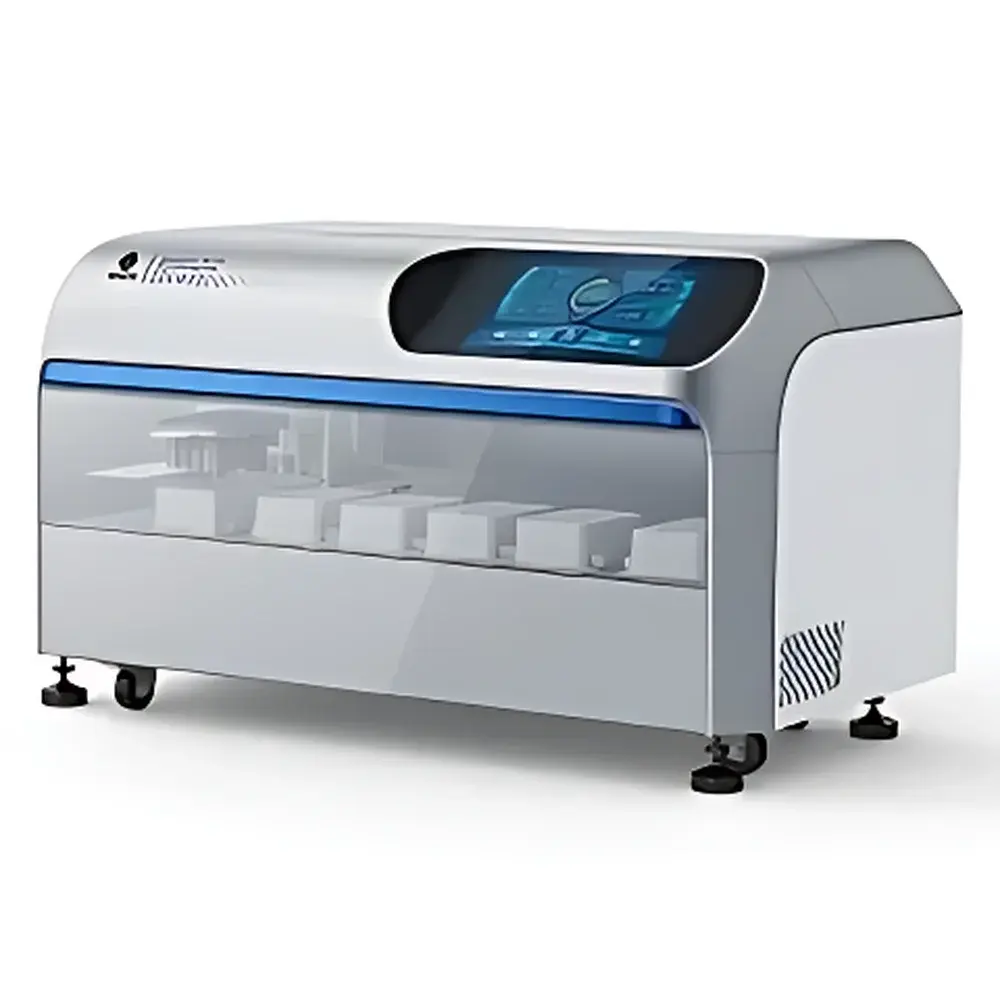
Bioer GenePure Pro 96T Automated Nucleic Acid Extraction and Purification System
| Brand | Bioer |
|---|---|
| Origin | Zhejiang, China |
| Manufacturer Type | Authorized Distributor |
| Regional Category | Domestic (PRC) |
| Model | NPA-96T |
| Instrument Type | Magnetic Bead-Based Automation |
| Automation Level | Dedicated Fully Automatic |
| Throughput per Run | 96 samples |
| Sample Volume Range | 20–1000 µL |
| Magnetic Bead Recovery Efficiency | ≥99% |
| Temperature Control Range | +10°C to +120°C |
| Heating Modules | Integrated Heated Block + Peltier (TE) Elements |
| Number of Heating Stations | 6 |
| Low-Temperature Storage Function | Yes |
| Temperature Display Resolution | 0.1°C |
| UV Sterilization Lamp | Integrated, Manual/Automatic Scheduling |
| User Interface | 10-inch Color TFT Touchscreen, Windows OS |
| Barcode Scanner | Optional |
| Preloaded Protocols | ≥1000 |
| Connectivity | USB |
| Power Supply | AC 100–240 V, 50/60 Hz |
| Dimensions (L×W×H) | 907 × 495 × 571 mm |
| Weight | 81.5 kg |
Overview
The Bioer GenePure Pro 96T is a dedicated fully automated nucleic acid extraction and purification system engineered for high-throughput laboratories requiring robust, reproducible isolation of DNA and RNA from diverse biological matrices. It operates on the principle of magnetic bead-based solid-phase extraction—leveraging superparamagnetic particles functionalized with silica or carboxyl groups that selectively bind nucleic acids under controlled chaotropic salt and pH conditions. The system employs a proprietary magnetic rod array architecture, where magnetized rods lift, suspend, wash, and elute beads without liquid transfer, minimizing cross-contamination and operator intervention. Designed specifically for clinical diagnostics, biobanking, pharmaceutical QC, and industrial-scale molecular testing, the GenePure Pro 96T delivers consistent yields and purity across sample types including whole blood, serum, plasma, saliva, buccal swabs, tissue homogenates, and cultured cells—all within a single 30–45 minute run.
Key Features
- Dynamic Magnetic Rod Actuation: Full-array magnetic rods with amplitude-adjustable vertical motion ensure optimal bead capture and release across variable bead sizes and suspension viscosities—critical for low-volume or viscous samples (e.g., sputum or FFPE lysates).
- Precision Thermal Management: Dual-mode heating—comprising uniform deep-well resistive heating elements and six independently controllable Peltier (TE) modules—maintains ±0.3°C thermal accuracy across all stations. This enables tightly regulated lysis (56–70°C), binding (room temperature), wash (20–25°C), and elution (65–85°C) steps.
- Integrated Biosafety Architecture: Motorized door interlock prevents operational interruption during processing; UV-C (254 nm) lamp with programmable cycle scheduling provides surface decontamination between runs—validated per ISO 15195:2019 for molecular laboratory environmental control.
- Modular & Serviceable Design: Field-replaceable magnetic rod cartridges require no recalibration post-installation. All fluidic pathways are sealed and non-contact—eliminating pump wear and tubing clogging risks inherent in pipetting-based platforms.
- Intuitive Human-Machine Interface: 10-inch Windows-based touchscreen supports multi-language UI, real-time protocol monitoring (including temperature, position, and status logs), and touch-enabled parameter adjustment without exiting active workflows.
Sample Compatibility & Compliance
The GenePure Pro 96T accommodates primary and processed specimens compliant with CLIA, CAP, and ISO 15189 pre-analytical requirements. Validated protocols cover ISO/IEC 17025-aligned extraction from EDTA/K2EDTA blood (≥200 µL), viral transport media (≥100 µL), and formalin-fixed paraffin-embedded (FFPE) tissue sections (up to 25 mg). All onboard thermal profiles adhere to ASTM E2918-22 (Standard Practice for Validation of Nucleic Acid Extraction Methods) and support GLP/GMP documentation via optional audit trail export (CSV/Excel). The system meets IEC 61010-1:2010 safety standards for laboratory equipment and incorporates electromagnetic compatibility per EN 61326-1:2013.
Software & Data Management
Firmware v3.2+ includes built-in protocol versioning, user role-based access control (administrator/operator/auditor), and timestamped event logging compliant with FDA 21 CFR Part 11 Annex 11 requirements when paired with networked authentication servers. Protocol libraries are import/export-capable via USB; barcode scanning (optional module) auto-links sample IDs to extraction metadata. Raw instrument logs—including temperature deviation history, magnetic actuation counts, and door-open events—are exportable for root cause analysis during internal audits or regulatory inspections.
Applications
- Clinical virology labs performing SARS-CoV-2, HPV, HBV, and HIV nucleic acid testing
- Genomic core facilities conducting library prep for NGS (Illumina, Ion Torrent)
- Vaccine development QA/QC departments extracting plasmid DNA from E. coli lysates
- Food safety labs detecting Listeria monocytogenes or Salmonella spp. in enrichment broths
- Forensic units processing low-template STR and mitochondrial DNA samples
FAQ
Does the GenePure Pro 96T support custom protocol development?
Yes—advanced users may modify incubation times, temperatures, mixing speeds, and magnetic dwell durations via the “Protocol Editor” mode, subject to firmware-level validation constraints.
Is third-party reagent compatibility validated?
Bioer provides compatibility matrices for select commercial magnetic bead kits (e.g., Qiagen MagAttract, Thermo Fisher KingFisher Flex-compatible chemistries); full validation remains the responsibility of the end user per ISO 15189 §5.5.2.
How is data integrity ensured during power interruption?
The system features non-volatile memory retention for active protocol state and thermal history; upon recovery, it resumes from the last completed step without sample loss.
What maintenance intervals are recommended?
UV lamp output verification every 6 months; magnetic rod cartridge replacement every 10,000 cycles or annually—whichever occurs first—as documented in the Maintenance Logbook (included).




