
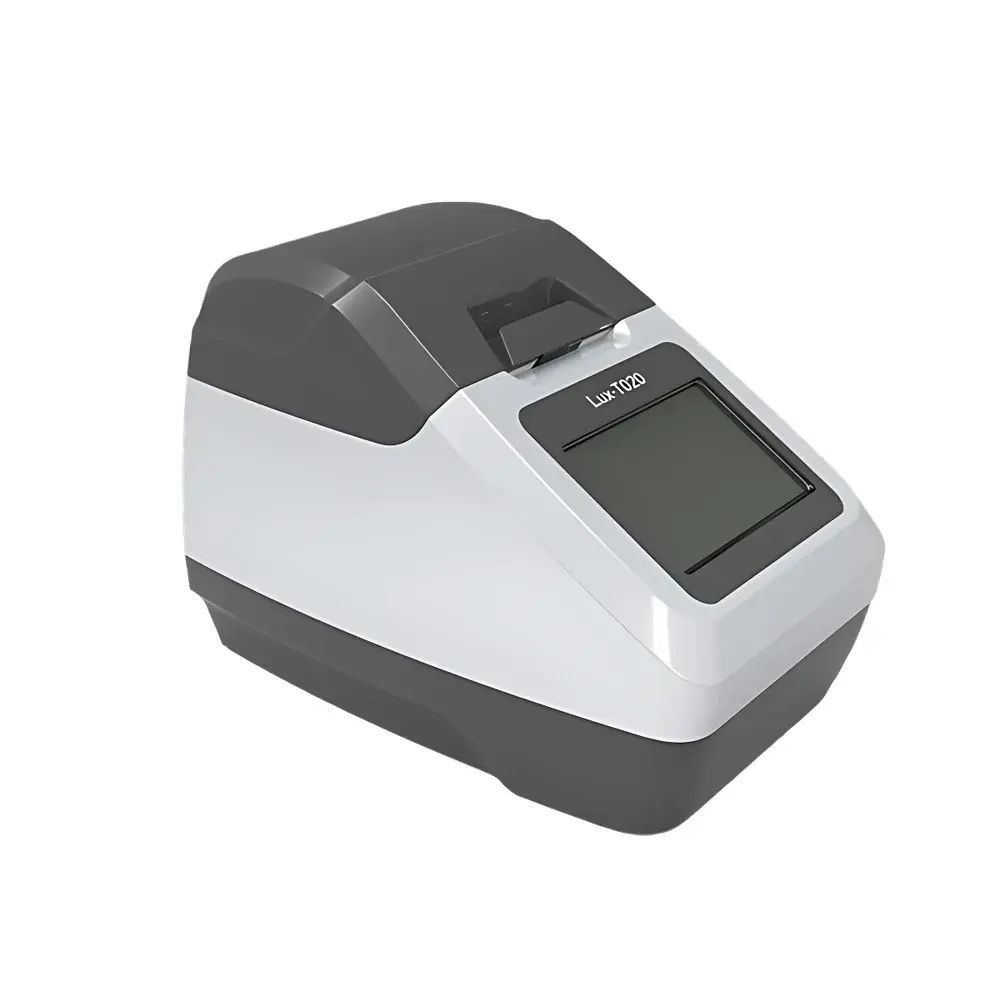
BioLight Lux-T020 High-Sensitivity Tube Luminometer
| Brand | BioLight |
|---|---|
| Model | Lux-T020 |
| Origin | Guangdong, China |
| Detector Type | Electrochemiluminescence & Bioluminescence Luminometer |
| Photomultiplier Tube (PMT) | Single-Photon Counting PMT |
| Max Count Rate | >100 million pulses/sec |
| Detection Sensitivity | ≤10 amol ATP or 20 zmol firefly luciferase |
| Dynamic Range | 7 decades (linear) |
| Sample Format | 12 × 55 mm test tubes or standard 0.5–2.0 mL microcentrifuge tubes |
| Interface | Touchscreen GUI with USB data export |
| Compliance | Designed for GLP-compliant workflows |
Overview
The BioLight Lux-T020 High-Sensitivity Tube Luminometer is a dedicated photonic detection system engineered for quantitative measurement of low-intensity luminescent signals arising from electrochemiluminescence (ECL), bioluminescence (BL), and chemiluminescence (CL) reactions. It operates on the principle of single-photon counting using a thermoelectrically cooled, ultra-low-noise photomultiplier tube (PMT) housed in a light-tight, vibration-damped chamber. Unlike analog-integration luminometers, the Lux-T020 employs pulse-height discrimination and digital photon counting to resolve discrete photon events against intrinsic electronic and thermal background noise—enabling reliable quantification at the attomole (amol) level without signal amplification artifacts. Its optical architecture features optimized light collection efficiency, minimized stray-light path length, and precise PMT bias voltage stabilization—critical for maintaining linearity and reproducibility across extended measurement durations.
Key Features
- Single-photon counting PMT with sustained count rate exceeding 100 million pulses per second—achieved without gain adjustment or high-voltage modulation, thereby eliminating drift-related calibration instability and extending detector service life.
- Attomolar-level sensitivity: validated detection limit of ≤10 amol ATP (using firefly luciferase/luciferin assay) and ≤20 zmol purified luciferase—comparable to reference-grade benchtop luminometers in ISO/IEC 17025-accredited laboratories.
- Seven-decade linear dynamic range (10⁰–10⁷ relative light units), permitting direct quantification of both weak bioluminescent signals (e.g., promoter-driven reporter assays) and intense chemiluminescent bursts (e.g., horseradish peroxidase–luminol systems) within a single acquisition cycle—no sample dilution or instrument gain reconfiguration required.
- Integrated touchscreen interface with preloaded assay protocols (e.g., ATP quantification, caspase-3 activity, kinase phosphorylation), real-time curve fitting, and timestamped raw-data logging to internal memory or external USB storage.
- Modular sample chamber accommodating standard 12 × 55 mm glass or plastic test tubes and common microcentrifuge formats (0.5–2.0 mL), enabling compatibility with existing labware and reducing consumables cost per assay.
Sample Compatibility & Compliance
The Lux-T020 accepts opaque or frosted-wall tubes to minimize cross-well crosstalk in multi-sample runs. Its dark-count performance (<0.5 counts/sec at −15 °C PMT temperature) meets ASTM E2869-22 criteria for low-background luminescence instrumentation. The system is compatible with common ECL substrates (e.g., ruthenium tris-bipyridyl derivatives), BL reporters (Renilla, firefly, NanoLuc), and CL reagents (luminol, acridan esters). When deployed with validated third-party laboratory information management systems (LIMS) or compliant data acquisition software, the Lux-T020 supports audit trails, electronic signatures, and data integrity controls aligned with FDA 21 CFR Part 11 and EU Annex 11 expectations. It is routinely employed in QC/QA environments adhering to ISO 15197 (in vitro diagnostics) and ISO 17025 (testing laboratories).
Software & Data Management
Data acquisition and analysis are performed via an embedded Linux-based OS with a responsive capacitive touchscreen. Raw photon counts are stored in CSV and XML formats with metadata including PMT temperature, integration time, tube ID, operator ID, and environmental timestamp. USB export enables seamless transfer to Excel, GraphPad Prism, or enterprise LIMS. Optional API access (HTTP/REST) permits integration into automated liquid handling platforms. All exported files include cryptographic hash verification to ensure post-acquisition data integrity—essential for regulatory submissions under ICH M4 or USP <1058>.
Applications
- Reporter gene assays (luciferase-based transcriptional activation/inhibition screening)
- Caspase-3/7 activity quantification in apoptosis studies
- Protein kinase activity profiling using luminescent ADP/ATP conversion assays
- Environmental toxicity assessment via bacterial bioluminescence inhibition (e.g., Vibrio fischeri Microtox®-compatible protocols)
- ECL immunoassays targeting cardiac troponins, cytokines, or infectious disease antigens
- High-throughput ATP monitoring in cell viability, cytotoxicity, and microbial load testing
- Method development for novel luminogenic substrates in diagnostic assay optimization
FAQ
What types of luminophores are compatible with the Lux-T020?
The instrument detects photons across 300–650 nm, covering firefly luciferase (λmax ≈ 560 nm), Renilla luciferase (λmax ≈ 480 nm), NanoLuc (λmax ≈ 450 nm), ruthenium-based ECL emitters (~450–500 nm), and luminol-derived CL (~425 nm). Filters are not required due to inherent PMT spectral response optimization.
Does the Lux-T020 support kinetic measurements?
Yes—programmable multi-point kinetics (up to 1,000 time points per well) with user-defined delay, integration duration, and interval timing. Data are exported as time-resolved intensity matrices suitable for decay constant modeling.
How is calibration traceability maintained?
The Lux-T020 includes factory-installed NIST-traceable LED reference sources for daily performance verification. Calibration certificates (ISO/IEC 17025 accredited) are provided with each unit, and recalibration services follow ILAC-G24 guidelines.
Can the Lux-T020 be integrated into robotic workcells?
Yes—RS-232 and USB CDC serial emulation modes enable command-line control via SCPI-like syntax. OEM SDKs (C/C++, Python) are available under NDA for custom middleware integration.
Is the instrument suitable for regulated GMP environments?
When operated with validated software configurations and documented change control procedures, the Lux-T020 satisfies core instrumentation requirements of EU GMP Annex 11 and USP <1058> Analytical Instrument Qualification (AIQ), particularly for Category C instruments (automated data-generating devices).
Related Products




