
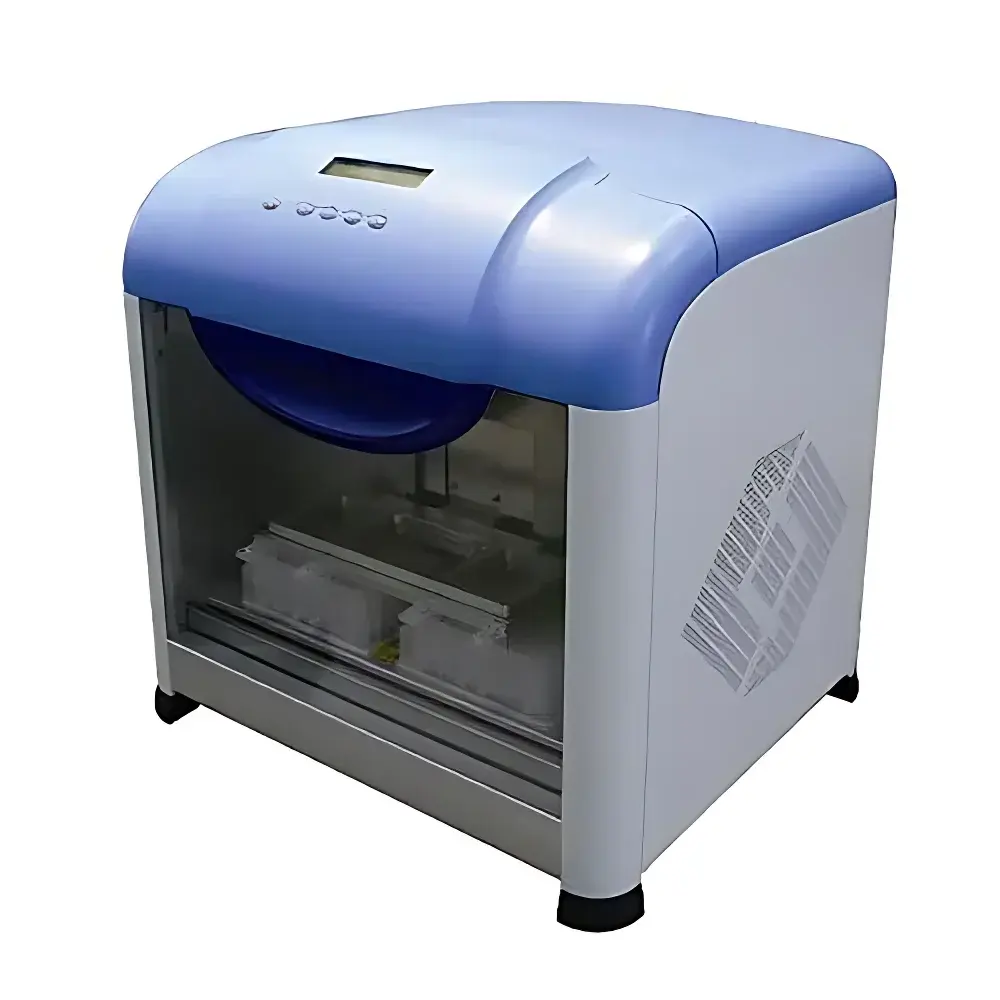
Bioer GenePure Plus NPA-32+ Automated Magnetic Bead-Based Nucleic Acid Extraction System
| Brand | Bioer |
|---|---|
| Origin | Zhejiang, China |
| Manufacturer Type | Authorized Distributor |
| Instrument Type | Magnetic Bead-Based Extraction |
| Automation Level | Dedicated Fully Automatic |
| Sample Throughput per Run | 1–32 samples |
| Sample Volume Range | 20–1000 µL |
| Magnetic Bead Recovery Efficiency | ≥98% |
| Lysis Heating Temperature Range | Ambient to 120 °C |
| Elution Heating Temperature Range | Ambient to 120 °C |
| Vortex Mixing | Multi-mode, Adjustable Intensity |
| Decontamination Method | Integrated UV Lamp (254 nm) |
| Barcode Scanning | Optional |
| Compatible Reagent Format | Magnetic Bead Kits Only |
| Operating System | Windows 7/8 Embedded |
| Control Interface | Integrated Tablet PC + External PC/Laptop Support |
| Connectivity | USB, RS-232, Bluetooth, Wi-Fi |
| Protocol Management | Create, Edit, Delete Custom Protocols |
| Dimensions (L×W×H) | 440 × 380 × 450 mm |
| Weight | 20 kg |
| Power Supply | AC 100–240 V, 50/60 Hz |
| Operating Temperature | 10–40 °C |
| Operating Humidity | 10–90% RH (non-condensing) |
Overview
The Bioer GenePure Plus NPA-32+ is a dedicated fully automated nucleic acid extraction system engineered for precision, reproducibility, and walk-away operation in clinical diagnostics, translational research, and high-throughput molecular biology laboratories. It implements magnetic bead-based solid-phase separation—a well-established, ISO 20387-compliant methodology—where nucleic acids bind selectively to paramagnetic beads under controlled chaotropic and pH conditions, followed by sequential washing and low-salt elution. Unlike column-based or phenol-chloroform methods, this approach eliminates centrifugation steps, minimizes manual handling errors, and ensures consistent recovery across diverse biological matrices—including whole blood, buffy coat, saliva, cultured cells, FFPE tissue lysates, and bacterial pellets. The instrument’s integrated thermal control modules support both high-efficiency lysis (up to 120 °C) and optimized elution kinetics, while its sealed processing chamber with UV-C irradiation (254 nm) mitigates cross-contamination risks between runs—a critical requirement under CLIA, CAP, and ISO 15189-accredited workflows.
Key Features
- Dedicated magnetic bead architecture with ≥98% bead recovery efficiency—validated using standardized QC protocols with human genomic DNA and plasmid reference materials.
- Programmable dual-zone heating: independent temperature control for lysis (ambient to 120 °C) and elution (ambient to 120 °C), enabling protocol optimization for challenging samples such as Gram-positive bacteria or fibrous tissues.
- Multi-mode orbital shaking with adjustable amplitude and frequency—ensuring uniform bead suspension, efficient binding kinetics, and complete wash-step removal without foaming or splashing.
- Integrated UV-C decontamination lamp (254 nm) with timed exposure cycles, activated automatically post-run to inactivate residual nucleases and amplicons on internal surfaces.
- Embedded tablet PC running Windows 7/8 with intuitive touch interface; supports remote monitoring and protocol execution via Bluetooth or Wi-Fi from external PCs or laptops.
- Full audit trail capability: timestamped logs record operator ID, protocol version, run parameters, error codes, and maintenance alerts—aligned with GLP/GMP documentation requirements and FDA 21 CFR Part 11 data integrity principles.
Sample Compatibility & Compliance
The NPA-32+ accommodates sample volumes from 20 µL to 1000 µL, supporting direct input of raw specimens or pre-lysed extracts. It is validated for use with CE-IVD and RUO magnetic bead kits from major suppliers (e.g., Qiagen, Thermo Fisher, Takara Bio), provided kit chemistry is compatible with the instrument’s fluidics and thermal profiles. All reagent consumables are loaded via standardized rack formats—no custom adapters required. The system meets IEC 61010-1 safety standards for laboratory equipment and complies with electromagnetic compatibility (EMC) directives (EN 61326-1). Its closed-tube workflow design reduces aerosol generation, satisfying biosafety level 2 (BSL-2) containment expectations when used with appropriate PPE and lab infrastructure.
Software & Data Management
The embedded software provides full protocol lifecycle management: users can create, duplicate, edit, and archive extraction protocols with granular control over incubation durations, mixing speeds, heating ramp rates, and magnet engagement timing. Each protocol stores metadata including lot numbers of reagents used, calibration dates, and instrument firmware revision. Export options include CSV-formatted run reports and PDF summary sheets compliant with ISO/IEC 17025 reporting guidelines. Data backups are supported via USB drive or network share; encrypted local storage ensures confidentiality of sensitive patient-derived genomic data per HIPAA and GDPR-aligned practices.
Applications
- Clinical molecular pathology: extraction of circulating tumor DNA (ctDNA) from plasma prior to NGS library preparation.
- Infectious disease testing: high-yield isolation of viral RNA from nasopharyngeal swabs for RT-qPCR assays (e.g., SARS-CoV-2, influenza A/B).
- Biobanking: standardized processing of longitudinal blood and tissue collections under ISO 20387 biobank accreditation criteria.
- CRISPR workflow support: purification of gRNA and donor DNA templates with minimal nuclease contamination.
- Veterinary diagnostics: parallel processing of animal tissue homogenates and environmental swab samples in One Health surveillance programs.
FAQ
Is the NPA-32+ compatible with third-party magnetic bead kits?
Yes—provided the kit’s binding/wash/elution buffers are chemically compatible with the instrument’s fluidic pathways and thermal profile specifications. Bioer provides a validated compatibility matrix upon request.
Does the system support traceability for regulatory audits?
Yes—each run generates an immutable digital log containing operator ID, start/end timestamps, protocol checksums, error flags, and environmental sensor readings (temperature/humidity), fulfilling ALCOA+ data integrity criteria.
Can protocols be exported and shared across multiple instruments?
Yes—protocols are saved in a proprietary but interoperable binary format (.gpp) and can be imported/exported via USB or network transfer, enabling method harmonization across multi-site laboratories.
What maintenance is required to ensure long-term performance?
Routine cleaning of the UV lamp housing and magnetic head surface is recommended after every 50 runs; annual calibration of temperature sensors and magnet strength verification are advised per ISO/IEC 17025 quality assurance schedules.




