
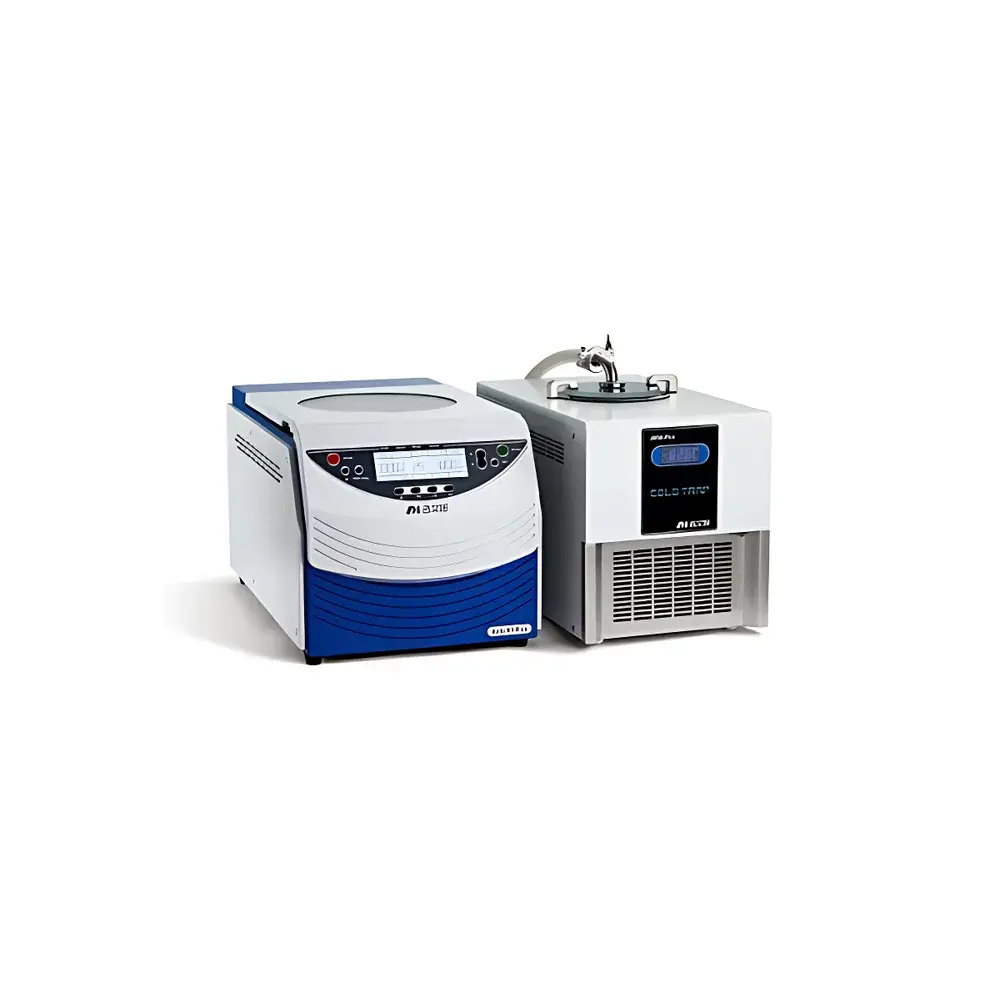
GiAim Auto R1-Plus Cryogenic Vacuum Centrifugal Concentrator
| Brand | GiAim |
|---|---|
| Model | Auto R1-Plus |
| Type | Vacuum Centrifugal Concentrator |
| Cooling Capability | Cryogenic (-5 °C to +100 °C) |
| Rotational Speed Range | 800–2000 rpm |
| Max Relative Centrifugal Force (RCF) | 530 ×g |
| Vacuum Control Range | 0.1–100 mbar |
| Vacuum Control Accuracy | ±0.1 mbar |
| Ultimate Vacuum | ≤0.2 mbar |
| Temperature Control Accuracy | ±1 °C |
| Timer Range | 0–9999 min |
| Chamber Pre-cooling | Yes |
| Real-time Centrifugal Imaging | Yes |
| Noise Level | ≤60 dB(A) |
| Power Supply | AC 220 V, 50/60 Hz, 10 A |
| Dimensions (L×D×H) | 608×370×330 mm |
| Weight | 46 kg |
| Chamber Material | 304 Stainless Steel with PTFE Coating |
| Rotor Capacity | Up to 180 × 1.5 mL Tubes |
| Programmable Methods | 30 User-Stored Protocols |
| Quick-Access Program Keys | 4 |
| Dual-Rotor Electromagnetic Drive System | Yes |
| Automatic Pressure Release Valve | Integrated, Import-Sourced |
Overview
The GiAim Auto R1-Plus Cryogenic Vacuum Centrifugal Concentrator is an engineered solution for high-integrity sample concentration in molecular biology, proteomics, metabolomics, and pharmaceutical development laboratories. It integrates three core physical principles—centrifugal force, vacuum-assisted solvent evaporation, and precise low-temperature thermal management—to enable gentle, reproducible removal of volatile solvents (e.g., ethanol, acetone, ethyl acetate) from heat-sensitive biological samples including nucleic acids, peptides, proteins, and small-molecule standards. Unlike ambient-temperature concentrators, the Auto R1-Plus maintains active cooling throughout the entire process—from chamber pre-cooling to endpoint drying—ensuring sample integrity across temperature-sensitive applications such as RNA stabilization or enzyme activity preservation. Its cryogenic operating range (–5 °C to +100 °C), coupled with dual-stage temperature regulation, prevents localized overheating at the sample surface while suppressing condensation in the vacuum path.
Key Features
- Integrated JM-Fast control system enabling intuitive protocol navigation, real-time parameter monitoring, and error diagnostics via a high-resolution LCD interface.
- Cryogenic operation with independent chamber and rotor temperature control—critical for preserving labile biomolecules during extended concentration cycles.
- Automated vacuum regulation with closed-loop feedback; adjustable setpoints between 0.1 and 100 mbar, maintaining stability within ±0.1 mbar tolerance for consistent evaporation kinetics.
- Electromagnetic dual-rotor drive architecture eliminating mechanical belts and brushes—reducing vibration, wear, and maintenance intervals while supporting simultaneous processing of up to 180 × 1.5 mL microtubes.
- Corrosion-resistant 304 stainless steel chamber with uniform PTFE coating, validated for compatibility with aggressive organic solvents and acidic/basic aqueous buffers.
- Optical centrifugal imaging module allowing non-invasive visual assessment of sample meniscus position and solvent level without interrupting rotation or vacuum—eliminating process uncertainty and enabling endpoint determination by observation.
- Imported pressure-relief valve with fail-safe automatic venting logic, compliant with IEC 61010-1 safety requirements for laboratory equipment under vacuum conditions.
- 30 programmable method slots accessible via four dedicated quick-launch keys—supporting standardized workflows across multiple users and shift schedules.
Sample Compatibility & Compliance
The Auto R1-Plus accommodates a broad spectrum of sample formats—including PCR tubes, microcentrifuge tubes (0.2–50 mL), deep-well plates, and custom vials—via 16 interchangeable rotor configurations (sold separately). All rotors are dynamically balanced and certified to ISO 15197:2013 mechanical safety standards. The instrument complies with electromagnetic compatibility (EMC) per EN 61326-1 and electrical safety per EN 61010-1. Its vacuum and temperature control architecture supports GLP/GMP-aligned documentation practices when integrated with external audit-trail-capable LIMS or ELN systems. While not inherently 21 CFR Part 11-compliant, its parameter logging capability (time-stamped vacuum, temperature, speed, and duration data) provides foundational traceability for regulated environments requiring retrospective validation.
Software & Data Management
The embedded firmware logs all operational parameters—including vacuum setpoint vs. actual, chamber temperature deviation, rotational speed stability, and total elapsed time—with timestamp resolution of 1 second. Data export is supported via USB 2.0 port in CSV format for post-processing in Excel, Python, or statistical analysis platforms. No proprietary software installation is required. Optional RS-232 or Ethernet modules (available upon request) enable remote status polling and integration into centralized lab automation frameworks. Audit trail functionality—such as user login tracking, method modification history, and emergency stop event logging—is implemented at firmware level and retained in non-volatile memory for ≥12 months.
Applications
- Concentration and desalting of DNA/RNA extracts prior to sequencing library preparation (Illumina, Nanopore).
- Removal of acetonitrile or methanol from LC-MS fractions without thermal degradation of post-translational modifications.
- Drying of synthetic oligonucleotides and phosphoramidite intermediates under inert gas-compatible vacuum conditions.
- Preparative-scale solvent exchange in formulation development—for example, transitioning drug candidates from DMSO stock solutions into aqueous buffer systems.
- Routine cleanup of enzymatic digestions (e.g., trypsin, Lys-C) prior to MALDI-TOF or nanoLC-MS/MS analysis.
FAQ
Does the Auto R1-Plus support continuous vacuum monitoring with data logging?
Yes—vacuum pressure is sampled every 2 seconds and recorded alongside timestamps, temperature, and speed in a local CSV log file.
Can the instrument be operated without pre-cooling the chamber?
Yes, though cryogenic operation is strongly recommended for thermolabile samples; ambient-start protocols are permitted but not validated for RNA integrity preservation.
Is rotor balancing required before each run?
No—the electromagnetic drive system automatically compensates for minor imbalances; however, grossly uneven tube loading (>±5% mass asymmetry) may trigger safety shutdown.
What vacuum pump compatibility does the Auto R1-Plus require?
It interfaces with standard oil-free diaphragm pumps (≥25 L/min flow rate, ultimate vacuum ≤0.1 mbar) meeting ISO 8573-1 Class 0 purity requirements for solvent-laden exhaust streams.
Are rotor certifications included with purchase?
Each rotor is supplied with a manufacturer-issued mechanical certification report referencing ISO 21501-4 for dimensional tolerances and dynamic balance verification at maximum rated speed.



