
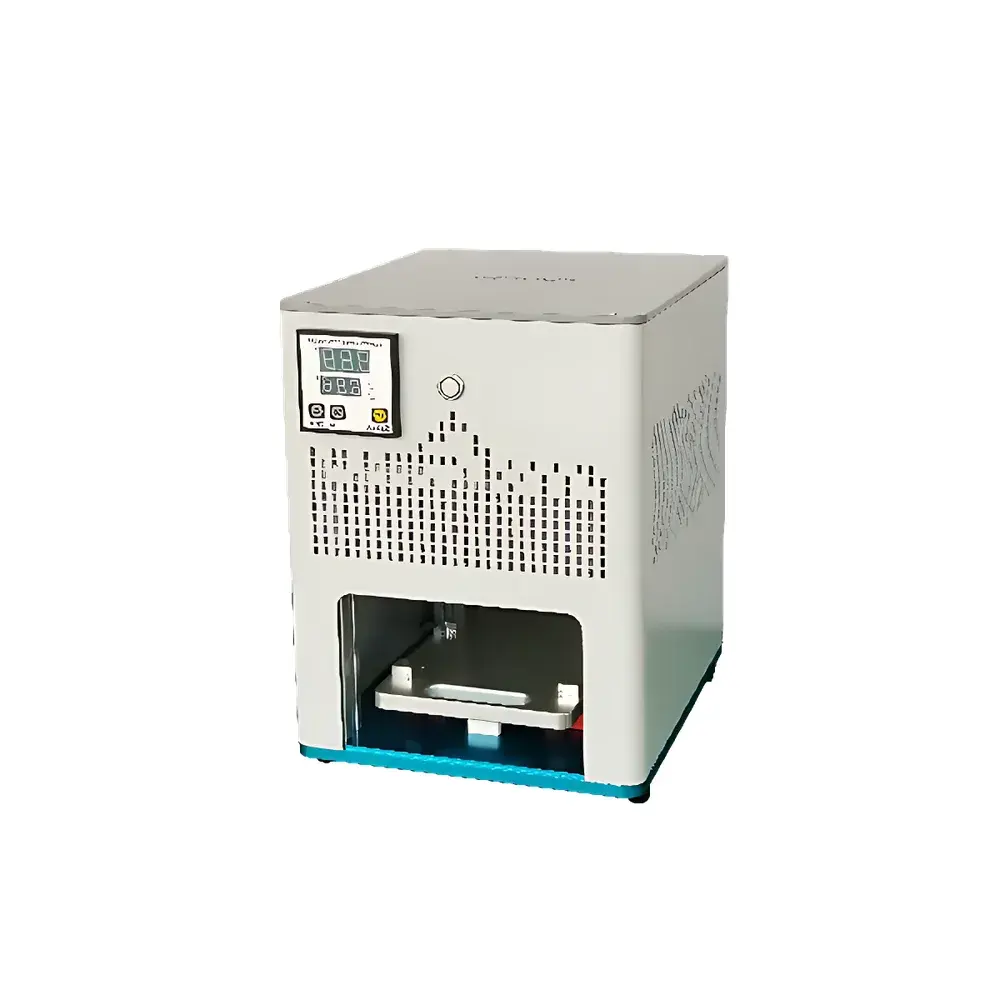
Zuofei YS-600 Microplate Heat Sealer
| Brand | Zuofei |
|---|---|
| Origin | Shanghai, China |
| Manufacturer Type | Direct Manufacturer |
| Region Category | Domestic (China) |
| Model | YS-600 |
| Automation Level | Semi-Automatic |
| Sealing Temperature Range | 30–200 °C |
| Temperature Accuracy | ±0.5 °C |
| Sealing Cycle Time | ~8 s (machine contact time: 2.5 s) |
| Plate Height Compatibility | 7–64 mm |
| Dimensions (W×D×H) | 315 × 260 × 360 mm |
| Net Weight | 25 kg |
| Compatible Plate Types | PCR plates, deep-well plates, standard microplates |
| Preheat Time | 10 min |
| Pressure Adjustment Range | 0–6 bar (0–0.6 MPa) |
| Required Air Supply | Clean, dry, oil-free, 6 bar |
| Operating Environment | 4–40 °C, 10–90% RH (non-condensing) |
| Input Voltage | AC 220 V |
Overview
The Zuofei YS-600 Microplate Heat Sealer is an engineered semi-automatic thermal sealing system designed for reliable, uniform, and contamination-controlled sealing of a broad spectrum of laboratory microplates. Utilizing resistive heating elements coupled with pneumatically actuated pressure application, the YS-600 delivers consistent thermal energy transfer across the entire sealing surface—ensuring hermetic closure without warping or delamination. Unlike manual or low-force systems, this instrument employs controlled dwell-time thermocompression to achieve molecular-level polymer fusion at the film–plate interface, critical for preserving sample integrity during long-term storage, transport, or high-throughput assay workflows. Its architecture supports routine operation in regulated environments—including QC labs, biobanks, and clinical diagnostic facilities—where reproducibility, traceability, and compatibility with GLP/GMP-aligned documentation practices are essential.
Key Features
- Semi-automatic operation with single-button activation—no software configuration or calibration required prior to use
- Precision temperature control (±0.5 °C) across a wide 30–200 °C range, enabling optimization for diverse film chemistries (e.g., polyester, polypropylene, aluminum-laminated films)
- Short mechanical sealing contact time of 2.5 s, minimizing thermal stress on plate materials while maintaining seal integrity
- Adjustable pneumatic pressure (0–6 bar) ensures optimal force delivery regardless of plate rigidity or film thickness
- Universal height adjustment mechanism accommodates plates from 7 mm (shallow PCR plates) to 64 mm (deep-well storage plates) without requiring interchangeable adapters
- Robust stainless-steel heating platen and corrosion-resistant housing support continuous operation under ambient lab conditions (4–40 °C, ≤90% RH non-condensing)
- No active cooling system required—engineered thermal mass management enables sustained duty cycles without performance degradation
Sample Compatibility & Compliance
The YS-600 is validated for use with ANSI/SLAS-standard microplates, including 96-well and 384-well PCR plates, 24- and 48-well deep-well plates, and standard flat-bottom or V-bottom assay plates. It supports common heat-sealable films compliant with ISO 20776-1 (clinical microbiology), ASTM D3330 (adhesive strength), and USP (plastic packaging systems). The sealed plates meet requirements for evaporation resistance (<0.5 µL/h per well at 37 °C, 50% RH), cross-contamination prevention, and stability during freeze-thaw cycling or centrifugation (up to 3,000 × g). While the device itself does not carry CE or UL certification, its electrical design conforms to IEC 61010-1 safety standards for laboratory equipment, and operational parameters can be logged manually for internal audit trails supporting FDA 21 CFR Part 11 readiness.
Software & Data Management
The YS-600 operates as a standalone hardware platform with no embedded firmware or network interface. All operating parameters—including set temperature, applied pressure, and cycle count—are mechanically or analogically controlled and recorded externally via lab notebooks or LIMS-integrated log sheets. Users may document each sealing event with timestamp, operator ID, plate lot number, and film batch for full traceability. For laboratories implementing electronic records, the device’s deterministic behavior (fixed 2.5 s dwell, calibrated temperature sensor output) allows integration into validated SOPs that reference fixed parameter tables—facilitating compliance with ISO/IEC 17025 clause 7.7 (control of equipment records) and GLP principles for equipment qualification (IQ/OQ).
Applications
- Pre-analytical sealing of nucleic acid extraction plates prior to automated library prep or qPCR
- Long-term archival storage of biobanked samples in deep-well plates under cryogenic or ambient conditions
- Transport stabilization of clinical specimens (e.g., serum, plasma, CSF) in multi-well formats
- Sealing of ELISA and immunoassay plates to prevent edge effects and reagent evaporation during incubation
- QC release testing of sealed plates used in IVD kit manufacturing per ISO 13485 Annex C
- Supporting high-throughput screening workflows where plate integrity must be preserved across robotic liquid handling, centrifugation, and thermal cycling steps
FAQ
Does the YS-600 require external compressed air? Why?
Yes—it requires a clean, dry, oil-free air supply at 6 bar (0.6 MPa) to actuate the sealing head. This ensures repeatable force application independent of operator variability.
Can it seal plates with raised rims or barcoded labels?
Yes—the adjustable height mechanism and floating platen design accommodate minor topography variations, provided the label material is heat-resistant below 200 °C.
Is temperature calibration traceable to NIST standards?
The unit includes a factory-calibrated PT100 sensor; users may perform periodic verification using an external NIST-traceable thermometer per ISO/IEC 17025 Section 6.6.
What maintenance is required for long-term reliability?
Annual inspection of pneumatic seals and cleaning of the heating platen with isopropyl alcohol; no lubrication or consumable replacement is specified in the manufacturer’s maintenance schedule.
How is seal quality verified post-application?
Visual inspection for continuity and absence of wrinkles or pinholes is standard; peel strength testing (per ASTM D903) may be performed using a texture analyzer if required by internal QA protocols.





