
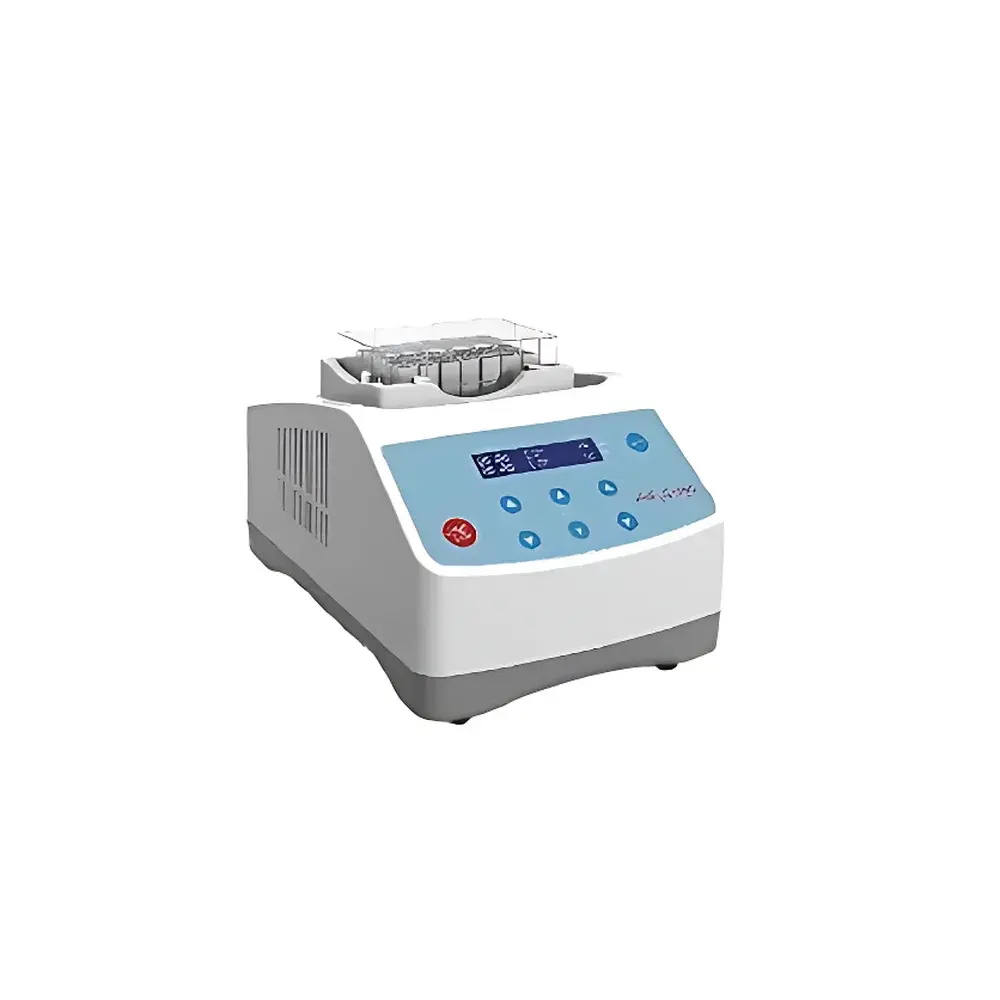
Zuofei GWJSY-1 High-Temperature Metal Block Heater
| Temperature Range | RT+5°C to 150°C |
|---|---|
| Temperature Accuracy | ±0.5°C |
| Display Resolution | 0.1°C |
| Temperature Uniformity | ±0.5°C |
| Heating Time (25°C → 100°C) | ≤10 min |
| Dimensions (W×D×H) | 218×240×95 mm |
| Net Weight | 3.5 kg |
| Heating Power | 150 W |
| Module Capacity | 1 × interchangeable block |
| Fuse | 250 V, 3 A, Φ5×20 mm |
| Compliance | CE-marked design principles, GLP-aligned operational safeguards |
Overview
The Zuofei GWJSY-1 High-Temperature Metal Block Heater is a microprocessor-controlled dry bath instrument engineered for precise, stable thermal management of samples in laboratory environments where water-based heating systems are impractical or undesirable. Unlike traditional water baths—prone to evaporation, contamination, and limited upper-temperature operation—the GWJSY-1 employs solid aluminum heating blocks with optimized thermal mass and forced-air-assisted heat distribution to deliver rapid, uniform heating from ambient +5°C up to 150°C. Its design adheres to fundamental thermodynamic principles of conductive heat transfer through high-purity metal blocks, ensuring minimal thermal lag and repeatable setpoint attainment across repeated cycles. The unit is intended for routine use in sample incubation, enzyme reaction activation, DNA denaturation, reagent pre-warming, and stability testing under controlled thermal conditions—applications common in pharmaceutical QC labs, food safety analysis, environmental testing laboratories, and academic research settings requiring ISO/IEC 17025-compliant instrumentation.
Key Features
- Microprocessor-based PID temperature control with real-time digital LED display showing both setpoint and actual block temperature (0.1°C resolution)
- Programmable timer function (1 minute to 99 hours 59 minutes) with countdown mode and audible end-of-cycle alert
- Integrated over-temperature protection circuit with automatic cut-off and visual/audible fault indication
- User-accessible temperature offset calibration to correct for long-term sensor drift or block-specific thermal gradients
- Quick-release modular block system enabling tool-free exchange of standardized aluminum blocks—designed for autoclaving, chemical resistance, and easy decontamination
- Compact footprint (218 × 240 × 95 mm) and lightweight construction (3.5 kg) suitable for benchtop deployment in space-constrained analytical labs or mobile field laboratories
- Energy-efficient 150 W heating element with low standby power draw and thermal insulation minimizing ambient heat dissipation
Sample Compatibility & Compliance
The GWJSY-1 supports a wide range of tube formats via interchangeable aluminum blocks—including 0.2 mL PCR tubes, 0.5 mL microcentrifuge tubes, 1.5 mL and 2.0 mL Eppendorf-style tubes, 13 mm and 16 mm culture tubes, and flat-bottom 96-well microplates (via optional ZF18 plate adapter). All standard blocks feature precision-drilled, vertically aligned wells with consistent depth and bottom geometry (round, conical, or flat) to ensure reproducible thermal contact across heterogeneous sample sets. While the device itself carries no formal ISO 13485 or FDA 21 CFR Part 11 certification, its operational architecture—featuring non-volatile parameter storage, audit-ready timer logs, and hardware-level thermal fail-safes—aligns with GLP and GMP documentation requirements for method validation and equipment qualification. Users may implement IQ/OQ protocols per ASTM E2500–21 guidelines for critical thermal applications.
Software & Data Management
The GWJSY-1 operates as a standalone instrument without proprietary software dependencies. All operational parameters—including temperature setpoint, hold time, ramp rate (fixed by default), and calibration offsets—are configured directly via front-panel membrane keys and retained in non-volatile memory after power cycling. The unit does not support USB, Bluetooth, or Ethernet connectivity; however, its deterministic thermal behavior and built-in timer functionality allow seamless integration into validated SOP workflows requiring manual data entry into LIMS or electronic lab notebooks (ELNs). For regulated environments, users may document temperature verification using external calibrated thermocouple probes traceable to NIST standards, with recorded deviations logged against predefined acceptance criteria per USP Analytical Instrument Qualification.
Applications
- Pre-heating reagents prior to ELISA, Western blotting, or immunoassay workflows
- Controlled denaturation of nucleic acids in molecular biology preparation steps
- Accelerated stability studies of APIs and excipients under elevated temperature stress
- Thermal conditioning of viscosity standards and calibration fluids in rheology labs
- Incubation of microbial cultures in food microbiology testing (e.g., AOAC 990.12, ISO 6579)
- Sample thawing and equilibration for GC-MS and HPLC sample introduction modules
- Supporting ASTM D341 viscosity-temperature correlation measurements at discrete points
FAQ
What is the maximum recommended continuous operating temperature?
The unit is rated for sustained operation up to 150°C. Prolonged use above 130°C may reduce long-term thermal sensor stability and accelerate surface oxidation of aluminum blocks.
Can the GWJSY-1 be used for sterilization of tools or glassware?
No. It is not designed as a dry heat sterilizer (which typically requires ≥160°C for ≥2 hours per ISO 17665). Its thermal profile meets incubation and warming specifications only.
Are replacement blocks available with custom well configurations?
Yes. Zuofei offers OEM block customization—including non-standard diameters, depths, and bottom geometries—subject to minimum order quantities and mechanical feasibility review.
Does the device meet electromagnetic compatibility (EMC) requirements for laboratory use?
The unit conforms to IEC 61326-1:2013 Class B emission limits for laboratory equipment and includes internal filtering to minimize conducted/radiated interference with adjacent sensitive instrumentation.
How frequently should temperature calibration be performed?
Per ISO/IEC 17025 Clause 6.4.10, calibration verification is recommended before each critical batch run or at least daily when used in regulated testing; full recalibration every 6 months or after physical impact to the block.



