
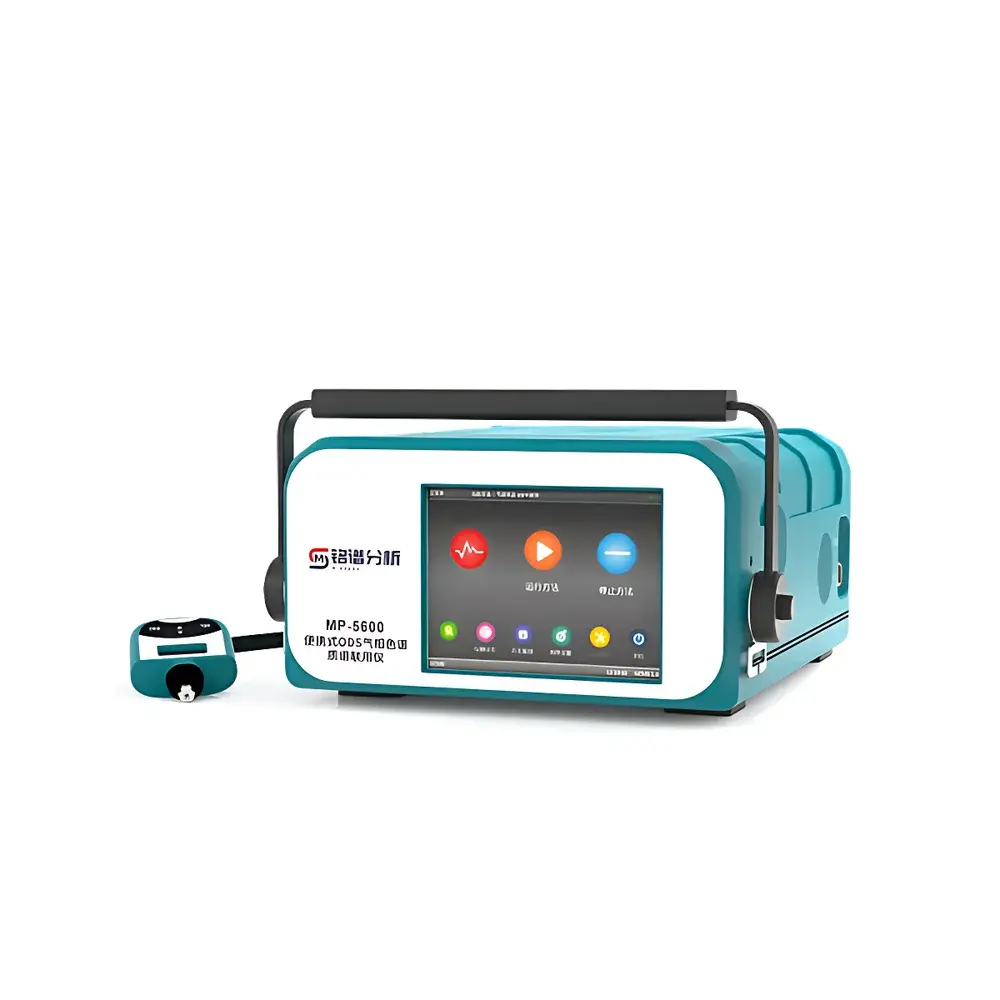
MINSPEC MP-5600 Portable ODS-Specific Gas Chromatography Mass Spectrometry System
| Brand | MINSPEC |
|---|---|
| Model | MP-5600 |
| Origin | Shandong, China |
| Instrument Type | Portable GC-MS |
| Mass Range | AMU (atomic mass units) |
| Dynamic Range | 7 decades |
| Mass Resolution | <1.0 amu at FWHM |
| Scan Modes | Full Scan, Selected Ion Monitoring (SIM), Tandem MS (MS/MS) |
| Sensitivity | 10× higher than conventional portable GC-MS systems |
| Weight | Not specified |
Overview
The MINSPEC MP-5600 is a purpose-built, field-deployable gas chromatography mass spectrometry (GC-MS) system engineered exclusively for on-site detection and quantification of ozone-depleting substances (ODS), including chlorofluorocarbons (CFCs), hydrochlorofluorocarbons (HCFCs), and halons. Unlike general-purpose portable GC-MS platforms, the MP-5600 integrates an ODS-optimized capillary column with a high-efficiency dual-curved linear ion trap mass analyzer—enabling selective separation, robust ion storage, and high-fidelity spectral acquisition under non-laboratory conditions. Its operational principle relies on thermal desorption or headspace sampling coupled with capillary GC separation, followed by electron ionization (EI) and mass analysis via a dynamically tuned ion trap. Designed for real-time decision support in regulatory and emergency response contexts, the MP-5600 delivers laboratory-grade analytical confidence without requiring sample transport or centralized lab infrastructure.
Key Features
- ODS-dedicated capillary GC column: Chemically tailored for optimal resolution of CFC-11, CFC-12, HCFC-22, HCFC-141b, and related compounds per HJ 1058–2019 and GB/T 32210–2015.
- Dual-curved linear ion trap mass analyzer: Provides extended ion storage capacity, enabling high duty-cycle operation across full-scan, SIM, and MS/MS modes while maintaining sub-1 amu resolution (FWHM) and 7-decade dynamic range.
- Field-hardened architecture: Ruggedized chassis, battery-operated mode (optional external power input), and integrated carrier gas supply (helium or hydrogen) for sustained operation in outdoor, mobile, or confined environments.
- Real-time spectral library matching: Embedded NIST-compatible spectral database with ODS-specific reference spectra; supports automated peak identification and semi-quantitative reporting using internal standard calibration.
- Onboard data validation: Built-in system suitability checks—including retention time stability, mass axis calibration, and signal-to-noise verification—ensuring traceable performance prior to each analysis cycle.
Sample Compatibility & Compliance
The MP-5600 accepts gaseous, headspace, and direct vapor samples from refrigeration systems, industrial effluents, ambient air, water (via purge-and-trap or static headspace), and polyurethane foam matrices. It complies fully with Chinese national standards governing ODS and VOC monitoring: GB/T 32210–2015 (technical requirements for portable GC-MS), HJ 1227–2021 (water VOC emergency testing), HJ 11223–2021 (ambient air VOC emergency testing), and HJ 1058–2019 (ODS in foams). While not certified to ISO/IEC 17025 or ASTM D6348, its measurement traceability aligns with GLP-aligned field protocols, and raw spectral data export supports retrospective review under audit-ready file structures (mzML-compliant metadata tagging).
Software & Data Management
The proprietary MINSPEC GC-MS Control Suite runs on embedded Linux and provides intuitive touchscreen workflow navigation—from method setup and instrument tuning to report generation. All acquired spectra, chromatograms, and calibration logs are stored locally with SHA-256 hash integrity verification. Data export supports CSV, mzML, and PDF formats; encrypted USB transfer enables secure chain-of-custody handover to central laboratories or regulatory databases. Audit trail functionality records user actions, parameter changes, and calibration events with timestamps and operator IDs—supporting alignment with basic data integrity principles referenced in FDA 21 CFR Part 11 for field-deployed instrumentation used in enforcement contexts.
Applications
- Refrigerant leak detection in HVAC/R maintenance and retrofit operations—identifying unauthorized CFC/HCFC use during equipment servicing.
- Customs and border inspection: Rapid screening of imported appliances, foams, and aerosol products for prohibited ODS content.
- Environmental enforcement: Field-level verification of VOC emissions from industrial sites, landfills, and chemical storage facilities under ambient air quality monitoring programs.
- Emergency response: Deployment during chemical spills, fire investigations, or industrial accidents where rapid identification of volatile halogenated compounds informs hazard mitigation strategies.
- Compliance auditing: On-site verification of ODS phase-out compliance in manufacturing plants subject to Montreal Protocol obligations and national implementation plans.
FAQ
Does the MP-5600 require external laboratory support for calibration or maintenance?
No—routine mass axis calibration, sensitivity verification, and system suitability tests are fully automated and executable in-field using built-in reference compounds and onboard diagnostics.
Can the MP-5600 quantify ODS concentrations without laboratory-derived calibration curves?
Yes—it supports single-point and multi-point calibration using certified gas standards; quantitative results are traceable to NIST-traceable reference materials when used per HJ 1058–2019 protocol.
Is the instrument compatible with hydrogen carrier gas for GC separation?
Yes—hydrogen is supported as an alternative carrier gas with optimized flow control and safety interlocks, reducing analysis time and improving peak shape for light ODS compounds.
What data security measures are implemented for forensic or evidentiary use?
All raw data files include digital signatures, immutable timestamps, and operator authentication logs; exported reports contain embedded metadata compliant with evidentiary documentation standards for environmental enforcement agencies.
How does the MP-5600 handle matrix interference in complex environmental samples?
The combination of ODS-selective column chemistry, MS/MS fragmentation filtering, and deconvolution algorithms minimizes co-elution effects and enhances specificity in mixed VOC backgrounds typical of landfill gas or industrial stack emissions.






