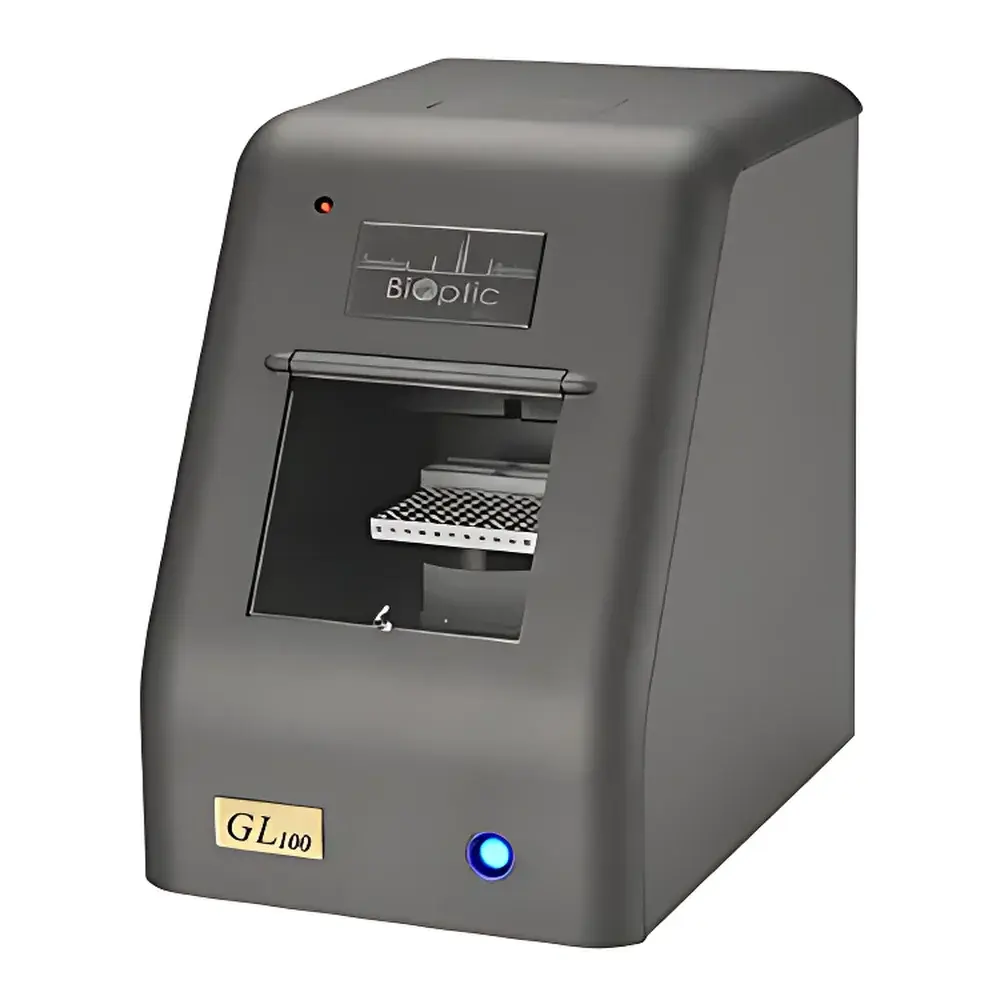
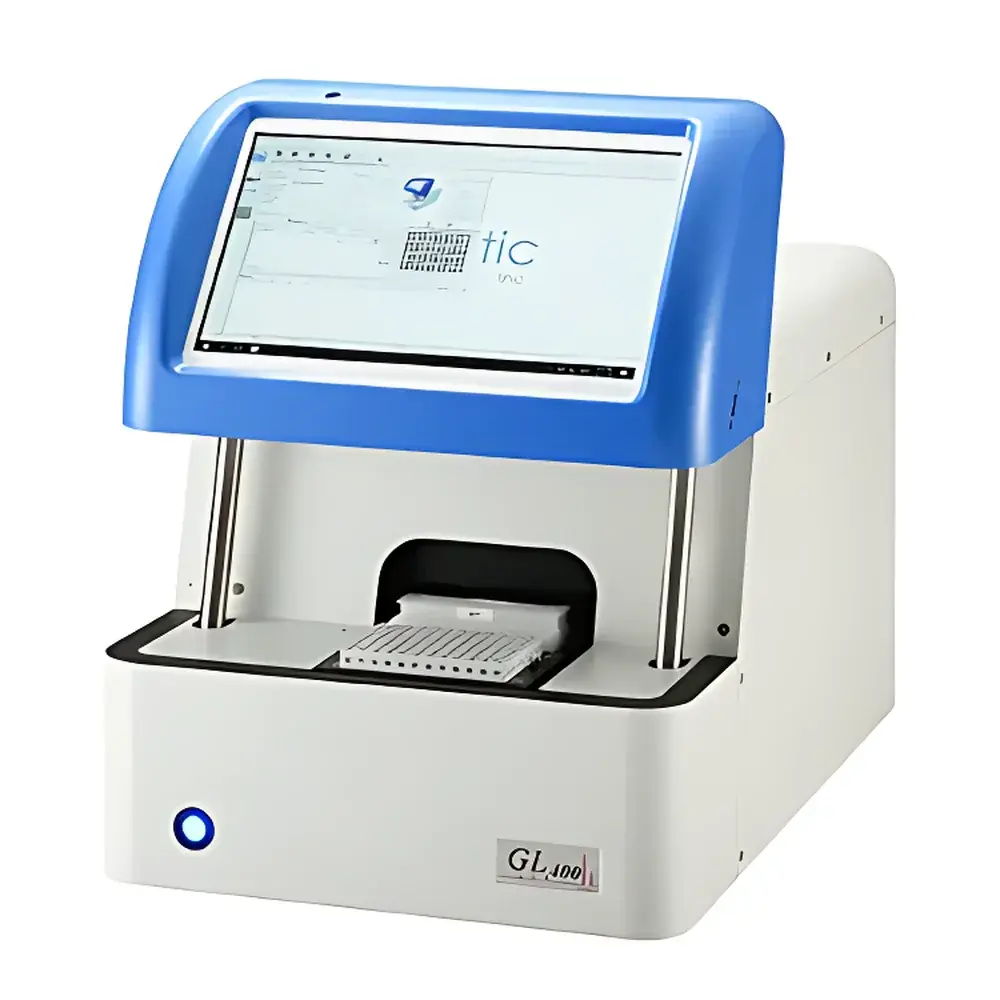
Bioptic GL100/400 Glycan Sample Analyzer
| Brand | Bioptic |
|---|---|
| Origin | Jiangsu, China |
| Manufacturer Type | Authorized Distributor |
| Product Category | Domestic Instrument |
| Model | GL100/400 |
| Instrument Classification | Conventional Nucleic Acid and Protein Analyzer |
| Minimum Sample Volume | 1 µL |
| Detection Technology | Capillary Gel Electrophoresis (CGE) with LED-Induced Fluorescence (LEDIF) |
| Sample Throughput | 96-well Auto-sampler |
| Consumable Format | Disposable Pre-cast Gel Cartridge |
| Included Modules | Integrated Sample Prep Platform (N-Glycan Release, Labeling & Purification Kit), Analysis Software with Data Export & Reporting Engine |
Overview
The Bioptic GL100/400 Glycan Sample Analyzer is a purpose-built, integrated capillary gel electrophoresis (CGE) system engineered for high-resolution, quantitative profiling of released N-linked glycans—particularly critical in the characterization of monoclonal antibodies (mAbs), Fc-fusion proteins, and other glycosylated biopharmaceuticals. Unlike conventional HILIC-UPLC or MALDI-TOF MS workflows—which require extensive method development, specialized operator training, and offline derivatization—the GL100/400 implements a streamlined, end-to-end analytical pipeline grounded in CE-based separation physics. Its core measurement principle relies on the differential electrophoretic mobility of fluorescently labeled glycans under controlled electric field conditions within a thermally stabilized capillary array embedded in a disposable pre-cast polyacrylamide gel cartridge. Separation resolution is enhanced by polymer matrix optimization and precisely regulated buffer composition, enabling baseline resolution of isomeric structures such as G0F, G1F, and G2F glycans. The system operates fully autonomously from sample injection to data export, supporting regulatory-compliant workflows aligned with ICH Q5B and USP guidance for glycosylation analysis.
Key Features
- Integrated CGE platform with built-in 96-well autosampler for unattended batch processing
- LED-induced fluorescence (LEDIF) detection system optimized for common glycan labels (e.g., 2-AB, ANTS), offering sub-picomolar sensitivity and linear dynamic range over three orders of magnitude
- Disposable pre-cast gel cartridges eliminate manual gel preparation, casting, and buffer equilibration—reducing hands-on time by >70% versus traditional slab-gel or home-packed capillary systems
- Dedicated N-glycan rapid digestion and labeling kit included: enables complete enzymatic release (PNGase F), reductive amination labeling, and solid-phase cleanup in under 90 minutes with validated recovery (>92%) and inter-day CV <4.5%
- Thermal management architecture maintains ±0.2 °C temperature stability across the separation capillary zone, ensuring retention time reproducibility (RSD <1.2% over 50 injections)
- Modular hardware design supports future expansion with optional UV-Vis absorbance detector module for orthogonal detection validation
Sample Compatibility & Compliance
The GL100/400 accepts native or reduced glycoprotein samples (1–100 µg), released N-glycans (≥1 pmol), and synthetic glycan standards. It accommodates complex biological matrices including cell culture supernatants, purified IgG fractions, and affinity-purified extracellular vesicles—provided glycan release and cleanup protocols are followed per Bioptic’s validated SOPs. All consumables meet ISO 13485-certified manufacturing requirements. The instrument firmware and software comply with FDA 21 CFR Part 11 for electronic records and signatures, featuring full audit trail logging, user access controls, and electronic signature capability. Method validation documentation—including specificity, linearity, accuracy, precision, LOD/LOQ—is available upon request and conforms to ICH Q2(R2) principles.
Software & Data Management
Bioptic GlycoAnalyze™ v3.2 software provides an intuitive, workflow-driven interface for method setup, run control, peak integration, glycan assignment (via integrated library matching against UniCarb-DB and GlyConnect reference spectra), and QC reporting. Raw data (.cdx format) is stored in a relational SQLite database with automatic timestamping, instrument metadata embedding, and version-controlled method files. Export options include CSV, PDF analytical reports, and XML-compatible structured output for LIMS integration. Software supports multi-user environments with role-based permissions (Analyst, Supervisor, Administrator) and includes built-in tools for system suitability testing (SST), calibration verification, and trending analysis across batches.
Applications
- Comparability assessment of biosimilars and innovator mAbs across manufacturing process changes
- Cell line selection and clone screening based on glycosylation profile consistency
- In-process monitoring of glycosylation during bioreactor runs (via periodic sampling and rapid turnaround analysis)
- Stability-indicating assays for glycan degradation pathways (e.g., desialylation, galactose oxidation)
- Supporting regulatory submissions (BLA, MAA) with fully documented, transferable analytical methods
- Academic research in glycoimmunology, host-cell glycosyltransferase expression profiling, and glycoengineering studies
FAQ
What glycan labeling chemistries are compatible with the GL100/400 system?
The instrument is validated for 2-aminobenzoic acid (2-AB), 2-aminoacridone (AMAC), and 8-aminopyrene-1,3,6-trisulfonic acid (APTS) labeling protocols. Alternative dyes may be used subject to method revalidation.
Can the system analyze O-linked glycans?
Yes—when coupled with appropriate enzymatic or chemical release methods (e.g., β-elimination with ammonia), though N-glycan analysis remains the primary validated application.
Is method transfer to another GL100/400 unit supported?
Yes—method files, calibration parameters, and spectral libraries are portable across instruments; Bioptic provides a formal method transfer protocol package compliant with ASTM E2554.
Does the software support automated glycan nomenclature (e.g., SNFG or GlycoCT)?
GlycoAnalyze™ exports annotated results in both SNFG pictorial format and GlycoCT-compliant text strings for interoperability with glycoinformatics platforms such as GlyTouCan and GlyConnect.