
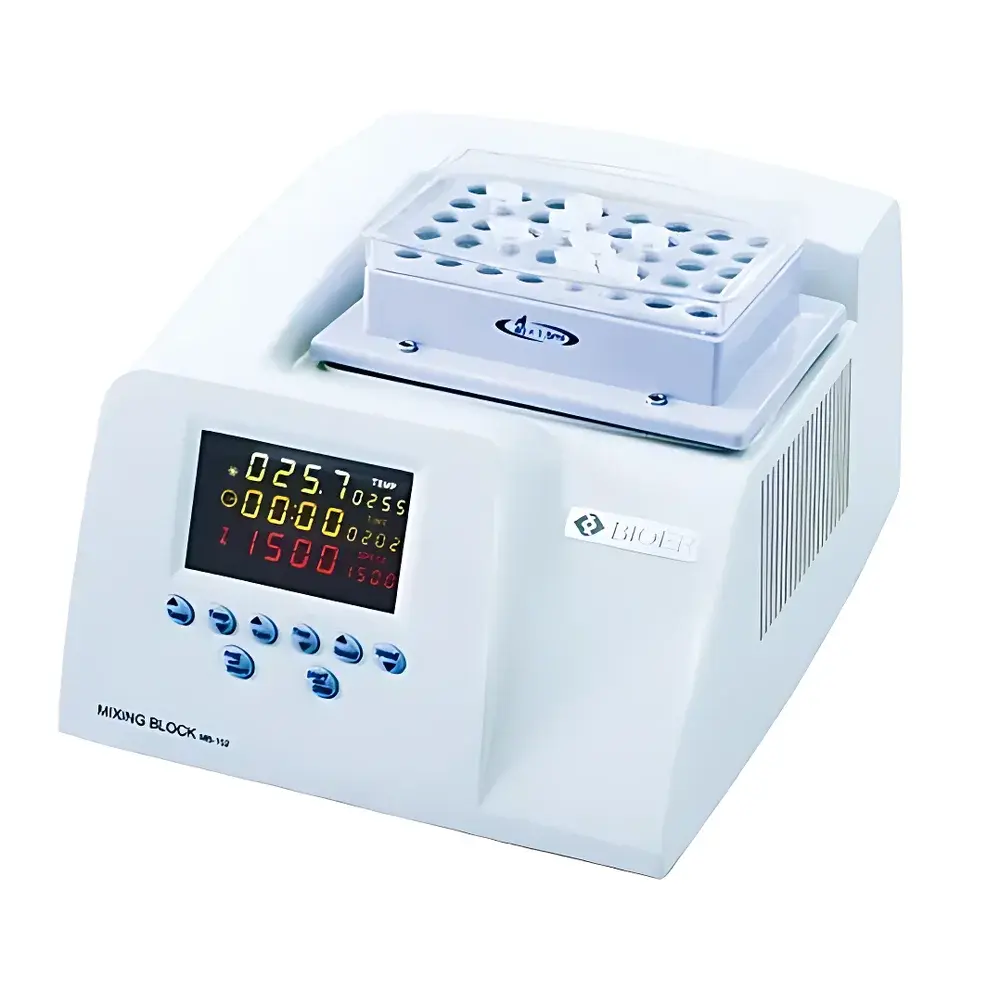
Bioer ThermoCell MB-102 Oscillating Metal Block Heater
| Brand | Bioer |
|---|---|
| Origin | Zhejiang, China |
| Model | MB-102 |
| Temperature Range | 0°C to 100°C (with active cooling down to ambient −14°C) |
| Temperature Accuracy | ≤ ±0.5°C |
| Temperature Uniformity | ≤ ±0.5°C |
| Heating Time | ≤12 min (20°C → 100°C) |
| Cooling Rate | ≥6°C/min (100°C → ambient), ≥0.8°C/min (ambient → −10°C) |
| Cooling Time | ≤8 min (ambient → −10°C), ≤15 min (100°C → ambient +10°C) |
| Oscillation Speed | 300–1500 rpm |
| Oscillation Amplitude | 3 mm |
| Timer Range | 1 min – 99 h 59 min |
| Dimensions (L×W×H) | 328 × 249 × 166 mm |
| Net Weight | 8.5 kg |
| Power Supply | AC 220 V ±22 V, 150 W, 50 ±1 Hz |
| Standard Blocks | A (40 × 1.5 mL), B (54 × 0.5 mL), C (96 × 0.2 mL), D (24 × φ15 mm), H (40 × 2.0 mL), G (26 × 0.5 mL + 24 × 1.5 mL), J (96-well microplate) |
Overview
The Bioer ThermoCell MB-102 Oscillating Metal Block Heater is an integrated thermal and mechanical incubation platform engineered for precise temperature control and reproducible orbital mixing in molecular biology, biochemistry, and pharmaceutical R&D workflows. Unlike conventional dry baths or standalone shakers, the MB-102 employs a Peltier-based thermoelectric system—capable of both heating and active cooling—to deliver bidirectional thermal regulation across a functional range of 0°C to 100°C, with dynamic cooling extending to ambient −14°C. Its core architecture combines a 32-bit microprocessor controller, brushless DC motor drive, and high-thermal-conductivity aluminum block construction to ensure stable setpoint maintenance (≤ ±0.5°C accuracy and uniformity) and low-vibration oscillation across its full speed range (300–1500 rpm). This dual-function design eliminates sequential incubation and mixing steps, enabling simultaneous thermal activation and homogeneous sample agitation—critical for enzymatic reactions, cell lysis, antigen-antibody binding, PCR setup, and reagent equilibration.
Key Features
- Peltier-driven thermoelectric module supporting both rapid heating (≤12 min, 20°C → 100°C) and controlled cooling (≥6°C/min from 100°C to ambient)
- High-resolution digital PID control with real-time temperature feedback and auto-tuning capability
- Orbital shaking mechanism with adjustable speed (300–1500 rpm) and fixed 3 mm amplitude for consistent mixing energy delivery
- Modular interchangeable block system—including configurations for 0.2 mL tubes (96-well), 0.5/1.5/2.0 mL tubes, 15 mm test tubes, and standard 96-well microplates—enabling lab-wide protocol standardization
- Extended timer function (1 minute to 99 hours 59 minutes) with automatic shutdown and audible alert
- Compact footprint (328 × 249 × 166 mm) and lightweight design (8.5 kg) optimized for benchtop use in biosafety cabinets and shared instrumentation spaces
- Energy-efficient operation (150 W max) with over-temperature and motor stall protection circuits
Sample Compatibility & Compliance
The MB-102 accommodates a broad spectrum of common laboratory consumables via its standardized block interface, including thin-walled PCR tubes, skirted and non-skirted 96-well plates, microcentrifuge tubes, and glass vials. All metal blocks are CNC-machined from aerospace-grade aluminum alloy and anodized for chemical resistance and thermal stability. The device complies with IEC 61010-1:2010 for electrical safety in laboratory equipment and meets electromagnetic compatibility requirements per EN 61326-1:2013. While not certified for GLP/GMP production environments, its repeatable thermal and mechanical performance supports method validation under ISO/IEC 17025-accredited testing laboratories. Data logging capabilities (via optional RS-232 or USB interface) can be configured to meet basic FDA 21 CFR Part 11 audit trail requirements when integrated with compliant LIMS platforms.
Software & Data Management
The MB-102 operates as a standalone instrument with an intuitive front-panel LCD interface and tactile membrane keys. No proprietary software is required for routine operation; however, optional serial communication (RS-232) enables integration into automated workflows via LabVIEW, Python (pySerial), or custom SCADA systems. Temperature and shaking parameters—including setpoints, ramp rates, dwell times, and real-time status—are accessible programmatically. For quality-critical applications, timestamped operational logs (start/stop time, actual vs. target temperature, rpm deviation) can be exported for traceability. Firmware updates are delivered via USB flash drive, ensuring long-term maintainability without hardware modification.
Applications
- Enzyme kinetics assays requiring simultaneous thermal activation and substrate homogenization
- Pre-PCR and post-PCR tube preparation, including master mix equilibration and primer dilution
- Protein denaturation/refolding studies under controlled thermal ramping and agitation
- Cell suspension culture maintenance during short-term incubation (e.g., transfection reagent mixing)
- Chemical synthesis optimization where exothermic/endothermic reaction control coincides with mixing efficiency
- Quality control testing of diagnostic reagents, including stability assessment under accelerated aging conditions
- Standardization of ELISA and lateral flow assay development protocols using 96-well plate modules
FAQ
Does the MB-102 support refrigerated operation below ambient temperature?
Yes—the Peltier module enables active cooling to ambient −14°C, though sustained sub-ambient operation requires adequate ventilation and ambient room temperature ≤25°C.
Can multiple temperature zones be controlled independently on a single unit?
No—the MB-102 features a single-zone thermal block; uniform temperature distribution across the installed module is maintained within ≤ ±0.5°C.
Is the 96-well microplate module compatible with all standard ANSI/SLAS-format plates?
Yes—the J-module accepts full-height and low-profile skirted/unskirted 96-well plates conforming to ANSI SLAS-1-2004 specifications.
What is the expected service life of the Peltier element under continuous duty?
Rated for >50,000 hours of operation at ≤80% load; typical field deployment exceeds 7 years with proper thermal management.
Are calibration certificates available for metrological traceability?
Factory calibration reports (NIST-traceable reference sensors) are provided upon request; users may perform in-house verification using Class AA platinum RTDs per ASTM E1137/E1142.



