
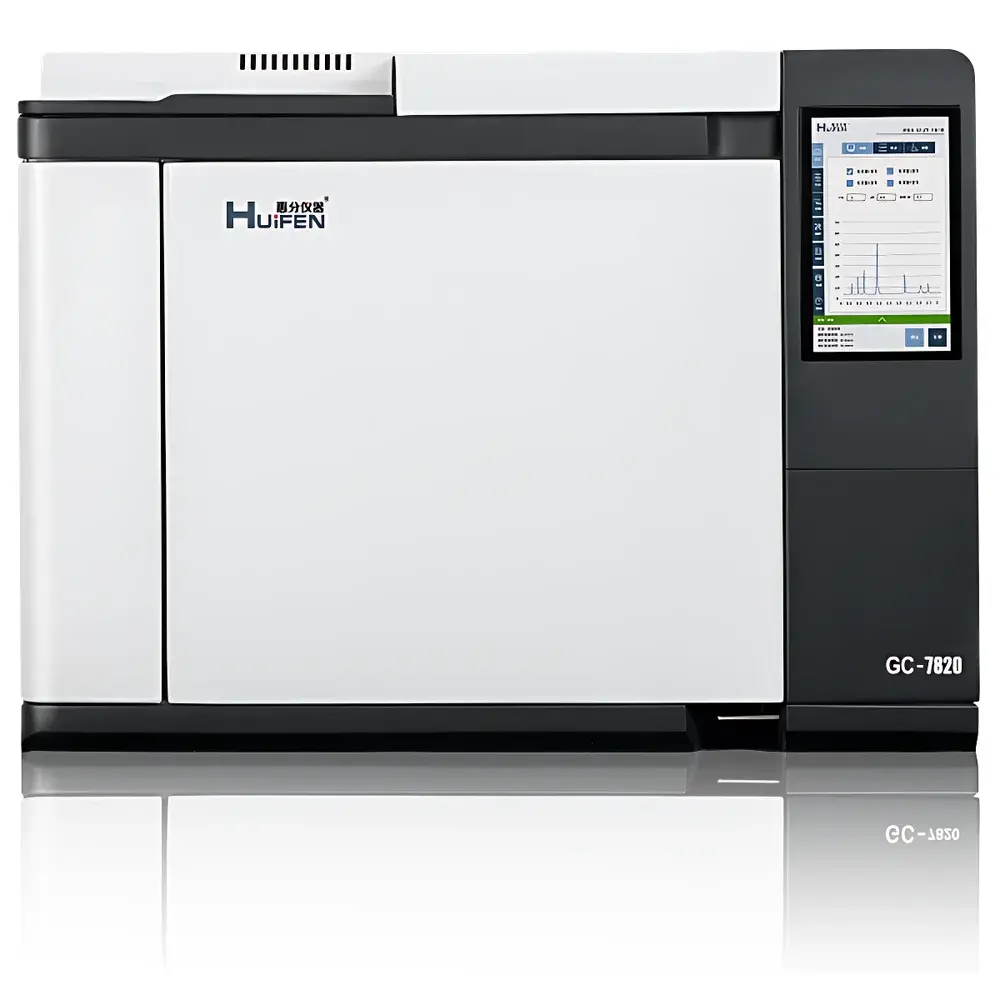
HUIFEN GC-7820 Laboratory Gas Chromatograph
| Brand | HUIFEN Instrument |
|---|---|
| Origin | Shandong, China |
| Model | GC-7820 |
| Instrument Type | Laboratory Gas Chromatograph |
| Application Scope | General-purpose |
| Temperature Control Range | 2°C above ambient to 450°C |
| Maximum Ramp Rate | 250°C/min |
| Cooling Rate | 450°C → 50°C in <3.2 min |
| Carrier Gas Flow Range & Control | 0–500 mL/min |
| Carrier Gas Pressure Range & Control | 0–0.4 MPa |
| Injector Maximum Operating Temperature | 450°C |
| Injector Pressure Setting Range | 0–0.4 MPa (customizable) |
| Injector Total Flow Setting Range | 0–500 mL/min (customizable) |
Overview
The HUIFEN GC-7820 is a laboratory-grade gas chromatograph engineered for precision, reproducibility, and long-term operational stability in routine and method-development environments. It operates on the fundamental principle of gas-phase separation: analytes in a vaporized sample are partitioned between a mobile phase (inert carrier gas) and a stationary phase (capillary or packed column), with retention time serving as the primary identification and quantification parameter. The system employs a classic mechanical-valve-based pneumatic architecture, enhanced by high-accuracy pressure transducers that provide real-time digital monitoring of both column head pressure and total flow across all gas paths. Its triple-oven modular design—comprising independently controllable injector oven, column oven, and detector oven—enables advanced multi-dimensional separations and supports complex valve-switching configurations (e.g., five-valve, seven-column setups). This architecture meets the thermal and mechanical demands of ASTM D1945, ISO 6416, USP , and EPA Method 8260/8021-compliant workflows.
Key Features
- Large-capacity column oven (≥23 L internal volume) with optimized heat exchange geometry, enabling rapid, uniform heating and cooling across the entire column bed—critical for gradient elution reproducibility and method transfer fidelity.
- Dual independent column oven zones allow simultaneous temperature programming of two separate column segments or parallel columns, supporting heart-cutting, back-flushing, and comprehensive 2D-GC (GC×GC) configurations.
- Intelligent maintenance tracking system logs cumulative usage hours for consumables (e.g., septa, liners, ferrules) and critical components (e.g., EPC modules, detector filaments); configurable thresholds trigger alerts via on-screen notification or email, aligning with GLP/GMP preventive maintenance requirements.
- Modular detector bay accommodates up to four detectors concurrently—including FID, TCD, FPD, ECD, NPD, PDHID, PID, PDECD, and PED—with independent temperature control and electrical bias management per unit.
- Robust mechanical gas control system with optional electronic pressure control (EPC) upgrade path; all pressure and flow parameters digitally logged with timestamped audit trail, compliant with FDA 21 CFR Part 11 data integrity requirements when paired with validated software.
Sample Compatibility & Compliance
The GC-7820 accepts liquid, gaseous, and solid (via thermal desorption or purge-and-trap) samples following standard derivatization or extraction protocols. It supports capillary columns (0.1–0.53 mm ID) up to 60 m length and packed columns (2–4 mm ID). The system complies with IEC 61000-6-3 (EMC) and IEC 61010-1 (safety) standards. Its hardware architecture and firmware design facilitate validation under ISO/IEC 17025, USP , and ASTM E2655 frameworks. Detector configurations meet sensitivity thresholds required for EPA Method 18 (VOCs), ASTM D6667 (total sulfur), and ISO 15585 (non-methane hydrocarbons).
Software & Data Management
The proprietary chromatography data system (CDS) features a Windows-native GUI with multi-window, multi-task operation—supporting concurrent control of up to 254 instruments over LAN or Wi-Fi. It includes full audit trail functionality (user actions, method changes, reprocessing events), electronic signatures, and role-based access control. Data export options include native .CDF, CSV, Excel (.xlsx), Word (.docx), and PDF formats. Optional specialized workstation modules—Non-Methane Hydrocarbon (NMHC), Calorific Value, Mine Gas Analysis, Trace Sulfur, Petroleum Hydrocarbons (TPH), and Total Volatile Organic Compounds (TVOC)—are pre-configured with validated calibration curves, reporting templates, and regulatory calculation engines. All software versions undergo annual verification per GAMP 5 guidelines.
Applications
The GC-7820 delivers consistent performance across regulated and research-driven applications: hydrocarbon profiling in refinery streams (ASTM D5292, D6730); residual solvent analysis in pharmaceuticals (ICH Q3C); pesticide screening in food matrices (AOAC 2007.01); VOC emissions monitoring from industrial stacks (EPA Method 25A); environmental soil and water analysis (SW-846 8260D); and natural gas composition and heating value determination (ISO 6974-2). Its thermal flexibility and detector versatility make it suitable for method development labs requiring platform consolidation without compromising analytical specificity.
FAQ
Does the GC-7820 support 21 CFR Part 11 compliance?
Yes—when deployed with the validated CDS version and configured with electronic signatures, audit trail logging, and user access controls.
Can the instrument operate unattended for extended batch runs?
Yes—equipped with auto-sampler compatibility (optional), thermal stabilization algorithms, and real-time fault detection to prevent run interruption.
Is remote diagnostics and firmware update supported?
Yes—via secure HTTPS web interface or dedicated mobile application; updates require administrator authentication and checksum verification.
What column dimensions and phases are compatible?
All standard fused-silica capillary columns (0.1–0.53 mm ID, ≤60 m) and stainless-steel/aluminum packed columns (2–4 mm ID); polarity and film thickness selection follows manufacturer-recommended guidelines for target analytes.
How is detector sensitivity verified during qualification?
Using certified reference standards (e.g., n-decane for FID, methane for TCD) per ASTM E260 and ISO 10723 protocols; system suitability tests include signal-to-noise ratio, peak symmetry, and retention time repeatability over ≥5 injections.





