
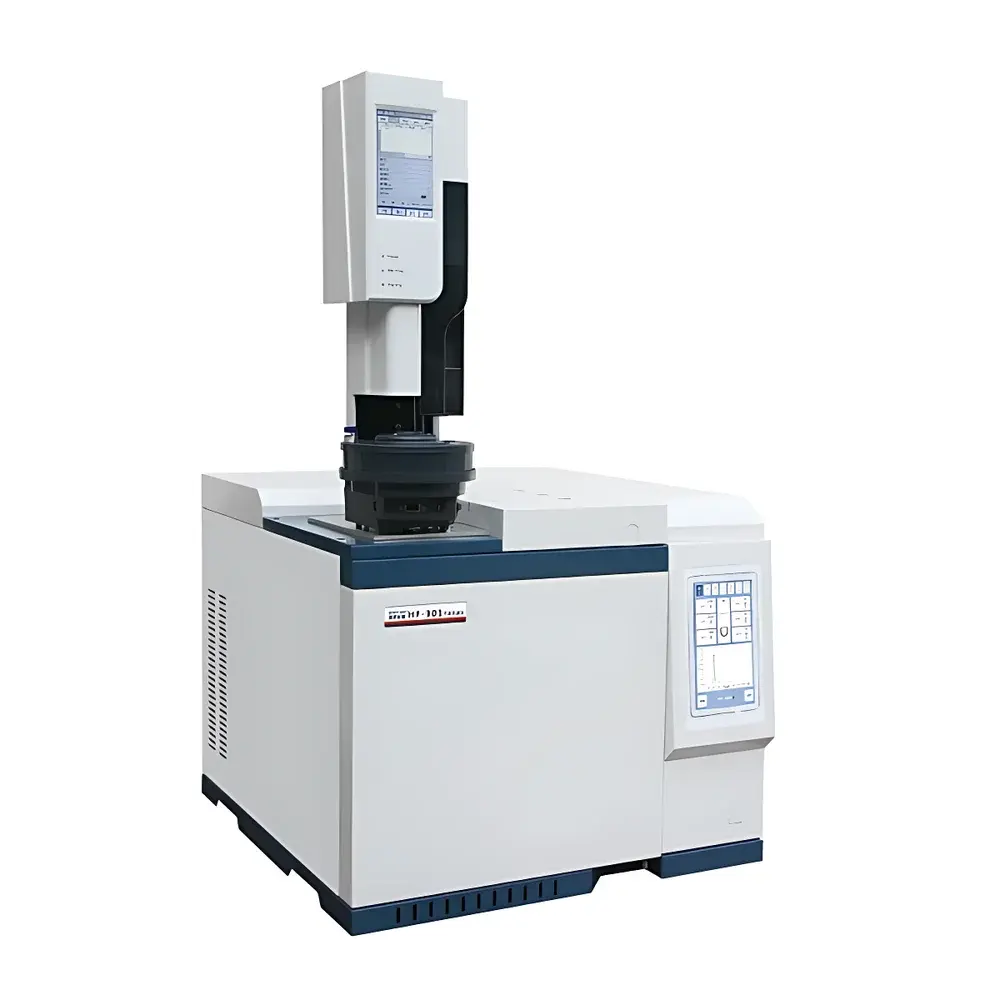
Huifen HF-901M Automated Coal Mine-Specific Gas Chromatograph
| Brand | Huifen Instrument |
|---|---|
| Origin | Shandong, China |
| Manufacturer Type | Authorized Distributor |
| Country of Origin | Domestic (China) |
| Model | HF-901M Automated Coal Mine-Specific Gas Chromatograph |
| Price Range | USD 4,200 – 7,000 (FOB) |
| Instrument Type | Laboratory Gas Chromatograph |
| Application Field | Coal Mining Safety Monitoring |
| Oven Temperature Range | Ambient + 3 °C to 450 °C |
| Oven Ramp Rate | 0.1–40 °C/min |
| Oven Cool-down Time | ~8 min (450 °C → 50 °C) |
| Carrier Gas Flow Range & Control | 0–1200 mL/min |
| Carrier Gas Pressure Range & Control | 0–970 kPa |
| Injector Maximum Operating Temperature | 450 °C |
| Injector Pressure Setting Range | 0–970 kPa |
| Injector Total Flow Setting Range | 0–1200 mL/min |
Overview
The Huifen HF-901M Automated Coal Mine-Specific Gas Chromatograph is a purpose-built analytical system engineered for continuous, unattended gas composition monitoring in underground coal mine environments. It serves as the core analytical module within centralized束管 (bundle-tube) surveillance systems—typically interfacing with 12–60 parallel sampling lines extending from strategic locations across active mining faces, sealed goafs, and fire zones. The instrument operates on classical gas chromatographic separation principles: gaseous samples are introduced via programmable multi-port valves, separated on dedicated capillary or packed columns under precisely controlled temperature gradients, and detected using multiple parallel detectors—including thermal conductivity detectors (TCD) and flame ionization detectors (FID), with optional methanizer integration for enhanced C₂ hydrocarbon sensitivity. Its primary operational objective is early detection of spontaneous combustion precursors (e.g., CO, C₂H₄, C₂H₂) and explosive atmosphere indicators (CH₄, O₂, N₂, CO₂) in real time, supporting quantitative compliance with China’s AQ 1019–2018 and MT/T 757–2020 standards for coal mine fire prediction.
Key Features
- Integrated auto-sampling control: Synchronizes with bundle-tube manifolds for sequential, timed analysis of up to 60 remote sampling points without manual intervention.
- Triple independent injection systems: Each detector (TCD, FID, methanizer-FID) features a dedicated, pressure-programmable inlet—eliminating cross-contamination and ensuring stoichiometric quantitation across O₂/N₂/CH₄/CO/CO₂/C₂H₄/C₂H₆/C₂H₂ in a single 5–8 minute run.
- High-stability thermal management: Oven temperature control accuracy ±0.1 °C; ramp rates programmable from 0.1 to 40 °C/min; rapid cool-down (~8 min from 450 °C to 50 °C) enables high-throughput operation in shift-based monitoring regimes.
- Self-diagnostic architecture: Comprehensive power-failure memory retention, keyboard lockout, anti-surge protection, automatic ignition sequence, and real-time fault logging with on-screen English/Chinese bilingual error codes.
- Dual-range logarithmic amplification: Provides linear response over 0–100% volume concentration for major gases (N₂, CH₄, CO₂) and sub-ppm detection capability for trace combustibles (C₂H₂, C₂H₄) without range switching.
Sample Compatibility & Compliance
The HF-901M accepts direct injection of raw mine air or pre-conditioned bundle-tube gas streams (dried and filtered per GB/T 16157–1996). It complies with intrinsic safety requirements for Zone 1 hazardous areas when installed in surface-based control rooms with explosion-proof sample conditioning units. Data integrity meets GLP-aligned audit trails: all method parameters, calibration events, run logs, and operator actions are timestamped and non-erasable. While not certified to IECEx or ATEX, its hardware architecture and software logic align with functional safety concepts referenced in ISO 8573-1 (compressed air purity) and ASTM D1945 (gas analysis by GC). Calibration traceability follows JJG 700–2016 (Chinese national metrology verification regulation for GC instruments).
Software & Data Management
The bundled Huifen MineGas v3.2 workstation provides full GUI control via mouse-driven interface with dual-language (English/Chinese) menus. Core modules include: (1) Real-time chromatogram acquisition and peak integration using adaptive baseline correction; (2) Explosion triangle visualization engine compliant with DIN 51649 and GB/T 17518–2022; (3) Historical trend database with SQL-backed storage—supporting temporal queries, comparative overlay plots, and automated alert thresholds (e.g., CO > 50 ppm sustained over 15 min triggers Level-2 alarm); (4) OPC UA-enabled data export for integration into mine-wide SCADA platforms (e.g., Siemens Desigo, Rockwell FactoryTalk). Audit trail functionality satisfies basic FDA 21 CFR Part 11 requirements for electronic records, including user authentication, electronic signatures, and immutable log archiving.
Applications
- Early-warning monitoring of coal seam oxidation: Quantitative tracking of CO/C₂H₄ ratio evolution to distinguish slow pyrolysis from incipient flaming.
- Sealed area assessment: Determining O₂ depletion rate and CO/CH₄ accumulation kinetics to evaluate fire extinction efficacy.
- Ventilation efficiency validation: Measuring N₂/O₂ dilution profiles to verify airflow distribution in longwall panels.
- Post-blast gas hazard evaluation: Rapid identification of incomplete detonation byproducts (NOₓ, CO) and residual CH₄ migration.
- Regulatory reporting: Auto-generation of daily gas reports aligned with China’s Coal Mine Safety Regulations (Order No. 87) Annex IV formats.
FAQ
Is the HF-901M certified for use in explosive atmospheres?
No—the analyzer itself is designed for surface installation only. Intrinsically safe sampling interfaces (e.g., Huifen HFS-200 series gas conditioners) must be deployed at underground sampling points.
Can it analyze hydrogen (H₂) in mine air?
Yes—when equipped with a high-sensitivity TCD and molecular sieve column (e.g., 5Å), H₂ detection limit is ≤10 ppm with RSD < 3% (n=6).
Does the software support remote diagnostics via VPN?
Yes—v3.2 supports encrypted SSH tunneling and remote desktop-assisted troubleshooting through authenticated IT administrator access.
What column configurations are factory-validated?
Standard configuration includes a 30 m × 0.32 mm Al₂O₃/KCl PLOT column for permanent gases and a 30 m × 0.25 mm DB-1ms column for C₁–C₄ hydrocarbons.
Is method transfer possible from Agilent or Shimadzu GC platforms?
Retention time alignment is achievable via gradient scaling and flow compensation algorithms embedded in MineGas v3.2; however, column geometry and detector response factors require empirical re-validation.
Related Products





