
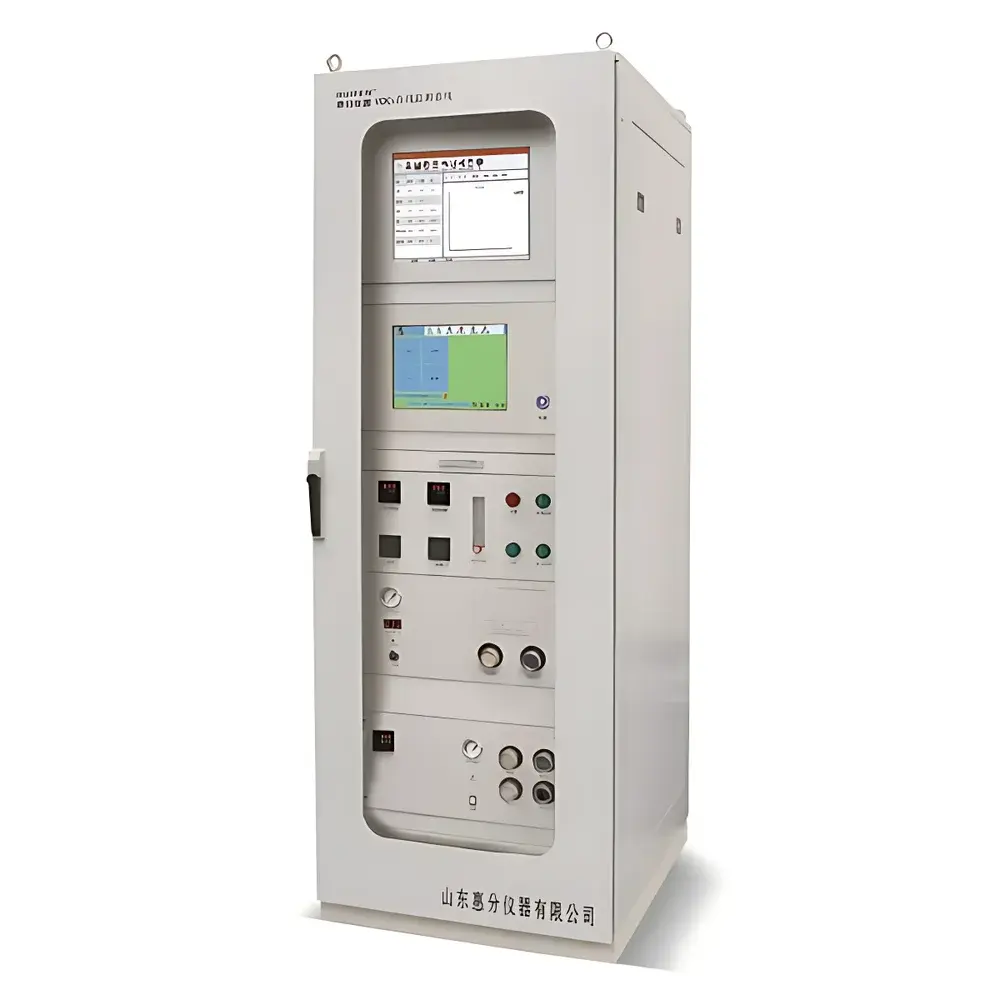
HUIFEN VOCs Online Monitoring System
| Brand | HUIFEN |
|---|---|
| Origin | Shandong, China |
| Manufacturer Type | Authorized Distributor |
| Country of Origin | China |
| Model | VOCs Online Monitoring System |
| Pricing | Available Upon Request |
Overview
The HUIFEN VOCs Online Monitoring System is a continuous emission monitoring system (CEMS) engineered for real-time, in-situ quantification of volatile organic compounds (VOCs) in industrial flue gas streams. It operates on the principle of gas chromatography with flame ionization detection (GC-FID), supplemented by optional photoionization detection (PID) or Fourier-transform infrared (FTIR) modules for compound-specific identification. Designed to meet regulatory requirements for stack emission compliance, the system delivers high-temperature, heated-sample-path measurement of total hydrocarbons (THC), methane (CH₄), non-methane hydrocarbons (NMHC), and aromatic compounds including benzene, toluene, ethylbenzene, and xylene isomers (BTEX). The entire sampling train — from probe tip to detector inlet — is maintained above 120 °C to prevent condensation, adsorption, or fractional loss of semi-volatile and polar VOCs, ensuring representative and bias-free measurement across diverse industrial source profiles.
Key Features
- Heated sampling path (≥120 °C) with integrated ceramic filter and particle removal stage to eliminate moisture interference and particulate carryover
- Modular architecture: independent subsystems for sampling (stainless-steel probe + heated line), conditioning (condensate trap, pressure regulation, flow control), and analysis (GC-FID core module)
- Real-time data acquisition at 1–5 minute intervals, compliant with EPA Method 25A, EN 12619, and HJ 1013–2018 for stationary source VOC monitoring
- Embedded industrial-grade PLC with dual Ethernet ports supporting Modbus TCP, OPC UA, and MQTT protocols for seamless integration into plant DCS/SCADA and environmental data management platforms
- Automatic zero/span calibration capability using certified standard gases (CH₄ in N₂, propane in air), programmable on scheduled or event-triggered basis
- Robust enclosure rated IP54 with internal temperature/humidity monitoring and fault logging for GLP-compliant operation
Sample Compatibility & Compliance
The system is validated for use with flue gas matrices containing up to 20% O₂, ≤15% CO₂, ≤100 mg/m³ particulate matter (after filtration), and dew points up to 120 °C. It accommodates variable flow rates (5–20 L/min) and pressure ranges (−5 to +5 kPa gauge). All wetted components are constructed from passivated 316L stainless steel or PFA-lined tubing to resist corrosion from acidic or halogenated VOCs. The system conforms to ISO 9001:2015 manufacturing standards and supports audit-ready documentation for environmental regulatory submissions under China’s MEP Order No. 39, EU IED Directive (2010/75/EU), and U.S. EPA 40 CFR Part 60 Subpart JJJJ. Optional 21 CFR Part 11-compliant software mode enables electronic signature, audit trail, and user role-based access control for pharmaceutical and fine chemical facilities operating under GMP/GLP frameworks.
Software & Data Management
The embedded HUIFEN CEMS Control Suite provides local HMI via a 10.1″ capacitive touchscreen with intuitive navigation, alarm configuration, and diagnostic dashboards. Raw chromatograms, peak integration reports, and calibration logs are stored locally (≥12 months) and synchronized to remote servers via TLS-encrypted HTTPS or SFTP. The platform exports standardized CSV and XML files compatible with national environmental monitoring networks (e.g., China’s National Emission Trading System, NETS). Remote maintenance is supported through secure SSH tunneling; firmware updates are delivered as signed binary packages with SHA-256 verification. Data integrity is preserved via write-once storage policies and cyclic redundancy checks on all transmitted packets.
Applications
This system is deployed across emission-intensive sectors requiring continuous VOC accountability: semiconductor fabrication cleanroom exhaust stacks; pharmaceutical tablet coating and solvent recovery units; petrochemical fluidized catalytic cracking (FCC) off-gas streams; automotive paint booth afterburner effluent; and flexographic printing press dryers. It supports process optimization studies (e.g., solvent recovery efficiency tracking), fugitive emission verification per LDAR programs, and ambient air quality modeling input generation. Field deployments have demonstrated long-term stability (>180 days between maintenance cycles) in high-humidity, high-dust environments typical of rubber vulcanization and composite curing operations.
FAQ
What VOC species can be quantified with this system?
The base GC-FID configuration reports THC, CH₄, and NMHC as mass-based concentrations (mg/m³ @ 11% O₂, dry basis). Optional BTEX-specific columns and calibration standards enable individual quantification of benzene, toluene, ethylbenzene, and xylenes.
Is the system certified for regulatory reporting in China?
Yes — it meets technical specifications outlined in HJ 1013–2018 and has undergone third-party verification by provincial environmental monitoring centers for CEMS certification.
Can the system interface with existing DCS or EMS platforms?
Yes — native Modbus TCP and OPC UA server functionality allows direct read/write access to measurement values, status flags, and alarm states without middleware.
What maintenance intervals are recommended?
Preventive maintenance is advised every 90 days, including filter replacement, FID jet cleaning, and carrier gas pressure verification; full calibration verification is required every 180 days per HJ 75–2017.
Does the system support remote diagnostics and troubleshooting?
Yes — built-in VNC server and diagnostic log streaming enable real-time technician access to instrument status, chromatogram history, and error codes over secure corporate networks.







