
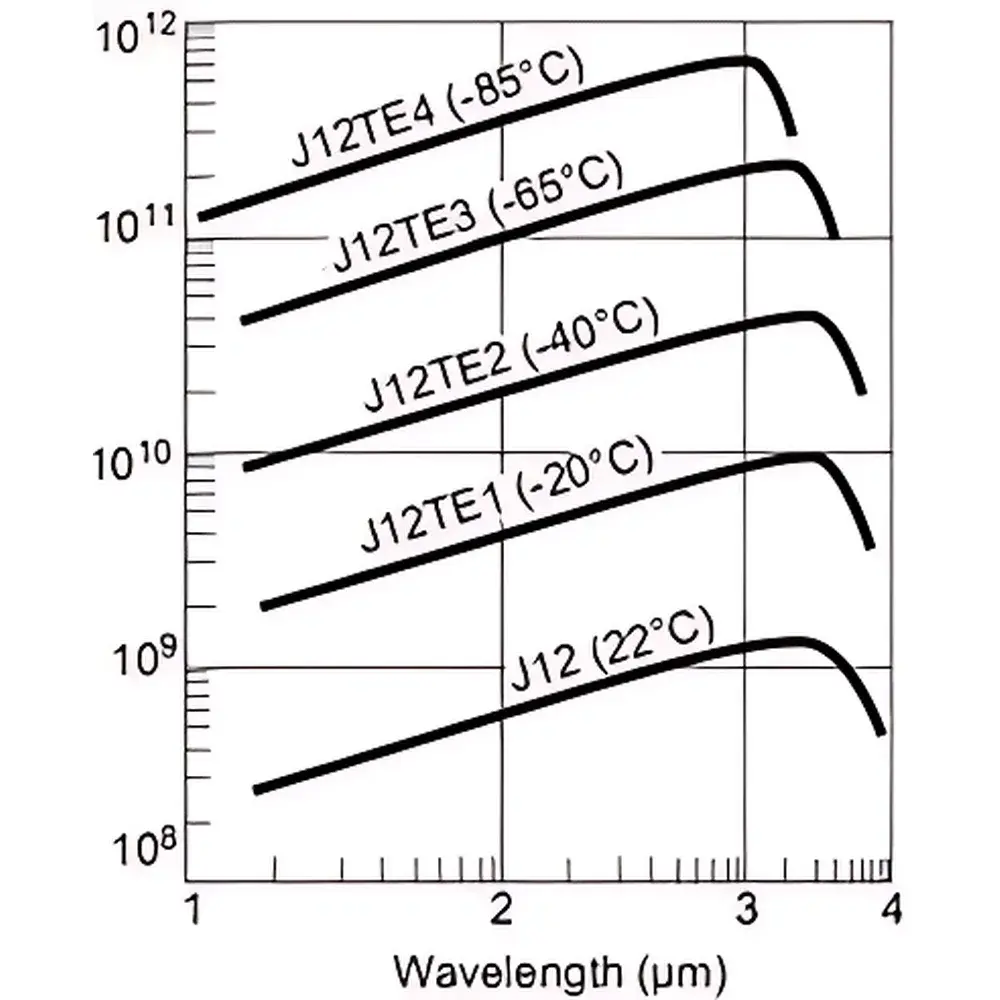
Teledyne Judson InAs Photovoltaic Detector
| Brand | Teledyne Judson |
|---|---|
| Model | InAs |
| Wavelength Range | 1.0–3.8 µm |
| Detector Type | Photovoltaic (Zero-Bias Operation) |
| Cooling | Multi-stage Thermoelectric (TE) Cooling |
| Pulse Response | <10 ns (typ.) |
| Operating Mode | DC to Low-Frequency & Pulsed Laser Monitoring |
| Compliance | RoHS-compliant packaging, compatible with ISO/IEC 17025-aligned calibration workflows |
Overview
The Teledyne Judson InAs Photovoltaic Detector is a high-performance infrared photodetector engineered for precision measurement in the short-wave infrared (SWIR) spectral region. Based on indium arsenide (InAs) semiconductor material, this detector operates on photovoltaic principle—generating a voltage signal upon photon absorption without requiring external bias voltage. This zero-bias architecture eliminates dark current drift and associated noise sources common in photoconductive detectors, delivering superior stability for DC-coupled and low-frequency applications. Its spectral responsivity spans 1.0 to 3.8 µm, making it ideally suited for applications involving near- to mid-infrared laser sources—including Nd:YAG harmonics (1.064 µm, 0.532 µm with upconversion), optical parametric oscillators (OPOs), quantum cascade laser (QCL) monitoring, and thermal emission analysis. The integrated multi-stage thermoelectric cooler ensures stable junction temperature control—critical for maintaining consistent responsivity, noise-equivalent power (NEP), and long-term measurement repeatability across laboratory and industrial environments.
Key Features
- Photovoltaic operation: No external bias required—enables ultra-low noise performance and inherent DC stability
- Extended SWIR response: Uniform responsivity from 1.0 µm to 3.8 µm, optimized for pulsed and CW laser detection
- Fast temporal response: Rise/fall times <10 ns (typ.), supporting accurate capture of nanosecond-scale laser pulses
- Multi-stage TE cooling: Maintains detector junction at –30 °C to –60 °C (adjustable), reducing thermal noise and enhancing detectivity (D*)
- Hermetically sealed TO-8 or TO-66 package: Ensures long-term reliability under varying ambient humidity and temperature conditions
- Low capacitance design: Facilitates high-speed signal coupling into 50-Ω instrumentation without impedance mismatch
Sample Compatibility & Compliance
The InAs detector is compatible with standard optical mounts (e.g., SM1-threaded housings) and integrates seamlessly into FTIR spectrometers, laser power meters, beam profiling systems, and OEM process monitoring platforms. It supports both free-space and fiber-coupled configurations (with optional FC/PC or SMA input adapters). All units are manufactured under controlled cleanroom conditions and undergo individual spectral responsivity calibration traceable to NIST-traceable reference standards. Packaging complies with RoHS Directive 2011/65/EU. While the detector itself is not a standalone measuring instrument, its use within calibrated systems supports compliance with ISO/IEC 17025 requirements when paired with documented uncertainty budgets and periodic verification protocols. For regulated environments (e.g., pharmaceutical laser-based sterilization validation), the detector’s stability and repeatability support adherence to FDA 21 CFR Part 11 data integrity expectations when used with compliant acquisition software.
Software & Data Management
The detector outputs analog voltage signals proportional to incident irradiance, interfacing directly with lock-in amplifiers, oscilloscopes, or data acquisition systems (e.g., National Instruments PXI, Keysight DAQ). Teledyne Judson provides detailed calibration reports including wavelength-dependent responsivity (A/W), NEP (W/√Hz), and linearity deviation (<±0.5% over 4-decade dynamic range). Users may import these coefficients into custom LabVIEW, Python (NumPy/SciPy), or MATLAB scripts for real-time radiometric correction. When deployed in GxP-regulated settings, integration with validated acquisition software enables audit-trail generation, electronic signature support, and raw-data archiving per ALCOA+ principles.
Applications
- Laser warning and countermeasure systems requiring rapid SWIR threat identification
- Real-time pulse energy monitoring in industrial laser machining and medical laser delivery systems
- In-line process control for semiconductor wafer inspection and thin-film thickness measurement
- FTIR spectrometer detection in research-grade gas-phase molecular spectroscopy (e.g., CO, NO, CH₄)
- Non-contact temperature sensing in furnace monitoring and combustion diagnostics (via 2–3 µm thermal radiation bands)
- Calibration transfer standards for SWIR radiometers and laser power meters accredited to ISO 17025
FAQ
Does this detector require an external bias supply?
No. As a photovoltaic device, it generates its own open-circuit voltage and operates optimally at zero bias.
What is the typical noise-equivalent power (NEP) at 2.0 µm?
Typical NEP is 1.2 × 10⁻¹⁰ W/√Hz at 2.0 µm and –50 °C junction temperature, measured with 10 Hz bandwidth.
Can it be used with fiber-optic inputs?
Yes—optional fiber-pigtailed versions are available with SMF-28 or fluoride fiber coupling; free-space models accept collimated or focused beams via adjustable kinematic mounts.
Is spectral calibration provided with each unit?
Yes. Each detector ships with a NIST-traceable spectral responsivity curve (1.0–3.8 µm, 10 nm resolution) and temperature-stabilized calibration certificate.
How does TE cooling affect long-term measurement stability?
Stabilizing the InAs junction temperature suppresses responsivity drift to 8-hour continuous measurement stability in environmental test chambers.




