
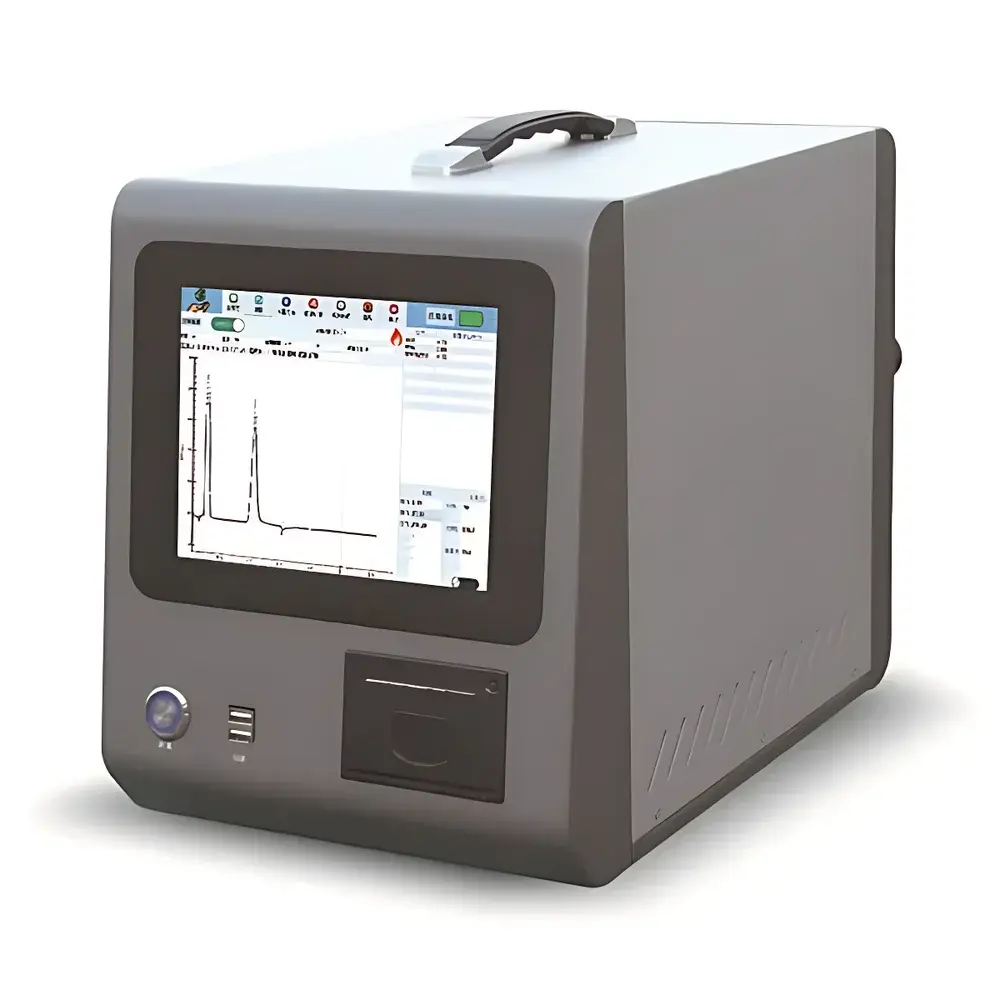
HUIFEN NMHF-60 Portable Gas Chromatograph for Methane / Non-Methane Hydrocarbons (NMHC) Analysis
| Brand | HUIFEN Instrument |
|---|---|
| Origin | Shandong, China |
| Model | NMHF-60 |
| Detection Limit | ≤0.1 ppm (Methane), 0.05 ppm (NMHC) |
| Repeatability | RSD ≤3% (Total Hydrocarbons) |
| Weight | 11 kg |
| Power Supply | <500 W, 24 V DC |
| Operating Temperature | 0–50 °C |
| Relative Humidity | 10–90% RH |
| Analysis Time | <60 s (NMHC) |
| Detector | Flame Ionization Detector (FID) |
| Linear Range | 10⁷ |
| EPC Control Precision | ±0.01 psi |
| Column Heating | Full-path heated zone (up to 200 °C) |
| Hydrogen Source | Solid-state metal hydride hydrogen generator |
Overview
The HUIFEN NMHF-60 is a field-deployable gas chromatograph engineered for real-time, on-site quantification of methane (CH₄), total hydrocarbons (THC), and non-methane hydrocarbons (NMHC) in ambient air, stack emissions, and emergency response scenarios. It operates on the principle of gas-phase separation via capillary or packed column chromatography, followed by selective detection using a high-sensitivity flame ionization detector (FID). Unlike laboratory-based GC systems, the NMHF-60 integrates all critical subsystems—including carrier gas generation, column oven, detector, electronic pressure control (EPC), and data acquisition—into a single ruggedized chassis. Its full-path heated pneumatic architecture (up to 200 °C) eliminates condensation and adsorption losses during sample transport, ensuring quantitative integrity for volatile organic compounds (VOCs) and light alkanes. Designed for compliance with regulatory monitoring workflows, it delivers sub-part-per-million detection capability without external gas cylinders, relying instead on an integrated solid-state metal hydride hydrogen generator.
Key Features
- Integrated FID detector with 10⁷ linear dynamic range and optimized flame stability for low-noise, high-reproducibility hydrocarbon response.
- Full-stream electronic pressure control (EPC) system achieving ±0.01 psi precision across carrier, makeup, and hydrogen flows—critical for retention time stability and method transferability.
- Heated sampling train: stainless-steel probe, thermostatically controlled heated tubing (120–200 °C), particulate filter, and zero-air purge manifold—all housed within a single portable unit.
- Onboard 24 V lithium-ion battery pack supporting >4 hours of continuous operation at full analytical load; compatible with vehicle DC input and AC/DC adapters.
- Ruggedized IP65-rated enclosure with shock-absorbing mounting, anti-vibration damping, and corrosion-resistant 316 stainless-steel fluidic components.
- Automatic ignition sequence with real-time hydrogen leak monitoring, flame-out detection, and hardware-level interlock shutdown per IEC 61000-6-4 EMC and UL 61010-1 safety requirements.
- Brushless diaphragm vacuum pump delivering stable flow rates (<1.5 L/min at 50 kPa ΔP) with acoustic noise <45 dB(A) and power consumption <12 W.
Sample Compatibility & Compliance
The NMHF-60 is validated for direct analysis of gaseous samples containing C₁–C₁₀ hydrocarbons, including methane, ethane, propane, butanes, benzene, toluene, ethylbenzene, and xylenes (BTEX). It meets the performance specifications outlined in HJ 1012–2018 (China’s technical standard for portable NMHC analyzers), GB/T 16157–1996 (stack sampling methodology), and DB11/T 1367 (Beijing municipal standard for fixed-source NMHC measurement). While not certified for EPA Method 25A or EN 12619, its FID response characteristics, calibration traceability to NIST-traceable hydrocarbon standards, and documented RSD ≤3% (THC) support use in GLP-aligned environmental monitoring programs. All wetted materials—Swagelok®-spec stainless-steel fittings, SilcoNert®-treated tubing, and fused-silica columns—are selected to minimize catalytic decomposition and surface adsorption.
Software & Data Management
The embedded Linux-based acquisition platform runs proprietary chromatographic software optimized for field deployment. It supports continuous sampling mode with programmable cycle times (10–60 s), automatic peak integration using valley-to-valley baseline algorithms, and dual-channel quantitation (CH₄ + THC → NMHC = THC − CH₄). Data are timestamped, stored locally on industrial-grade eMMC (32 GB), and exportable via USB or Wi-Fi 802.11n to networked servers. The interface complies with FDA 21 CFR Part 11 requirements for audit trail logging, user role-based access control (admin/operator), and electronic signature capture. Raw chromatograms, calibration reports, and QC check logs are archived in open CSV and CDF formats for third-party validation and LIMS integration.
Applications
- Regulatory stack testing at industrial facilities (e.g., refineries, chemical plants, landfills) under national emission standards.
- Mobile ambient air quality surveys in urban corridors, near traffic intersections, or downwind of VOC-emitting sources.
- Rapid leak detection and quantification during LDAR (Leak Detection and Repair) programs per ISO 16000-22.
- Emergency response screening following chemical spills, pipeline ruptures, or fugitive emission incidents.
- Research-grade field studies requiring speciated hydrocarbon profiles alongside meteorological co-variables (temperature, humidity, wind speed).
FAQ
Does the NMHF-60 require external hydrogen or compressed air cylinders?
No. It uses an integrated solid-state metal hydride hydrogen generator and ambient air as oxidant—eliminating cylinder logistics and enabling true portability.
Can the instrument be calibrated using certified gas standards?
Yes. It accepts standard gas mixtures (e.g., 1 ppm methane in air, 0.5 ppm NMHC in nitrogen) via built-in calibration port; calibration curves are stored with uncertainty propagation metadata.
Is remote data transmission supported?
Yes. Via embedded Wi-Fi, Ethernet, RS232/RS485, and optional 4G LTE module—enabling secure TLS-encrypted uploads to cloud platforms or local SCADA systems.
What maintenance intervals are recommended?
FID nozzle cleaning every 200 hours; column bake-out monthly; hydrogen generator refilling every 6 months (based on usage); full system verification annually per HJ 1012–2018 Annex D.
Is the software compliant with data integrity regulations?
Yes. Audit trails record all method edits, calibration events, and user logins with immutable timestamps; electronic signatures meet ALCOA+ principles for GxP environments.






