
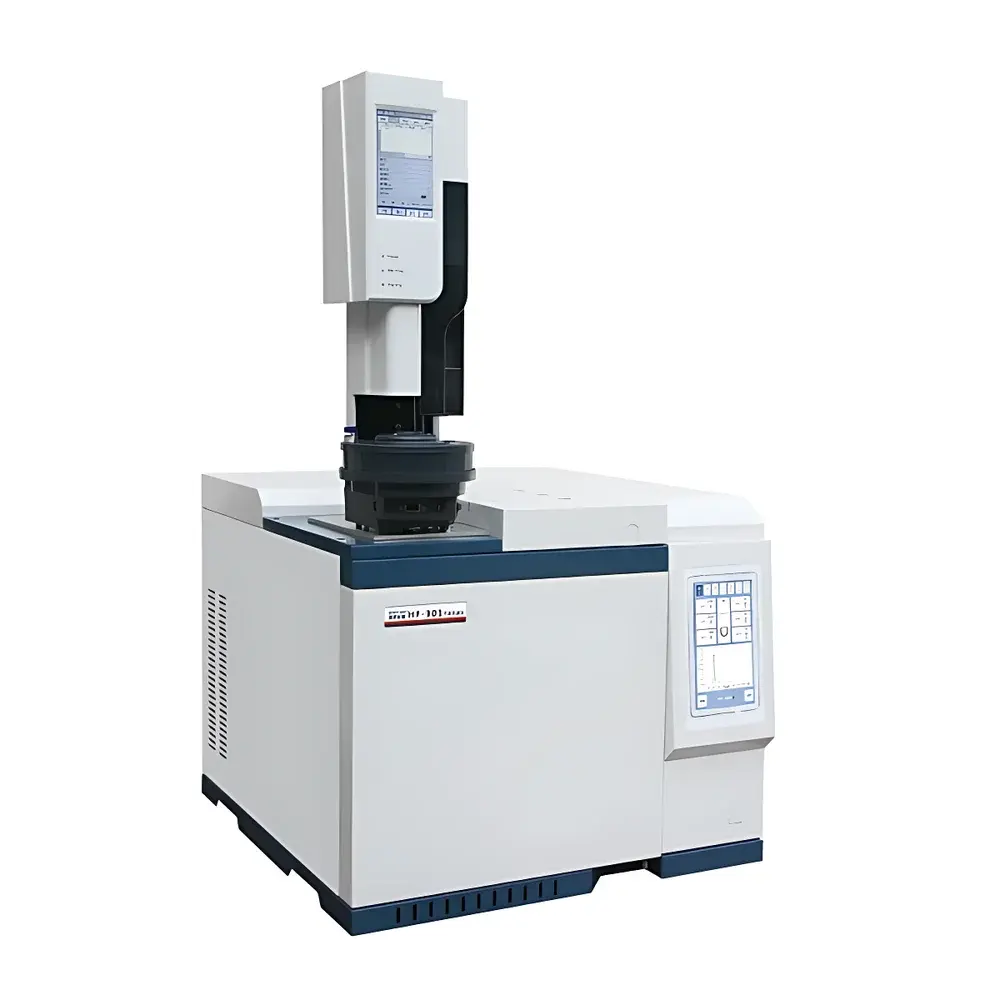
Huifen HF-901D Power Transformer Oil Gas Chromatograph
| Brand | Huifen Instrument |
|---|---|
| Origin | Shandong, China |
| Manufacturer Type | Authorized Distributor |
| Product Category | Domestic |
| Model | HF-901D Power Transformer Oil Gas Chromatograph |
| Instrument Type | Laboratory Gas Chromatograph |
| Application Field | Petroleum & Petrochemical Industry (Specialized for Electrical Insulating Oil) |
| Temperature Control Range | Ambient + 3 °C to 450 °C |
| Oven Ramp Rate | 0.1–80 °C/min |
| Cooling Rate | 450 °C → 50 °C in ~8 min |
| Carrier Gas Flow Range & Control | 0–1200 mL/min |
| Carrier Gas Pressure Range & Control | 0–970 kPa |
| Injector Maximum Operating Temperature | 450 °C |
| Injector Pressure Setpoint Range | 0–970 kPa |
| Injector Total Flow Setpoint Range | 0–1200 mL/min |
| Detection Sensitivity (Minimum Detectable Concentration in Oil) | ≤0.1 μL/L for H₂, CH₄, C₂H₄, C₂H₆, C₂H₂, CO, CO₂ |
| Analysis Cycle Time | ≤7 min per sample |
| Temperature Stability | ±0.1 °C |
| Power Consumption | 1.9 kW |
| Dimensions (W×D×H) | 660 × 560 × 480 mm |
Overview
The Huifen HF-901D Power Transformer Oil Gas Chromatograph is a dedicated laboratory-scale gas chromatograph engineered for the precise quantification of dissolved gases in electrical insulating oils—primarily mineral-based transformer oils used in high-voltage power equipment. It operates on the principle of capillary or packed-column gas chromatography with multi-detector configuration, enabling simultaneous separation and detection of seven key fault-gas species: hydrogen (H₂), methane (CH₄), ethylene (C₂H₄), ethane (C₂H₆), acetylene (C₂H₂), carbon monoxide (CO), and carbon dioxide (CO₂). The system implements the three-detector configuration recommended by national standards—including a high-sensitivity thermal conductivity detector (TCD), a low-noise flame ionization detector (FID), and a nickel-catalyzed methanizer—ensuring complete speciation and compliance with diagnostic gas analysis protocols required for predictive maintenance of power transformers.
Key Features
- Triple-detector architecture (TCD + FID + Ni-methanizer) optimized for full-profile dissolved gas analysis (DGA) in accordance with DL/T 703–2015 and GB/T 7252–2001.
- Electronic pressure control (EPC) and electronic flow control (EFC) systems delivering carrier gas pressure regulation accuracy of ±0.01 psi and flow stability within ±0.1% RSD over extended operation.
- Compact, low-dead-volume injection system supporting 1 mL liquid-phase oil sampling via headspace extraction or direct injection, minimizing carryover and improving reproducibility.
- Robust oven design with rapid heating (up to 80 °C/min) and accelerated cooling (450 °C → 50 °C in approximately 8 minutes), enabling high-throughput routine DGA workflows.
- Transformer oil–specific anti-fouling composite chromatographic column with enhanced resistance to heavy hydrocarbon residue accumulation, extending column lifetime beyond 2,000 injections under standard operating conditions.
- Integrated self-diagnostic firmware with real-time error logging, automatic ignition sequence for FID, pneumatic fault protection, and non-volatile memory retention during power interruption.
- Ethernet-based communication interface compliant with TCP/IP protocols, supporting remote instrument monitoring, method transfer, and centralized data aggregation in SCADA-integrated utility laboratories.
Sample Compatibility & Compliance
The HF-901D is validated for use with ASTM D3612 Class B (headspace extraction) and Class C (direct injection) procedures, as well as IEC 60567 Annex A methodologies. Its analytical performance meets the repeatability (RSD ≤3%) and sensitivity requirements stipulated in GB/T 7252–2001 for all seven target gases at concentrations ≥0.1 μL/L in oil matrix. The instrument’s hardware architecture and software logic are structured to support audit-ready operation under GLP-compliant environments; raw data files include embedded timestamps, operator ID fields, and immutable acquisition metadata required for regulatory traceability. While not pre-certified for FDA 21 CFR Part 11, the system supports third-party validation packages for GxP-aligned deployment in quality control laboratories serving OEM transformer manufacturers.
Software & Data Management
Control and data processing are executed via Huifen ChromaSuite™ v4.x—a Windows-based chromatography data system (CDS) offering method editor, sequence scheduler, peak integration engine, and customizable reporting templates. The software supports automated calibration curve generation using external standard addition or internal standard methods, with built-in calculation modules for key DGA interpretation indices (e.g., Duval Triangle, Rogers Ratio, IEC 60599 coding). All chromatograms, integration results, and audit logs are stored in vendor-neutral .CDF format (compatible with OpenChrom and Chromeleon readers), ensuring long-term archival integrity. Networked installations allow concurrent access from up to 16 client workstations, with role-based user permissions configurable to meet ISO/IEC 17025 documentation requirements.
Applications
- Preventive maintenance screening of in-service power transformers, reactors, and bushings in transmission and distribution networks.
- Factory acceptance testing (FAT) and type testing of new oil-filled equipment prior to commissioning.
- Root-cause analysis of thermal faults (e.g., overheating windings), partial discharge activity, and arcing events through trended gas ratio analysis.
- Insulating oil aging assessment via CO/CO₂ ratio monitoring and correlation with furanic compound profiles (when coupled with optional LC module).
- Supporting condition-based maintenance (CBM) programs mandated by grid operators under IEEE C57.104–2019 and CIGRE TB 398 guidelines.
FAQ
What standards does the HF-901D comply with for transformer oil DGA?
It fully conforms to DL/T 703–2015, GB/T 7252–2001, ASTM D3612, and IEC 60567 for instrumentation, method execution, and reporting requirements.
Can the system be integrated into an existing LIMS or SCADA infrastructure?
Yes—the Ethernet interface supports Modbus TCP and OPC UA protocols for bidirectional data exchange with enterprise-level laboratory information management systems and utility automation platforms.
Is method validation support available for ISO/IEC 17025 accreditation?
Huifen provides IQ/OQ documentation templates, reference standard certificates, and on-site qualification assistance for laboratories pursuing formal accreditation.
What maintenance intervals are recommended for the nickel methanizer and FID?
The Ni-converter requires regeneration every 6–12 months depending on sample load; FID jet cleaning and detector alignment are advised quarterly, with full detector bake-out performed semiannually.
Does the instrument support unattended overnight operation?
Yes—equipped with auto-shutdown sequencing, temperature ramp hold functions, and event-triggered email alerts for abnormal conditions such as pressure loss or flame extinction.
Related Products





