
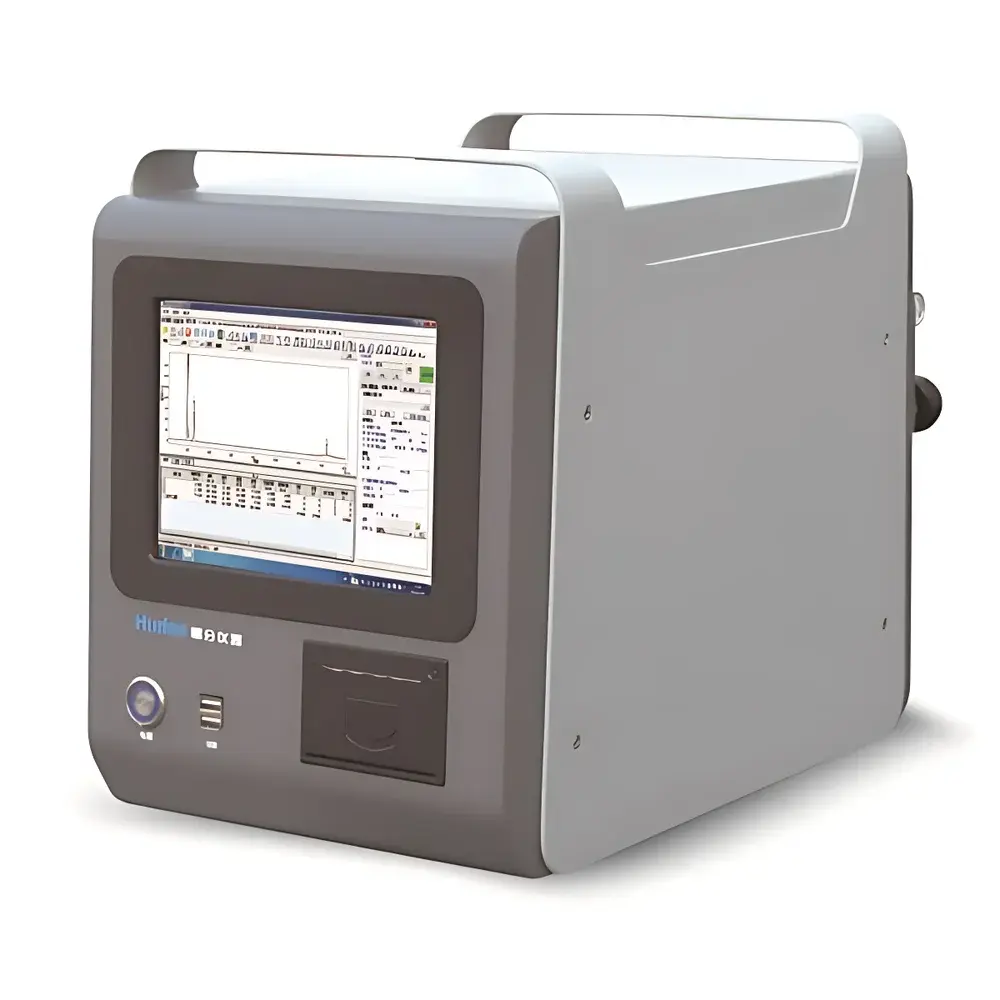
Huifen GCS-80 Portable Trace Sulfur Analyzer
| Brand | Huifen Instrument |
|---|---|
| Origin | Shandong, China |
| Manufacturer Type | Authorized Distributor |
| Country of Origin | China |
| Model | GCS-80 Portable Trace Sulfur Analyzer |
| Power Supply | DC 24 V (Internal Rechargeable Lithium Battery) |
| Operating Temperature | 5–45 °C |
| Operating Humidity | 5–95 % RH |
| Power Consumption | 500 W |
| Detector | Flame Photometric Detector (FPD) |
| Detection Range (FPD) | 100 ppb – 0.1 % (v/v) |
| Accuracy | ±5 % for major components |
| Dimensions (L×W×H) | 390 × 230 × 310 mm |
| Net Weight | ≤12 kg |
| Hydrogen Source | Solid-State Metal Hydride Cartridge |
| Runtime | Up to 12 h continuous operation |
| Gas Flow Control | Electronic Pressure Control (EPC) |
| Data Output | Integrated Thermal Micro-Printer |
| Nitrogen Cylinder Interface | Quick-Connect Fitting with Pressure Regulation |
Overview
The Huifen GCS-80 Portable Trace Sulfur Analyzer is a field-deployable gas chromatographic system engineered for quantitative determination of sulfur-containing compounds—including H2S, COS, mercaptans, sulfides, and SO2—in natural gas, refinery off-gas, biogas, and liquefied petroleum gas (LPG). It integrates a compact capillary GC column oven, solid-state hydrogen generator, flame photometric detector (FPD), and embedded electronic pressure control (EPC) into a single ruggedized chassis. Unlike conventional benchtop sulfur analyzers requiring external gas supplies and extended warm-up periods, the GCS-80 achieves operational readiness within minutes via pre-heating capability enabled by its high-capacity lithium battery. Its measurement principle relies on selective excitation of sulfur radicals in a hydrogen-rich flame, followed by optical detection at 394 nm—ensuring high specificity and minimal interference from hydrocarbons or nitrogen oxides.
Key Features
- Integrated Solid-State Hydrogen Generation: Eliminates reliance on compressed H2 cylinders; metal hydride cartridges deliver stable, ultra-pure hydrogen at regulated flow rates (<100 mL/min), certified to ISO 8573-1 Class 1 for particulate and moisture content.
- Electronic Pressure Control (EPC) System: Maintains column head pressure stability within ±0.01 psi across ambient temperature fluctuations, ensuring retention time reproducibility <0.05 min (RSD <0.3 % over 24 h).
- Field-Optimized Thermal Management: Dual-zone oven design with independent PID control enables simultaneous stabilization of injection port (up to 250 °C) and column (40–220 °C), minimizing thermal lag during rapid environmental transitions.
- Onboard Data Handling: Built-in thermal micro-printer supports immediate hardcopy output of chromatograms, peak tables, calibration reports, and QA/QC flags—fully compliant with GLP documentation requirements.
- Robust Mechanical Architecture: Aluminum alloy chassis with IP54-rated enclosure; shock-absorbing feet and reinforced internal mounting mitigate vibration-induced baseline drift during vehicle-mounted deployment.
Sample Compatibility & Compliance
The GCS-80 accepts gaseous samples via direct injection using a heated 6-port rotary valve (standard) or optional heated sampling loop (0.25–1.0 mL). Compatible matrices include pipeline-quality natural gas (per ASTM D1945 and ISO 6974-5), sour gas streams (ASTM D6667), and syngas (ISO 15403-2). All hardware and firmware conform to IEC 61000-6-2 (immunity) and IEC 61000-6-3 (emissions) standards. The FPD response is linear across three orders of magnitude (100 ppb–10 ppm), validated per USP chromatographic system suitability criteria. Data integrity safeguards align with FDA 21 CFR Part 11 requirements, including user-level access control, electronic signature support, and immutable audit trails for method changes and result modifications.
Software & Data Management
Control and data acquisition are managed through the Huifen ChromaView™ Lite software suite (Windows 10/11 compatible), supporting real-time chromatogram visualization, automated peak integration (with customizable baseline algorithms), multi-point calibration curve generation (linear, quadratic, or weighted least-squares), and export to CSV, PDF, or XML formats. Raw data files (.hfd) retain full detector signal metadata—including timestamp, detector gain, EPC setpoints, and ambient sensor readings—for retrospective analysis. Software validation packages (IQ/OQ documentation) and 21 CFR Part 11 configuration templates are available upon request for regulated laboratory environments.
Applications
- Real-time monitoring of sulfur breakthrough in amine scrubbers and molecular sieve beds
- Quality assurance of LNG cargo prior to loading (per ISO 8573-5 and GPA 2172)
- Compliance testing for EPA Method 1664B and EN 15470 (sulfur in automotive fuels)
- Leak detection and source attribution in gas transmission networks
- Process optimization in Claus unit tail gas treatment and sulfur recovery units
FAQ
Does the GCS-80 require external calibration gases for routine operation?
Yes—certified sulfur standard mixtures (e.g., H2S/N2, SO2/N2) traceable to NIST SRMs are required for initial calibration and daily verification. A two-point calibration is sufficient for most field applications.
Can the instrument be operated inside an explosion-proof enclosure?
The GCS-80 is not intrinsically safe (IS) rated; however, it may be installed in Zone 2 classified areas when housed in a pressurized purge cabinet meeting IEC 60079-2 requirements.
What maintenance intervals are recommended for the FPD and column?
FPD jet cleaning every 200 injections; ceramic igniter replacement every 12 months; capillary column reconditioning every 6 months or after exposure to >10 ppm total sulfur load.
Is remote diagnostics supported?
Yes—via optional Ethernet/Wi-Fi module enabling secure SSH-based firmware updates, log file retrieval, and live status monitoring through a web dashboard.
How is hydrogen safety ensured during transport?
Solid-state hydride cartridges contain no free H2 gas under ambient conditions; they comply with UN 3479 (Class 4.3 dangerous goods) for air freight when shipped with appropriate packaging and documentation.




