
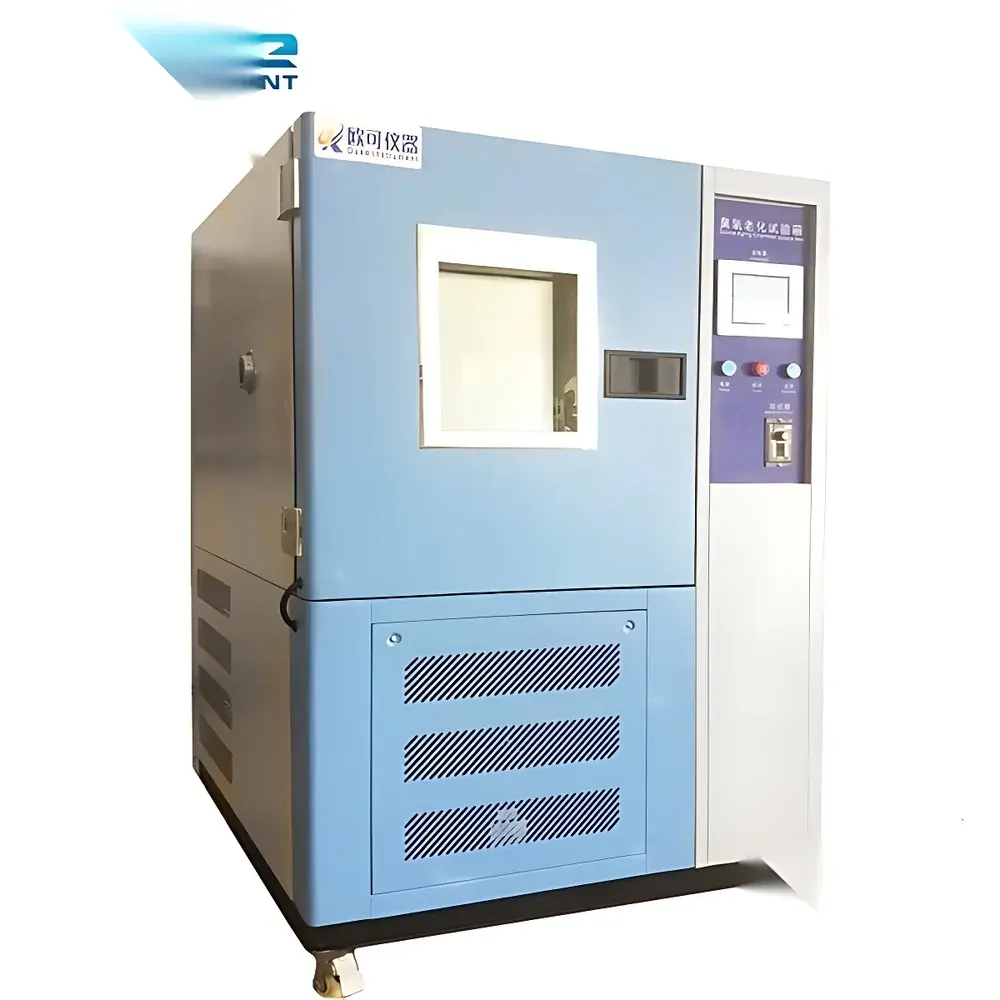
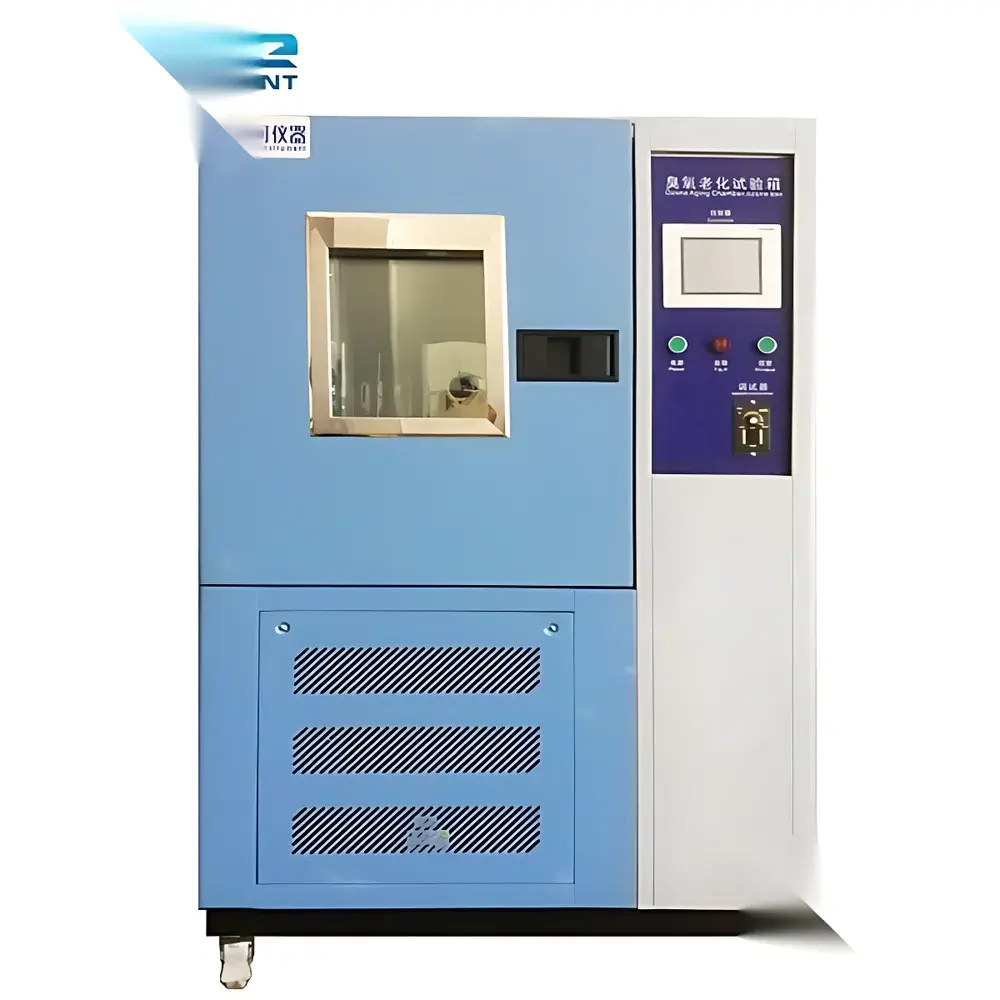
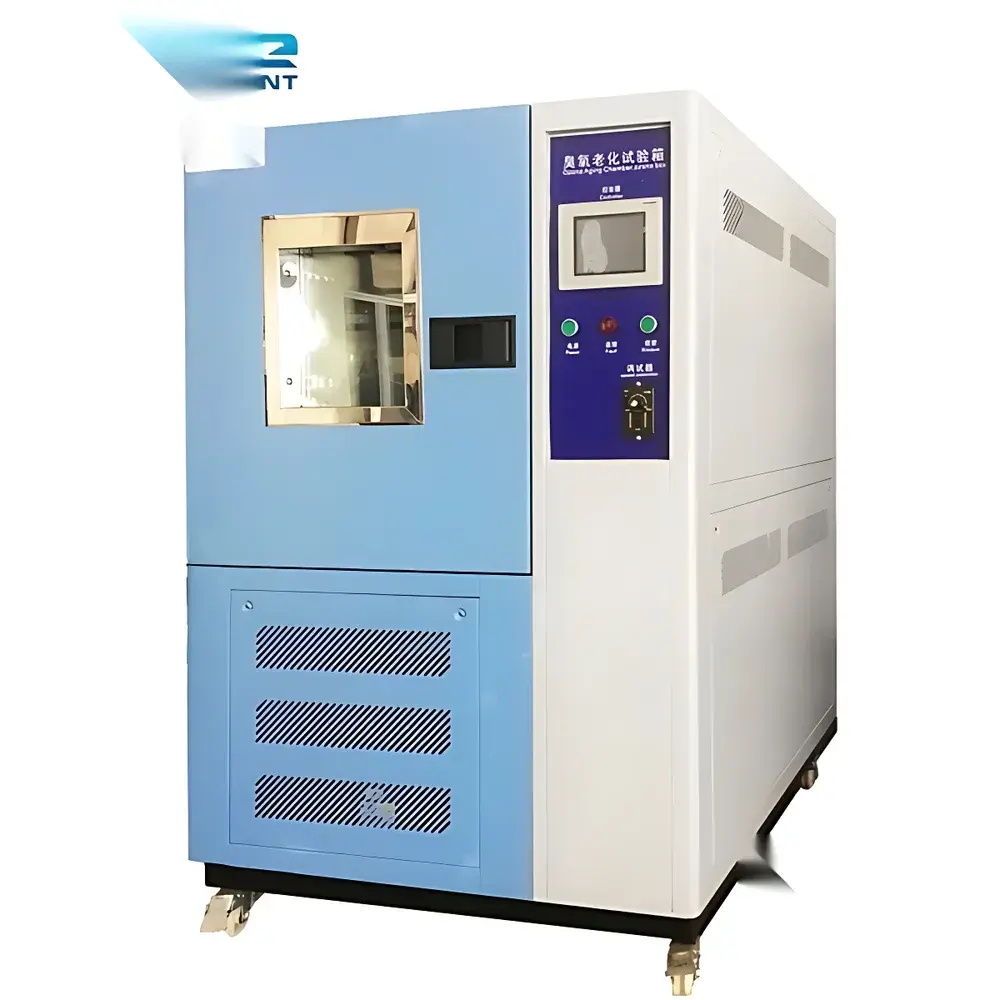
Ozone Aging Test Chamber – QY Series (Customizable Volume) for Rubber Product Durability Evaluation
| Key | Brand: OEM |
|---|---|
| Origin | Imported |
| Manufacturer Type | Authorized Distributor |
| Price | USD 6,300 (FOB ex-works |
| Chamber Volume Options | 80 L / 225 L / 500 L / 1000 L |
| Temperature Range | 25–40 °C ±0.5 °C |
| Humidity Range | 30–65 % RH |
| Ozone Concentration Range | 50–1500 pphm (parts per hundred million) |
| Ozone Generation Method | Silent Discharge Tube |
| Ozone Monitoring | Non-Dispersive UV Absorption Analyzer (≥5 yr service life) |
| Control System | Weilun Color Touchscreen + Siemens PLC |
| Sample Motion | Static or Dynamic (360° rotation at 1 rpm, cycloidal trajectory compliant) |
| Gas Flow Velocity | 8–16 mm/s |
| Compliance Standards | GB/T 7762–2003, GB/T 2951.21–2008, GB/T 11206–2009, ISO 1431-1:2004 |
| Safety Features | Leak-proof closed-loop ozone circulation, over-temperature, over-current, motor thermal, and short-circuit protection |
| Interface | RS232 communication port, 4–20 mA analog output, metrology calibration port |
Overview
The QY Series Ozone Aging Test Chamber is an engineered environmental simulation system designed specifically for accelerated evaluation of ozone-induced degradation in elastomeric materials. It operates on the principle of controlled atmospheric exposure—generating precise, stable ozone concentrations within a sealed stainless-steel test chamber while maintaining tightly regulated temperature and relative humidity conditions. Unlike general-purpose climate chambers, this instrument implements a fully recirculating, leak-tight gas loop that isolates ozone generation (via silent discharge tube technology) from operator environment, ensuring both measurement integrity and personnel safety. The system enables reproducible assessment of crack initiation and propagation in vulcanized rubber compounds under standardized oxidative stress, supporting material formulation optimization, antioxidant efficacy screening, and product lifetime prediction in accordance with internationally recognized test protocols.
Key Features
- Stainless-steel test chamber constructed to ASTM D1149 and ISO 1431-1 dimensional and surface finish specifications, minimizing catalytic ozone decomposition.
- Adjustable ozone concentration control from 50 to 1500 pphm with real-time feedback via non-dispersive ultraviolet (NDUV) absorption analyzer—calibration traceable to NIST standards and certified for ≥5 years of continuous operation.
- Dual-mode sample mounting: static fixture for fixed-strain evaluation (per GB/T 7762–2003) or dynamic cycloidal-motion sample rack (1 rpm, full 360° rotation) meeting ISO 1431-1’s requirement for uniform surface exposure during elongation testing.
- Integrated PID-controlled environmental regulation: temperature maintained at ±0.5 °C across 25–40 °C range; humidity stabilized between 30–65 % RH using precision vapor injection and condensation management.
- Human-machine interface featuring Weilun industrial color touchscreen paired with Siemens S7-1200 PLC for deterministic logic execution, alarm logging, and parameter recall—supporting audit-ready operational history.
- Comprehensive safety architecture: redundant thermal cutoffs, motor overheat monitoring, ozone leak detection interlock, and electrical isolation compliant with IEC 61000-6-2 EMC immunity requirements.
Sample Compatibility & Compliance
The QY chamber accommodates standard dumbbell-shaped specimens (ISO 37, ASTM D412), ring tensile samples (ISO 3382), and molded component sections up to 100 cm × 100 cm × 100 cm (QY-1000 model). All configurations adhere to mandatory mechanical and environmental controls outlined in GB/T 7762–2003 (Chinese national standard), ISO 1431-1:2004 (international rubber aging protocol), and GB/T 2951.21–2008 (cable insulation testing). The closed-loop ozone delivery system meets GLP documentation requirements for traceability, including timestamped setpoint logs, sensor drift compensation records, and user-accessible calibration verification ports. Optional third-party certification (e.g., CNAS or UKAS) is available upon request for regulatory submission packages.
Software & Data Management
No proprietary cloud platform is embedded; instead, the system provides native RS232 serial output and 4–20 mA analog signal interfaces compatible with industry-standard SCADA, LIMS, or MES environments (e.g., Siemens Desigo, LabVantage, or DeltaV). All runtime parameters—including ozone concentration, chamber temperature/humidity, elapsed test time, and actuator status—are timestamped and stored locally on SD card (16 GB included) with configurable retention intervals (1–36 months). Data export formats include CSV and XML, enabling direct ingestion into statistical analysis tools such as JMP or Minitab for Weibull failure modeling or Arrhenius-based lifetime extrapolation. Audit trails comply with FDA 21 CFR Part 11 requirements when deployed with validated electronic signature modules.
Applications
- Accelerated aging validation of automotive rubber components (door seals, bushings, hoses) under simulated urban ozone profiles.
- Comparative screening of antiozonant additives (e.g., p-phenylenediamine derivatives) in synthetic rubber formulations (SBR, BR, EPDM).
- Quality control release testing for wire & cable jacketing per IEC 60811-506 and UL 1581 Section 1060.
- Research-grade investigation of ozone diffusion kinetics in filled vs. unfilled elastomers using synchronized gravimetric and visual crack-mapping protocols.
- Supporting ISO/IEC 17025 accredited laboratories in generating test reports admissible for CE marking and REACH Annex XIV dossiers.
FAQ
Does the QY chamber support dynamic testing per ISO 1431-1 Clause 6.2?
Yes—the optional dynamic sample rack rotates at precisely 1 rpm with mechanically constrained cycloidal motion, ensuring consistent strain distribution across all specimen surfaces during ozone exposure.
Can ozone concentration be validated externally using a portable calibrator?
Absolutely—the integrated metrology port allows connection to NIST-traceable ozone transfer standards (e.g., 2B Technologies Model 106-L) without chamber disassembly or process interruption.
Is remote monitoring possible without vendor-specific software?
Yes—RS232 ASCII protocol documentation and Modbus RTU mapping are provided in the technical manual, enabling integration with existing facility-wide monitoring systems.
What maintenance intervals are recommended for the UV ozone sensor?
The NDUV detector requires no consumables; annual zero-point verification using ambient air and span calibration with certified ozone gas (100 pphm ±2 %) is advised per ISO 1431-2:2018 Annex B.
Are custom chamber dimensions available beyond the four standard models?
Yes—structural engineering drawings and thermal/ozone uniformity validation reports are supplied for client-approved bespoke volumes up to 2000 L, subject to ASME BPVC Section VIII design review.



