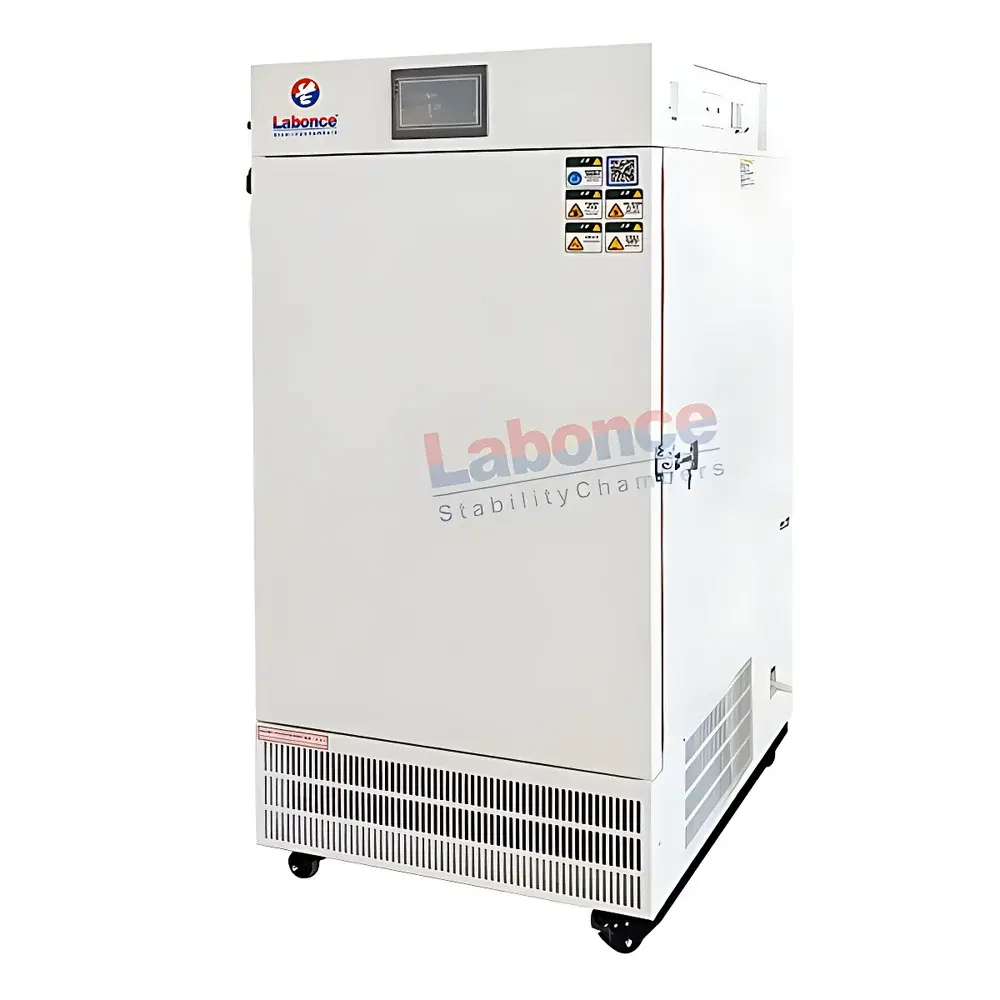
Labonce Labonce-150GS-FC Pharmaceutical Stability Testing Chamber (Single-Door Configuration)
| Brand | Labonce |
|---|---|
| Origin | Beijing, China |
| Manufacturer Type | Direct Manufacturer |
| Model | Labonce-150GS-FC |
| Temperature Range | 10–65 °C |
| Humidity Range | 15–95 %RH |
| Internal Volume | 150 L |
| Internal Dimensions (W×D×H) | 600×405×625 mm |
| External Dimensions (W×D×H) | 780×830×1480 mm |
| Power Consumption | 1.5 kW |
| Temperature Uniformity | ±1.0 °C |
| Temperature Fluctuation | ±0.5 °C |
| Humidity Uniformity | ±3 %RH |
| Humidity Fluctuation | ±2 %RH |
| Ambient Operating Temperature | +5 to +35 °C |
| Power Supply | 220 V, 50/60 Hz |
| Standard Compliance | ICH Q1A(R2), Chinese Pharmacopoeia 2020 Edition |
| Control System | 7-inch programmable color touchscreen with variable-frequency compressor output display |
| User Access | Three-tier role-based authentication (Administrator / Supervisor / Operator) |
| Audit Trail | Time-stamped, tamper-resistant operation and alarm logs exportable via USB in read-only format |
| Humidity Sensor | Imported capacitive type, maintenance-free, low drift, long-term stability |
| Refrigeration | Imported hermetic inverter compressor (≥50% energy & water savings vs. fixed-speed systems) |
| Insulation | High-density polyurethane foam (≥120 mm thickness, closed-cell structure) |
| Interior Material | Mirror-finish AISI 304 stainless steel |
| Exterior Finish | Powder-coated cold-rolled steel |
| Safety Systems | Independent overtemperature cutoff, compressor overheat/overpressure protection, low-water and dry-burn prevention, real-time fault diagnostics |
| Alarm Modes | Local audible alarm + remote SMS notification for temperature/humidity deviation and power failure |
| Door Design | Dual-door — outer solid insulated door + inner tempered glass observation door (minimizes internal environmental disturbance during inspection) |
| Data Output | Integrated dot-matrix printer + embedded non-volatile memory (≥1 year continuous logging at 10-min intervals) |
Overview
The Labonce Labonce-150GS-FC Pharmaceutical Stability Testing Chamber is an engineered environmental simulation system designed explicitly for compliance-driven stability studies under ICH Q1A(R2), Q5C, and Chinese Pharmacopoeia 2020 Edition requirements. It maintains tightly controlled temperature (10–65 °C) and relative humidity (15–95 %RH) conditions across its 150 L working volume, enabling accelerated, intermediate, and long-term stability protocols—including real-time storage (25 °C/60 %RH), accelerated testing (40 °C/75 %RH), and photostability assessments when integrated with optional UV/visible light modules. Its core architecture integrates a hermetic inverter-driven refrigeration circuit, high-efficiency humidification/dehumidification subsystems, and a thermally decoupled dual-door configuration—ensuring minimal thermal mass perturbation during routine sample access. The chamber operates continuously under GMP and cGMP environments, supporting full lifecycle traceability from protocol initiation through final data archival.
Key Features
- Hermetic inverter compressor system delivering ≥50% reduction in electrical consumption and condensate water usage versus conventional fixed-speed units—validated per ISO 50001 energy performance benchmarks.
- Triple-layer thermal insulation: 120 mm thick closed-cell polyurethane foam (thermal conductivity ≤0.022 W/m·K) combined with vacuum-sealed perimeter joints and magnetic gasket seals on both doors.
- 7-inch industrial-grade resistive touchscreen controller with real-time visualization of compressor frequency output (%), PID loop status, and setpoint deviation metrics.
- Three-tier user permission hierarchy (Administrator / Supervisor / Operator) enforced via encrypted local database; password policies support complexity enforcement and expiration rules.
- Audit trail compliant with FDA 21 CFR Part 11 Annex 11 and EU GMP Annex 11: all critical actions—including parameter changes, user logins, alarm acknowledgments, and calibration events—are time-stamped, uniquely identified, and stored in immutable binary format.
- Capacitive humidity sensor (imported from Germany) with NIST-traceable calibration certificate, ±0.8 %RH accuracy (20–80 %RH), and <0.05 %RH/year drift specification—eliminating periodic recalibration needs.
- Dual-door architecture: outer door constructed from 1.5 mm powder-coated steel with integrated thermal break; inner door composed of 8 mm tempered low-iron glass with anti-fog coating—enabling visual monitoring without compromising chamber integrity.
Sample Compatibility & Compliance
The Labonce-150GS-FC accommodates standard pharmaceutical packaging formats including blister cards, HDPE/PP bottles, aluminum tubes, and vials on three adjustable 304 stainless steel shelves (standard configuration). Its interior chamber—fully welded, electropolished AISI 304 stainless steel—meets USP extractables profiling requirements and passes ISO 14644-1 Class 5 particle generation tests under static conditions. Regulatory alignment includes explicit design verification against ICH Q1A(R2) section 4.1 (stability study conditions), ICH Q5C (biotechnological product stability), and Chinese Pharmacopoeia General Chapter “Stability Testing of Drug Substances and Products.” All firmware and control logic undergo annual cybersecurity vulnerability assessment per IEC 62443-3-3 SL2 baseline.
Software & Data Management
- Embedded data logger stores ≥12 months of 10-minute interval temperature/humidity readings (timestamped to ±100 ms), alarm states, and operational mode transitions in FAT32-formatted non-volatile flash memory.
- USB export interface supports export of audit trails and raw sensor logs as .CSV files with SHA-256 hash signatures—preventing post-export modification.
- Integrated thermal printer provides immediate hardcopy of current setpoints, real-time values, and active alarms; printouts include chamber ID, operator ID, and UTC timestamp.
- Firmware supports optional Ethernet/IP connectivity for integration into centralized Laboratory Information Management Systems (LIMS) via Modbus TCP or OPC UA protocols—enabling automated data ingestion and electronic batch record (EBR) linkage.
- Calibration management module tracks sensor calibration due dates, stores digital certificates, and enforces lockout until recalibration completion—fully aligned with ISO/IEC 17025 Clause 6.6.
Applications
This chamber is routinely deployed in QC laboratories conducting forced degradation studies (acid/base hydrolysis, oxidation, photolysis), bracketing/matrixing validation per ICH Q5C, and shelf-life determination for small-molecule APIs, biologics, and combination products. It supports WHO prequalification stability programs, EMA Module 3 submissions, and FDA ANDA/BLA stability databases. Additional use cases include excipient compatibility screening, packaging integrity evaluation under cyclic humidity stress, and reference standard storage under ICH Q5D-specified conditions. Its precise humidity control enables hygroscopicity profiling per USP and moisture sorption isotherm generation using dynamic vapor sorption (DVS) methodology.
FAQ
Does the Labonce-150GS-FC meet FDA 21 CFR Part 11 requirements for electronic records and signatures?
Yes—the system implements role-based electronic signatures, audit trail immutability, and secure user authentication in full alignment with Part 11 Subpart B technical controls.
Can the chamber be validated per IQ/OQ/PQ protocols?
Yes—factory-supplied validation documentation includes URS, DQ, IQ test scripts with pass/fail criteria, OQ protocols covering temperature/humidity uniformity mapping (per ISO 14644-3 Annex B), and PQ templates compatible with ASTM E2500-13.
Is remote monitoring supported out-of-the-box?
The base unit includes SMS-based alerting; optional Ethernet module enables real-time web dashboard access, SNMP trap forwarding, and LIMS integration via standard industrial protocols.
What is the expected service life of the humidity sensor?
The imported capacitive sensor is rated for ≥5 years of continuous operation with no field recalibration required, backed by a manufacturer’s drift warranty of ≤0.05 %RH/year.
How is temperature uniformity verified during qualification?
Validation employs 9–15 calibrated PT100 sensors per ICH Q1A(R2) Appendix 1, mapped across three vertical planes (top/mid/bottom) and five horizontal positions (center + four corners), with acceptance criteria of ±1.0 °C max deviation.