
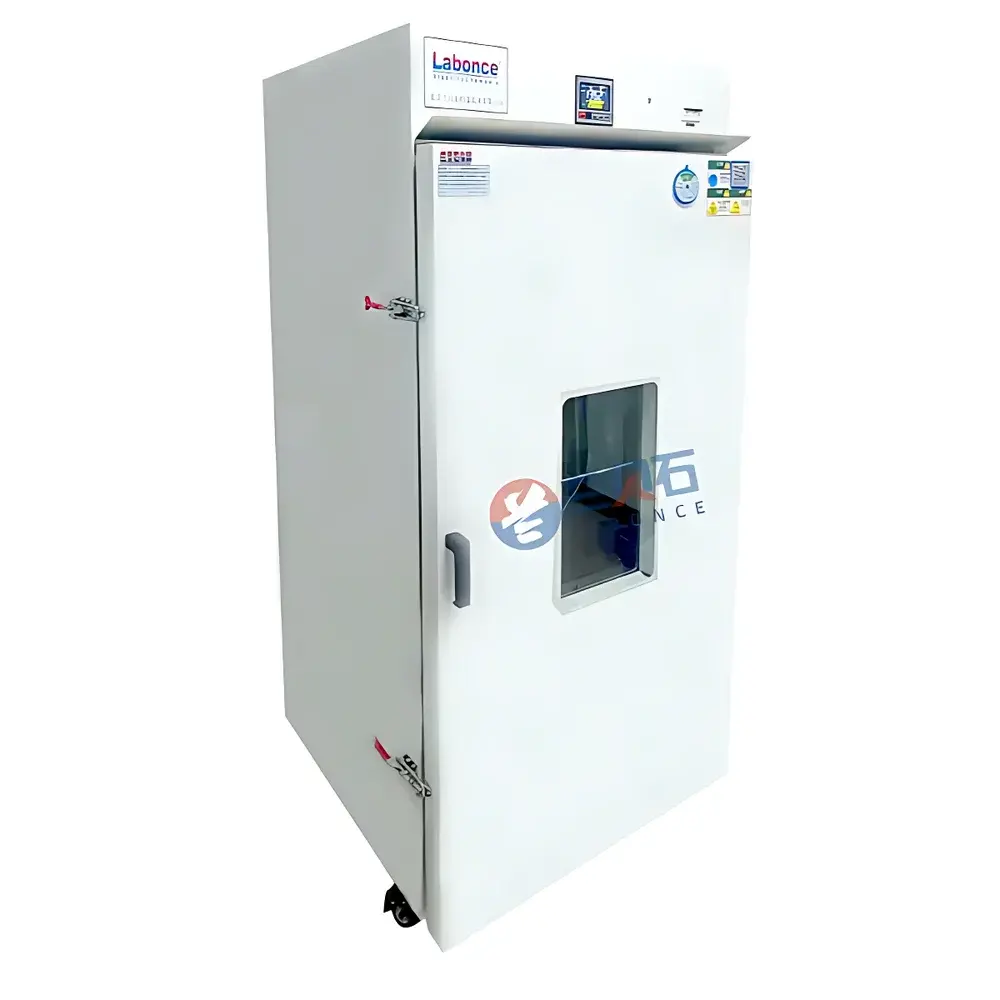
Labonce Labonce-425JMH Precision Forced-Air Drying Oven (300°C)
| Brand | Labonce |
|---|---|
| Model | Labonce-425JMH |
| Temperature Range | RT+20°C to 300°C |
| Chamber Volume | 420 L |
| Internal Dimensions (W×D×H) | 640 × 585 × 1355 mm |
| External Dimensions (W×D×H) | 780 × 750 × 1880 mm |
| Power Supply | AC 380 V ±10%, 50 Hz |
| Rated Power | 3.1 kW |
| Temperature Uniformity | ±3.0°C (at ≤200°C) |
| Temperature Fluctuation | ±1.0°C |
| Standard Shelving | 4 stainless steel shelves (adjustable) |
| Construction | Exterior – powder-coated steel |
| Safety | Independent over-temperature protection circuit |
| Control System | Digital LED temperature controller |
Overview
The Labonce Labonce-425JMH Precision Forced-Air Drying Oven is an industrial-grade thermal processing instrument engineered for consistent, repeatable high-temperature drying, curing, baking, and stabilization of materials in research laboratories, quality control environments, and manufacturing R&D facilities. Operating across a calibrated temperature range from ambient +20°C up to 300°C, the oven employs a forced-convection airflow architecture—based on optimized ducted circulation—to ensure uniform thermal distribution throughout its 420-liter working chamber. This design conforms to fundamental principles of convective heat transfer, where fan-driven air movement minimizes thermal stratification and reduces localized hot/cold zones. Unlike natural convection ovens, the Labonce-425JMH achieves rapid thermal equilibration and maintains stable setpoint conditions under variable load conditions—critical for applications requiring adherence to ASTM E145, ISO 17025, or IEC 60068-2-2 test protocols.
Key Features
- Forced-air circulation system with rear-mounted centrifugal blower and directional air ducts, delivering uniform airflow across all shelf levels
- Chamber constructed from corrosion-resistant 304 stainless steel interior and powder-coated carbon steel exterior—designed for long-term durability in humid or chemically exposed lab environments
- Digital LED temperature controller with PID algorithm, enabling precise setpoint programming, real-time display, and manual tuning of proportional-integral-derivative parameters
- Dual-stage safety architecture: primary thermostat plus independent mechanical over-temperature cut-off switch (non-resettable fuse type), compliant with EN 61000-6-2 EMC and IEC 61010-1 safety standards
- Four adjustable stainless steel shelves included as standard—load-rated for up to 15 kg per shelf—with reinforced support rails and smooth vertical positioning mechanism
- Energy-efficient insulation using high-density mineral fiber (≥100 mm thickness), minimizing thermal loss and reducing standby power consumption
Sample Compatibility & Compliance
The Labonce-425JMH accommodates a broad spectrum of sample types—including polymer films, metal components, electronic assemblies, ceramic substrates, pharmaceutical excipients, and coated substrates—without risk of cross-contamination or outgassing-induced degradation. Its stainless steel chamber resists oxidation and acid vapor exposure, supporting routine use in environments governed by GLP (Good Laboratory Practice) and GMP (Good Manufacturing Practice) frameworks. The oven’s thermal performance has been validated per ISO/IEC 17025 calibration requirements for laboratory equipment, with traceable verification of temperature uniformity and stability at multiple points (9-point mapping per IEC 60068-3-5). It is suitable for pre-conditioning per IPC-TM-650 2.6.25 and moisture removal per USP for packaging integrity studies.
Software & Data Management
While the Labonce-425JMH operates via standalone digital controller, it supports optional RS485 Modbus RTU interface for integration into centralized lab monitoring systems (e.g., LabVantage, Thermo Fisher SampleManager, or custom SCADA platforms). When interfaced, users can log time-stamped temperature profiles, generate audit trails compliant with FDA 21 CFR Part 11 (with appropriate user access controls and electronic signature configuration), and export CSV-formatted data for statistical process control (SPC) analysis. Firmware updates are delivered via USB port, ensuring continued alignment with evolving regulatory expectations for equipment qualification (IQ/OQ/PQ documentation readiness).
Applications
- Thermal aging of electrical insulators and printed circuit board laminates per IPC-TR-579 and MIL-STD-202
- Moisture content determination in raw materials prior to tablet compression (pharmaceutical QC)
- Curing of epoxy adhesives and silicone sealants in automotive and aerospace component assembly
- Pre-drying of filter media, catalyst supports, and desiccant materials in analytical chemistry workflows
- Stabilization of reference standards and certified reference materials (CRMs) under controlled thermal history
- Accelerated life testing of battery electrode coatings and separator films
FAQ
What is the maximum recommended continuous operating temperature for the Labonce-425JMH?
The oven is rated for continuous operation up to 300°C; however, sustained use above 280°C is not advised without periodic verification of sensor drift and door gasket integrity.
Can the oven be used for sterilization or depyrogenation?
No—it lacks the validation-grade temperature mapping, HEPA filtration, and steam supply required for sterilization (ISO 11135) or dry-heat depyrogenation (USP ). It is intended for drying and thermal conditioning only.
Is the temperature controller programmable with ramp-soak cycles?
The standard LED controller supports single-setpoint operation only; multi-step profiling requires optional upgrade to a programmable microprocessor-based controller (available as Labonce PCT-425 add-on module).
How often should the temperature sensor be recalibrated?
Annual calibration against NIST-traceable reference thermometers is recommended; more frequent checks are advised when used in regulated environments or after physical impact to the chamber.
Does the oven meet CE marking requirements for export to the EU?
Yes—the unit complies with the Low Voltage Directive (2014/35/EU), EMC Directive (2014/30/EU), and carries full technical documentation supporting CE self-declaration by the manufacturer.



