
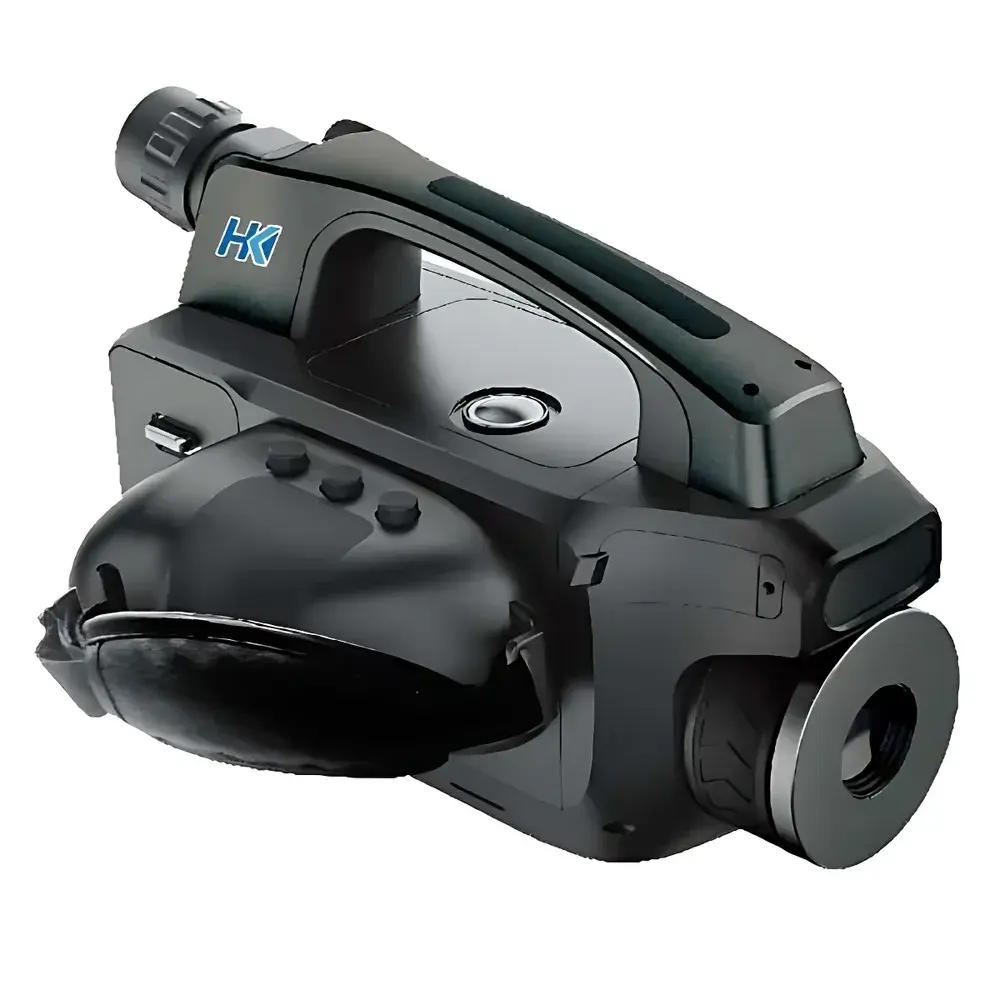
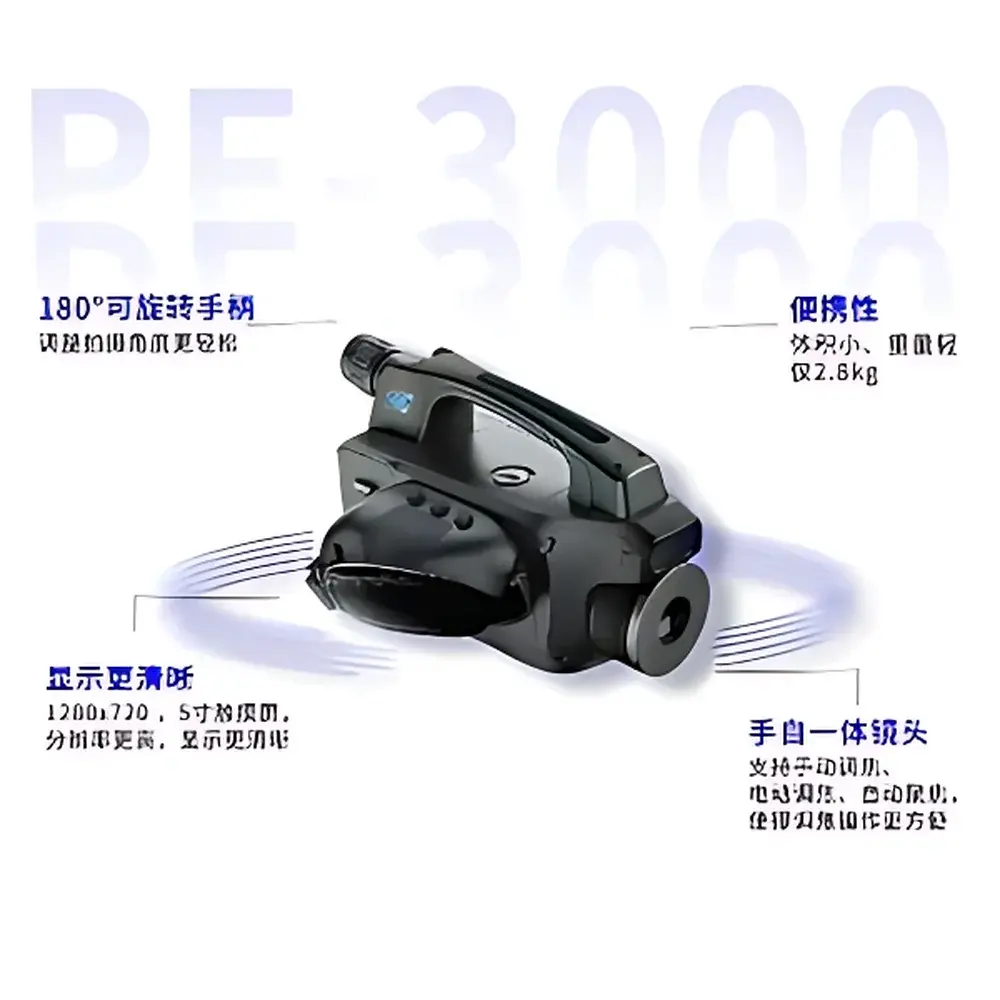
HUANKONG PF-3000 Portable MWIR Optical Gas Imaging (OGI) Camera
| Brand | HUANKONG |
|---|---|
| Origin | Shandong, China |
| Manufacturer Type | OEM Producer |
| Country of Origin | China |
| Model | PF-3000 |
| Price | Upon Request |
| Spectral Band | Mid-Wave Infrared (MWIR, 3–5 µm) |
| Detector Type | Cooled Type-II Superlattice (T2SL) Single-Element IR Detector |
| Application | Continuous Monitoring & Leak Survey |
| Measurement Method | Non-Contact Passive Imaging |
| Cooling Mechanism | Integrated Stirling Cryocooler |
| Frame Rate | 50 Hz |
| Temperature Accuracy | ±1% of reading |
| Thermal Sensitivity (NETD) | ≤10 mK |
| Temperature Range | −20 °C to +350 °C |
| IR Spatial Resolution | 1280 × 720 pixels |
| Spectral Tuning | Optimized for VOC absorption bands (e.g., CH₄, C₂H₆, C₃H₈, VOCs with C–H stretch fundamentals) |
Overview
The HUANKONG PF-3000 is a portable, cooled mid-wave infrared (MWIR) optical gas imaging (OGI) camera engineered for real-time, non-contact visualization and localization of volatile organic compound (VOC) and hydrocarbon gas leaks. It operates on the principle of passive infrared absorption spectroscopy: gaseous species—particularly those containing C–H bonds (e.g., methane, ethane, propane, benzene, and chlorinated solvents)—exhibit strong, characteristic fundamental vibrational absorption bands in the 3–5 µm spectral window. The PF-3000 integrates a high-performance, Stirling-cooled Type-II superlattice (T2SL) single-element detector optimized for this band, enabling high-contrast differential imaging between background thermal radiation and gas-phase absorption signatures. Unlike point-sensor or open-path FTIR systems, the PF-3000 delivers spatially resolved, video-rate thermal imagery—allowing operators to scan large equipment arrays, elevated piping, flanges, valves, and inaccessible seal points without physical contact or sampling. Its design conforms to the functional requirements of EPA Method 21–compliant LDAR (Leak Detection and Repair) programs and supports regulatory compliance under 40 CFR Part 60, Subpart VV, and EU IED Annex IV.
Key Features
- Cooled MWIR T2SL detector with NETD ≤10 mK, delivering superior thermal contrast for low-concentration, low-velocity plume detection
- True 1280 × 720 infrared resolution at 50 Hz frame rate—enabling stable, flicker-free video capture during dynamic scanning
- Dual-mode operation: simultaneous optical gas imaging and quantitative infrared thermography (−20 °C to +350 °C, ±1% accuracy)
- Motorized and manual focus mechanisms with macro mode support for close-range (<1 m) leak identification
- Ergonomic 180° rotating handle with integrated OLED status display and one-hand operability for overhead, confined-space, or angled inspections
- ATEX/IECEx-certified housing (Category 2G, Zone 1, II 2G Ex db IIB T4 Gb) for use in hazardous locations across petrochemical, refinery, and LNG facilities
- Onboard image annotation, timestamping, GPS tagging (optional), and radiometric video export compliant with ASTM E1934 and ISO 18434-1
Sample Compatibility & Compliance
The PF-3000 detects gases exhibiting absorption in the 3–5 µm MWIR band—including but not limited to CH₄, C₂H₆, C₃H₈, C₄H₁₀, C₂H₄, C₂H₂, CH₃Cl, CH₂Cl₂, acetone, methanol, and benzene. It is validated for minimum detectable leak rates ≤0.4 g/hr (CH₄ equivalent) under standard atmospheric conditions (23 °C, 50% RH, 10 m path length). The system meets mechanical and electromagnetic compatibility requirements per EN 61326-1 (industrial environments) and environmental robustness per IP54. Its measurement traceability aligns with ISO/IEC 17025 principles when operated within calibrated ambient conditions. For regulated reporting, raw radiometric data and annotated thermal videos support audit-ready documentation per EPA OOOOa, US EPA LDAR protocols, and EU ETS monitoring plans.
Software & Data Management
The PF-3000 interfaces with HUANKONG OGI Studio v3.2—a Windows-based desktop application supporting full radiometric video playback, pixel-level temperature profiling, plume quantification (using empirical correlation models), and automated report generation (PDF/CSV). All stored files include embedded EXIF metadata: detector calibration coefficients, lens parameters, emissivity settings, ambient temperature/humidity, and operator ID. Audit trail functionality records user login, parameter changes, and image export events—meeting FDA 21 CFR Part 11 and GLP/GMP data integrity requirements where applicable. Firmware updates are delivered via encrypted USB dongle; no cloud connectivity is required, preserving operational security in air-gapped industrial networks.
Applications
- LDAR program execution across refineries, chemical plants, and compressor stations—replacing traditional sniffer-based surveys with rapid area screening
- Pre-commissioning and turnaround verification of flare stacks, relief valves, and vapor recovery units
- Environmental compliance monitoring for fugitive emissions reporting to state EPAs and national inventories (e.g., U.S. GHG Reporting Program)
- Hazardous area inspection in offshore platforms, LNG terminals, and underground storage facilities where spark-free tools are mandatory
- Emergency response by fire departments and HAZMAT teams for real-time plume tracking during VOC spills or tank over-pressurization events
- Research-grade emission characterization in biogas upgrading facilities, pharmaceutical synthesis suites, and coal-to-chemical process units
FAQ
Does the PF-3000 require external gas reference cells or calibration gases for routine operation?
No. As a passive imaging system, it relies on inherent molecular absorption contrast and does not require gas cell calibration. Periodic NIST-traceable blackbody verification (annually or per ISO 18434-1) is recommended.
Can the PF-3000 quantify leak mass flow rates in real time?
It provides qualitative and semi-quantitative plume visualization. Absolute quantification requires integration with wind speed data and empirical correlation libraries—available as optional modules in OGI Studio.
Is the detector sensitive to solar glare or reflected sky radiation?
Yes—MWIR imaging is susceptible to specular reflections and solar loading. Optimal detection occurs during dawn/dusk or overcast conditions; built-in solar rejection filters mitigate direct sun interference.
What training is required for certified OGI operator qualification?
Operators must complete a third-party OGI certification course aligned with API RP 755 and Q19 guidelines. HUANKONG offers Level I–II field training accredited by the Infrared Training Center (ITC).
How is firmware and software validation handled for regulated environments?
Each release undergoes internal IQ/OQ testing per ASTM E2758. Validation documentation packages—including test scripts, pass/fail reports, and version-controlled binaries—are available upon request for QA/QC submission.




