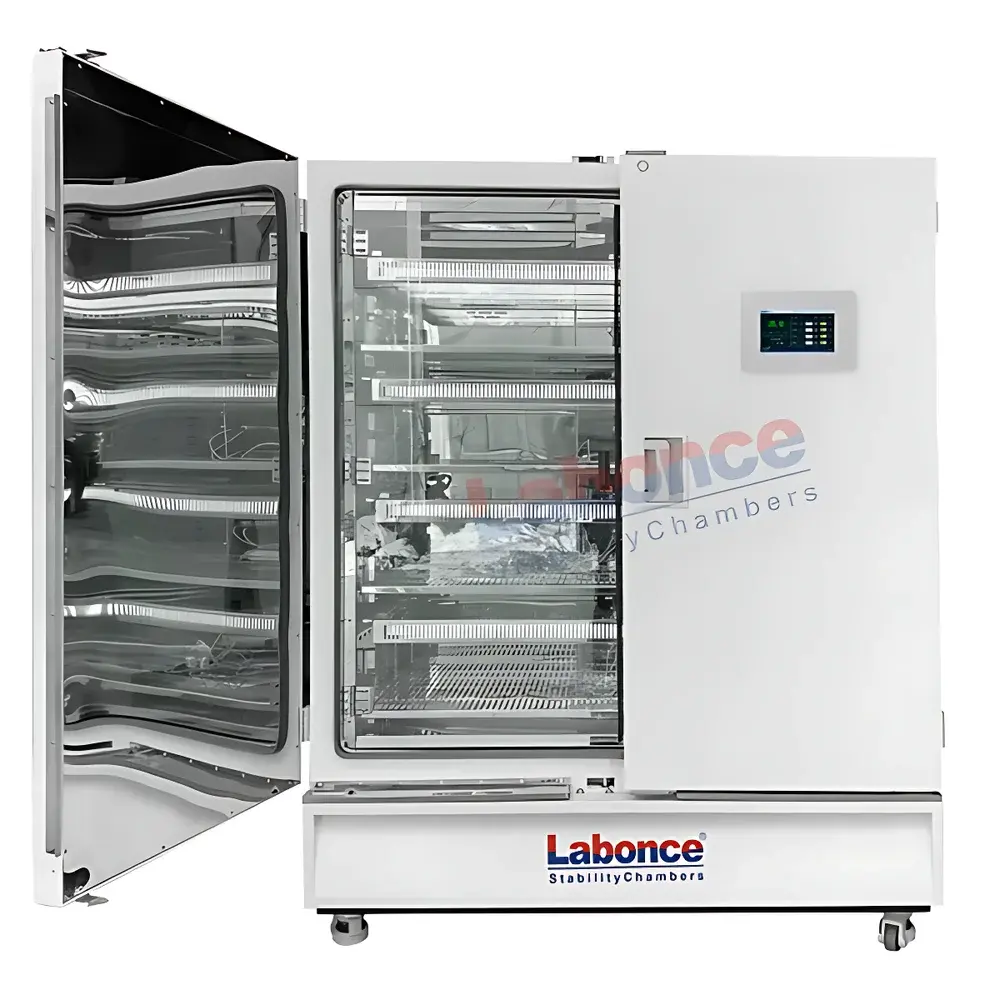
Labonce Labonce-1000TPS-3 Pharmaceutical Photostability Testing Chamber
| Brand | Labonce |
|---|---|
| Origin | Beijing, China |
| Manufacturer Type | Direct Manufacturer |
| Product Origin | Domestic (China) |
| Model | Labonce-1000TPS-3 |
| Pricing | Upon Request |
| Temperature Range | 15–50 °C |
| Chamber Volume | 1000 L |
| Internal Dimensions (W×D×H) | 1360×490×1360 mm |
| External Dimensions (W×D×H) | 1620×910×1990 mm |
| Power Consumption | 2.5 kW |
| Visible Light Range | 100–8000 Lux (settable, ±500 Lux deviation at 4500 Lux target) |
| Near-Ultraviolet Irradiance | 0.84–5 W/m² |
| Photostability Compliance | ICH Q1B, Chinese Pharmacopoeia 2020 Edition |
| Illumination Uniformity | Optimized top-mounted D65-spectrum visible + 320–400 nm near-UV lamp array with per-shelf independent control |
| Temperature Stability | ±1.0 °C fluctuation during illumination |
| Ambient Operating Range | +5 to +35 °C |
| Power Supply | AC 220 V ±10%, 50 Hz |
| Construction | Exterior — powder-coated steel |
| Insulation | High-density polyurethane foam (≥80 mm thickness) |
| Cooling System | Imported hermetic compressor |
| Controller | ≥7-inch color programmable touchscreen with audit trail and three-tier user permission (Admin/Operator/Viewer) |
| Data Handling | Built-in thermal line printer + internal non-volatile memory + USB export capability |
| Safety Systems | Compressor overheat/overpressure protection |
| Additional Features | Test ports with silicone plugs, casters with locks, adjustable shelves |
Overview
The Labonce Labonce-1000TPS-3 Pharmaceutical Photostability Testing Chamber is an ICH Q1B-compliant environmental simulation system engineered for rigorous forced degradation studies of drug substances and products under controlled photic stress. It operates on the principle of accelerated photochemical exposure—applying standardized visible light (D65 illuminant spectrum) and near-ultraviolet radiation (320–400 nm) simultaneously or independently to replicate real-world light-induced degradation pathways. Designed specifically for regulatory submission support, the chamber delivers traceable, reproducible irradiance profiles across its 1000 L working volume, enabling full compliance with ICH Q1B’s requirement of ≥1.2 × 10⁶ Lux·hr total visible exposure and ≥200 W·hr/m² near-UV energy dose. Its thermally stable architecture maintains ≤±1.0 °C temperature fluctuation during active illumination—critical for decoupling thermal effects from photochemical outcomes—and ensures ≤±2.0 °C spatial uniformity within any single shelf plane.
Key Features
- Triple-layer independent illumination control: Each of the three internal shelves hosts a dedicated D65 visible lamp set and 320–400 nm near-UV lamp array, allowing stratified photostress protocols without cross-interference.
- Regulatory-grade illumination metrology: Integrated real-time lux and W/m² sensors feed closed-loop feedback to the controller, enabling direct setpoint entry and automatic intensity modulation—no manual recalibration required.
- Audit-ready software architecture: Three-tier user permissions (Administrator, Operator, Viewer), full electronic audit trail per 21 CFR Part 11 Annex 11 expectations, and tamper-evident timestamped event logs.
- Dual-door thermal inertia design: Outer solid insulated door minimizes ambient heat/moisture exchange; inner tempered glass door permits visual sample inspection without measurable chamber disturbance (<0.3 °C transient rise in <30 s).
- Pharmaceutical-grade construction: Mirror-polished AISI 304 stainless steel interior eliminates particle shedding and facilitates cleaning validation; high-density polyurethane insulation (≥80 mm) ensures humidity retention and thermal efficiency.
- Redundant safety systems: Independent overtemperature cutoff, compressor overpressure/overheat monitoring, and configurable SMS alerts for temperature excursions or mains failure—fully documented in the Factory Acceptance Test (FAT) report.
Sample Compatibility & Compliance
The Labonce-1000TPS-3 accommodates diverse pharmaceutical dosage forms—including vials, blister packs, sachets, ampoules, and stability-indicating reference standards—on fully adjustable, corrosion-resistant stainless steel shelves. Its illumination geometry adheres to ICH Q1B Annex 2 guidance on irradiance uniformity: measured deviations remain ≤±5% across any defined 100 cm² area within a shelf plane when operated at nominal 4500 Lux + 1.5 W/m² settings. All materials contacting the chamber interior meet USP extractables profiling criteria. The system supports qualification per IQ/OQ/PQ protocols aligned with ISO 14644-1 (cleanroom classification), ASTM E2875 (photostability test method), and EU GMP Annex 15. Full validation documentation packages—including sensor calibration certificates traceable to NIM (National Institute of Metrology, China) and irradiance mapping reports—are available upon request.
Software & Data Management
The embedded ≥7-inch capacitive touchscreen runs Labonce’s proprietary STABILITRACK™ firmware, compliant with ALCOA+ data integrity principles. All parameter changes, alarm events, and manual interventions are immutably logged with operator ID, timestamp, and reason-for-change fields. Data is stored internally in encrypted SQLite format with cyclic overwrite protection and exported via USB 2.0 to CSV or PDF (including graphical irradiance/temperature/time plots). The integrated thermal line printer provides immediate hardcopy of current session parameters and real-time trend snapshots—each printout bearing a unique batch ID and digital signature hash. Electronic records satisfy FDA 21 CFR Part 11 requirements for electronic signatures, audit trails, and record retention (minimum 15 years).
Applications
- ICH Q1B photostability protocol execution for new drug applications (NDAs), marketing authorization applications (MAAs), and generic submissions.
- Forced degradation studies to identify primary photolytic degradation products and establish stability-indicating HPLC/UPLC methods.
- Comparative photostability assessment of alternative packaging formats (e.g., amber vs. clear vials, aluminum foil vs. polymer blisters).
- Light sensitivity screening of APIs during preformulation development.
- Revalidation of photostability chambers after relocation, major maintenance, or software updates per WHO TRS 992 Annex 5.
- Supporting root cause analysis for out-of-specification (OOS) results linked to uncontrolled light exposure in storage or distribution.
FAQ
Does the Labonce-1000TPS-3 meet ICH Q1B mandatory irradiance thresholds?
Yes. It delivers ≥4500 Lux ±500 Lux (visible) and ≥1.5 W/m² (near-UV) across the entire shelf surface—validated per ICH Q1B Annex 2 uniformity requirements.
Can irradiance and temperature be logged simultaneously with time stamps?
Yes. All sensor data—including lux, W/m², chamber air temperature, and shelf-level thermocouple readings—are sampled every 10 seconds and archived with millisecond-precision timestamps.
Is third-party calibration certification included with delivery?
Each unit ships with factory-issued calibration certificates for all irradiance and temperature sensors, traceable to national standards (NIM, China), plus a full IQ/OQ summary report.
How is data integrity ensured during USB export?
Exported files include SHA-256 checksums and embedded metadata (operator ID, export timestamp, firmware version), preventing undetected file corruption or tampering.
What maintenance intervals are recommended for lamp replacement?
D65 lamps require replacement every 1200 hours of cumulative operation; near-UV lamps every 800 hours—both tracked automatically by the controller and flagged via dashboard alert.