
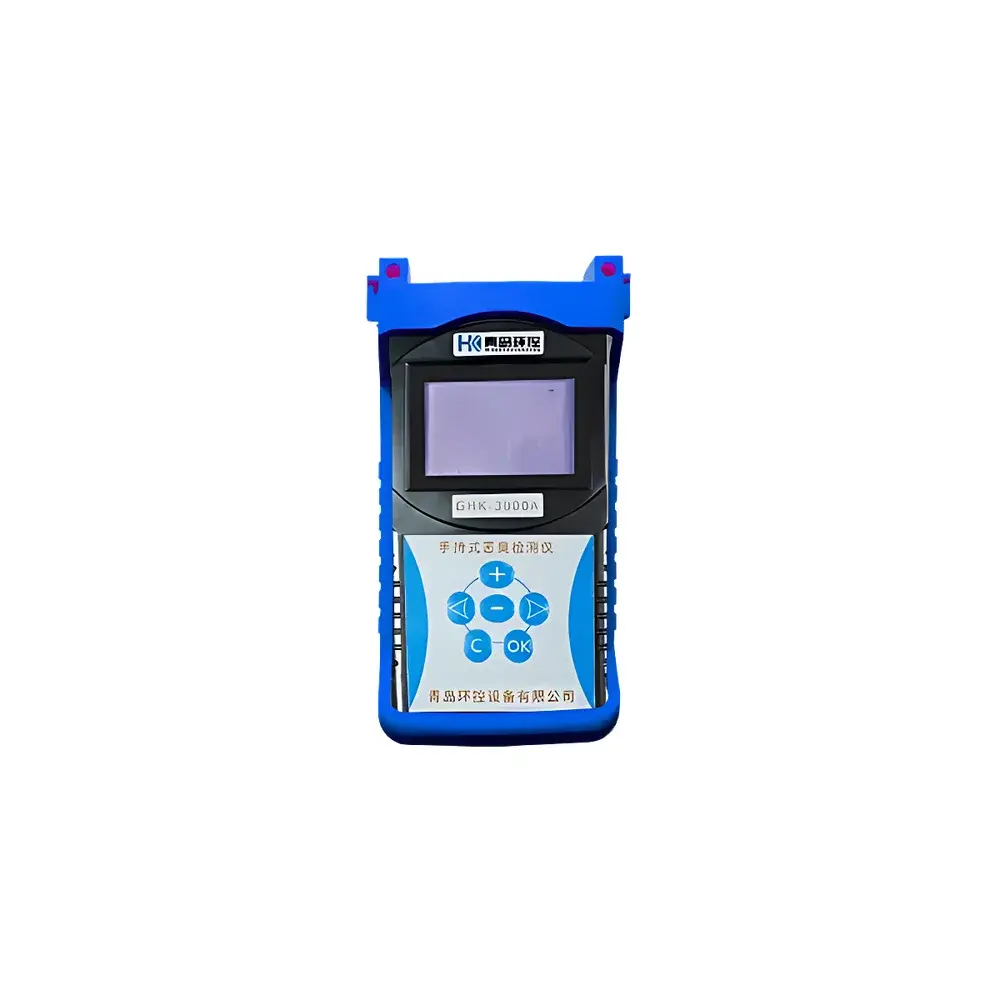
HUANKONG GHK-3000A Handheld Odor Detection Analyzer
| Brand | HUANKONG |
|---|---|
| Origin | Shandong, China |
| Manufacturer Type | OEM/ODM Manufacturer |
| Country of Origin | China |
| Model | GHK-3000A |
| Instrument Type | Portable |
| Detection Principle | Electrochemical / Metal Oxide Semiconductor (MOS) Sensor Array (Multi-sensor Olfactory Mimic Platform) |
| Sample Flow Rate | 0.7 L/min |
| Operating Temperature Range | -20 °C to +60 °C |
| Sensor Resolution | down to 1 ppb |
| Measurement Range | up to 10,000 ppm (configurable per sensor module) |
| Battery Life | >8 hours (fully charged Li-ion) |
| Compliance | GB 14554–1993, HJ 905–2017, HJ 1262–2022 |
Overview
The HUANKONG GHK-3000A Handheld Odor Detection Analyzer is an engineered field-deployable instrument designed for quantitative and semi-quantitative assessment of odorant compounds in ambient air, occupational environments, and emergency response scenarios. Unlike single-gas detectors, the GHK-3000A employs a multi-sensor olfactory mimic platform—comprising electrochemical and metal oxide semiconductor (MOS) sensor arrays—calibrated to respond selectively to key odor-causing volatiles including hydrogen sulfide (H₂S), methyl mercaptan (CH₃SH), ammonia (NH₃), trimethylamine (C₃H₉N), and volatile organic compounds (VOCs) associated with sewage, industrial effluent, composting, and landfill emissions. Its operational principle relies on real-time resistance/conductivity modulation across sensor elements, translated via embedded signal conditioning and temperature/humidity compensation algorithms into standardized odor concentration units (OUE/m³) or compound-specific concentrations (ppb–ppm). The device meets the methodological requirements of Chinese national standards GB 14554–1993 (Emission Standard of Malodorous Pollutants), HJ 905–2017 (Technical Specification for Odor Monitoring in Ambient Air and Exhaust Gas), and HJ 1262–2022 (Determination of Odor Concentration by Three-Point Comparative Olfactometry)—enabling direct correlation with regulatory pass/fail thresholds and supporting legally defensible field data collection.
Key Features
- Modular sensor architecture: Interchangeable sensor cartridges support configuration for H₂S, NH₃, VOCs, total reduced sulfur (TRS), or custom odorant blends—each factory-calibrated with NIST-traceable reference gases.
- High-fidelity flow control: Integrated German-made diaphragm sampling pump (0.7 L/min nominal flow) coupled with closed-loop electronic mass flow metering ensures stable sample delivery independent of external duct pressure or backpressure fluctuations.
- Environmental resilience: IP65-rated enclosure; operational range from –20 °C to +60 °C with automatic thermal drift compensation; humidity tolerance up to 95% RH non-condensing.
- Regulatory-grade data logging: Internal memory stores ≥10,000 timestamped records (including instantaneous, 1-min avg, 15-min TWA, and STEL values); supports GLP-compliant audit trails with user ID tagging and calibration history retention.
- Extended autonomy: High-capacity 7.4 V / 4,400 mAh lithium-ion battery enables >8 hours continuous operation at 1-sampling-interval mode; hot-swappable battery option available.
- Configurable alarm system: Dual-stage audible (≥85 dB) and visual (RGB LED) alerts with fully programmable upper/lower limits per measured parameter; latching and non-latching modes supported.
- Wireless interoperability: Optional Bluetooth 5.0 module enables secure pairing with Android/iOS mobile apps for real-time telemetry, remote configuration, and on-device report generation (PDF/CSV).
Sample Compatibility & Compliance
The GHK-3000A is validated for use in heterogeneous gas matrices typical of municipal wastewater treatment plants, food processing facilities, rendering operations, biogas upgrading stations, and chemical manufacturing sites. It accommodates particulate-laden, humid, or mildly corrosive airstreams when used with optional hydrophobic particulate filter (0.3 µm pore size) and activated carbon pre-scrubber. All sensor modules undergo quarterly recalibration verification per HJ 905–2017 Annex B protocols. Device firmware and data management software comply with ISO/IEC 17025:2017 clause 7.7 (traceability of measurements) and support 21 CFR Part 11–aligned electronic signatures when deployed in GMP-aligned environmental monitoring programs.
Software & Data Management
The companion PC software (HUANKONG DataLink v3.2) provides full traceability: raw sensor output, compensated concentration values, calibration coefficients, and environmental metadata (T, RH, barometric pressure) are stored in encrypted SQLite databases with SHA-256 hashing. Export formats include ASTM E2918-compliant CSV, ISO 14001-aligned Excel templates, and PDF reports featuring digital signature fields, QA/QC flags, and compliance status indicators against GB 14554–1993 limit values. Audit logs record every calibration event, parameter change, and user login—retained for ≥5 years per internal QA policy.
Applications
- Real-time odor impact assessment around landfills and composting facilities
- Workplace exposure monitoring per OSHA PEL and ACGIH TLV® guidelines
- Leak detection and source identification during process upset events
- Validation of biofilter or activated carbon abatement system performance
- Community complaint investigations with geotagged, time-synchronized measurement records
- Baseline surveys and long-term trend analysis for environmental permit renewals
FAQ
What odor compounds does the GHK-3000A detect?
It detects hydrogen sulfide, ammonia, methyl mercaptan, dimethyl sulfide, trimethylamine, and broad-spectrum VOCs—configurable via sensor module selection.
Is the instrument certified for use in hazardous locations?
No. It is rated for general-purpose industrial environments (non-explosive atmospheres); intrinsic safety certification (e.g., ATEX/IECEx) is not included but can be evaluated upon request.
How often must sensors be recalibrated?
Factory recommendation is every 90 days under routine use; field zero checks with clean air are advised before each deployment.
Can data be integrated into existing SCADA or EMS platforms?
Yes—via Modbus RTU (RS-485) or MQTT over Wi-Fi (optional module), enabling seamless ingestion into enterprise environmental management systems.
Does the device meet international odor standards beyond Chinese regulations?
While optimized for GB/HJ methods, its sensor response profiles align with EN 13725:2022 (odor concentration determination) and ASTM D6920–22 (field screening of malodorous compounds) for comparative interpretation.







