
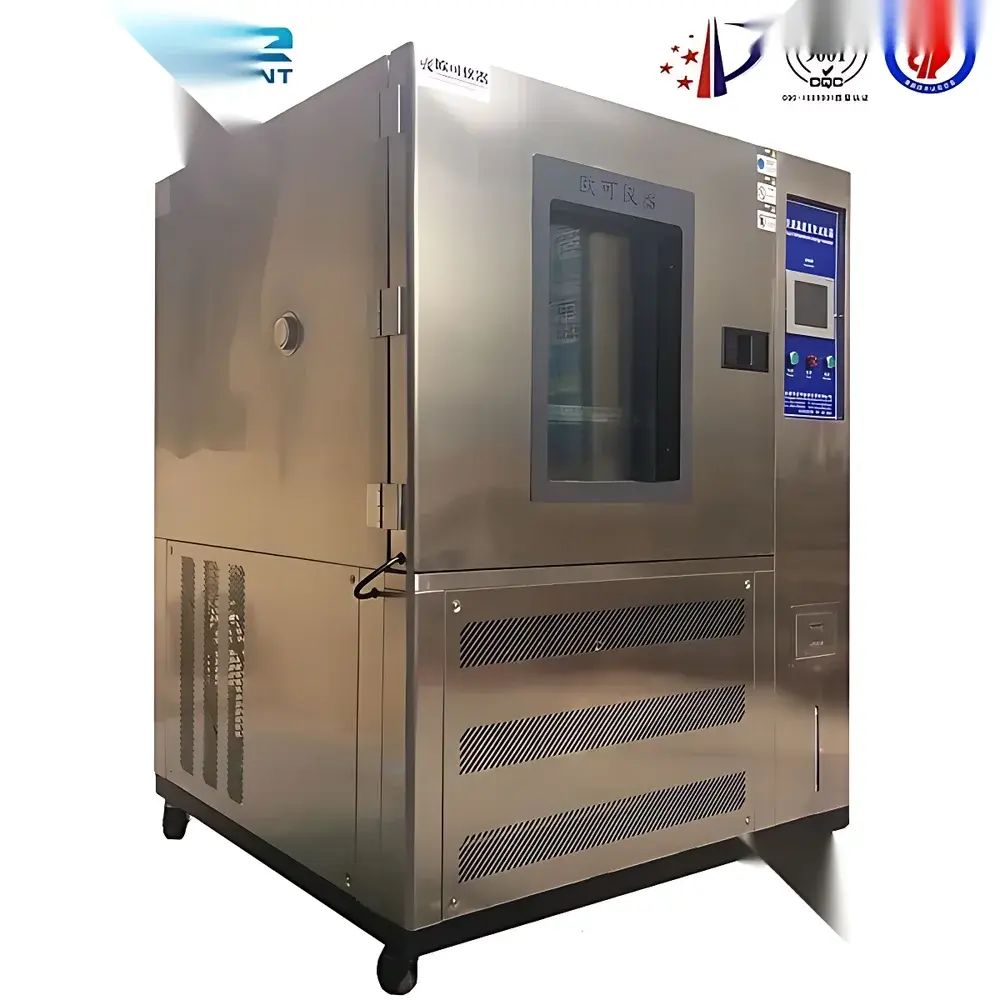
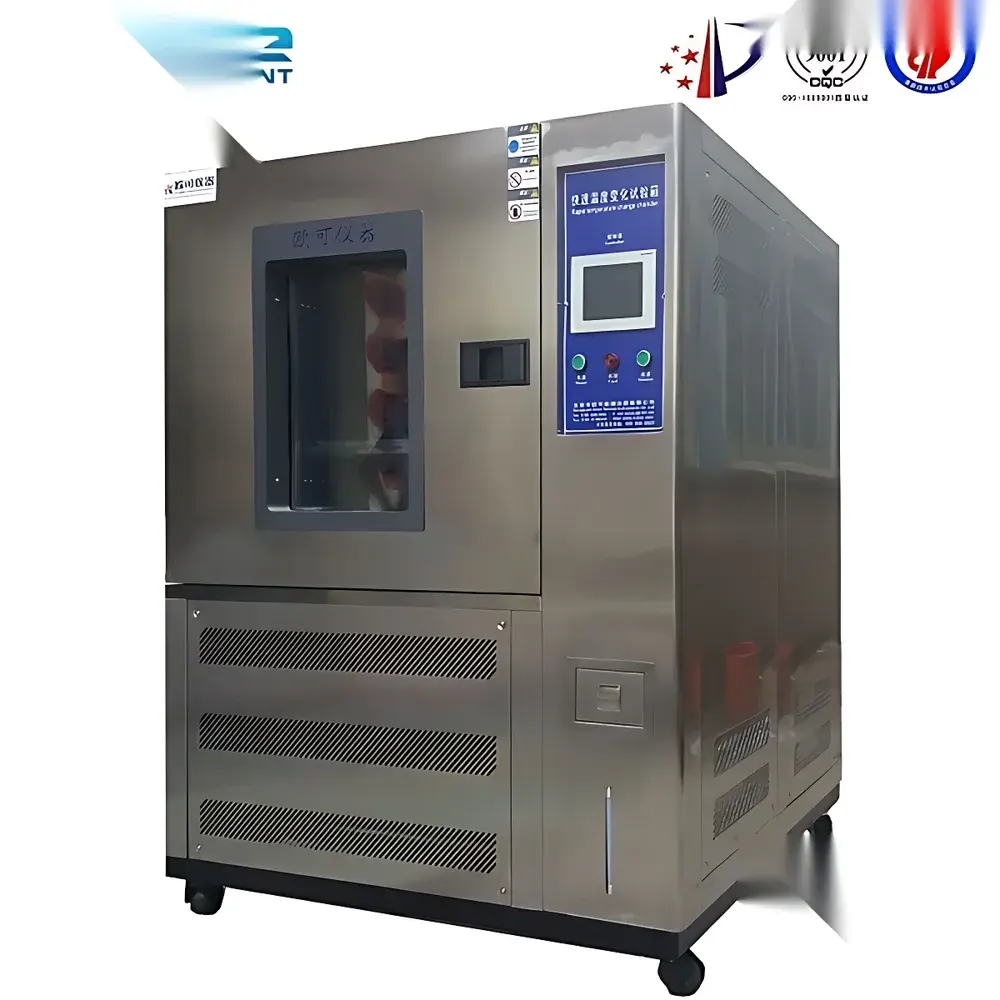
KS-TH Series Rapid Temperature Transition Environmental Test Chamber
| Brand | Other Brands |
|---|---|
| Origin | Imported |
| Manufacturer Type | Authorized Distributor |
| Temperature Range | -70 °C to +150 °C |
| Rapid Transition Range | -45 °C to +85 °C |
| Max Linear Ramp Rate | 15 °C/min |
| Adjustable Ramp Rate | 3–20 °C/min (linear/non-linear) |
| Humidity Range (optional) | 5–98% RH |
| Temperature Resolution/Accuracy | 0.1 °C / ±0.5 °C |
| Humidity Resolution/Accuracy | 0.1% RH / ±2.5% RH |
| Uniformity | ±2.0 °C / ±3.0% RH |
| Internal Construction | SUS304 Stainless Steel, Matte Finish |
| Insulation | High-Density Polyisocyanurate Foam |
| Cooling System | Air-Cooled or Water-Cooled |
| Compressor | Tecumseh (France) |
| Refrigerant | R-404A & R-501 (EPA-compliant) |
| Power Supply | AC 220 V, 1-Phase or AC 380 V, 3-Phase |
Overview
The KS-TH Series Rapid Temperature Transition Environmental Test Chamber is an engineered solution for accelerated thermal stress testing in reliability engineering, product validation, and qualification protocols across aerospace, automotive, electronics, and medical device industries. Designed around a dual-refrigeration circuit architecture with precision-controlled expansion valves and high-efficiency Tecumseh compressors, the chamber delivers repeatable, linear temperature transitions across its full operating range of –70 °C to +150 °C. Its core capability lies in programmable ramp-rate control—enabling users to define custom thermal profiles with linear or non-linear segments, achieving transition speeds up to 15 °C/min under full-load linear conditions and up to 20 °C/min in optimized non-linear modes. This performance supports standardized test methods including MIL-STD-810H Method 503.6 (Temperature Shock), IEC 60068-2-14 (Change of Temperature), and JEDEC JESD22-A104F (Temperature Cycling), making it suitable for HALT/HASS pre-screening, solder joint fatigue analysis, and material coefficient-of-thermal-expansion (CTE) characterization.
Key Features
- Large double-layered, low-emissivity tempered glass observation window with integrated anti-fogging heater and high-lumen PL fluorescent lighting for real-time sample monitoring without thermal disturbance
- LCD-based controller with intuitive touchscreen interface supporting multi-segment program editing—enabling simultaneous temperature/humidity ramping with QUICK (step) or SLOP (gradient) profile modes
- Dual-stage sealing system: magnetic door gasket plus silicone rubber compression seal ensures thermal integrity and minimizes leakage (<0.5 K/hr ambient drift under steady-state conditions)
- Modular insulation using closed-cell polyisocyanurate foam (thermal conductivity ≤0.022 W/m·K at 23 °C) with stainless steel SUS304 interior and exterior cladding for corrosion resistance and cleanroom compatibility
- Standard 50 mm diameter test port with removable silicone plug; optional internal glass access door for live signal/power feedthrough without compromising chamber integrity
- Integrated castor wheels with locking leveling feet for stable repositioning and floor-level alignment—designed for ISO 14644-1 Class 7 cleanroom-rated environments
- Comprehensive safety architecture: refrigerant high/low pressure cutoffs, overtemperature/overhumidity interlocks, compressor overload protection, phase failure detection, and dry-run alarm for water-cooled variants
Sample Compatibility & Compliance
The KS-TH series accommodates test specimens up to 1000 L (KS-TH-1000 model), with internal dimensions scalable from 40 × 50 × 40 cm to 100 × 100 × 100 cm. Its uniform airflow design—achieved via rear-mounted centrifugal fans with adjustable baffle guidance—ensures spatial temperature deviation ≤±2.0 °C and humidity variation ≤±3.0% RH across the working volume (per IEC 60068-3-5). All models comply with CE marking requirements under the EU Machinery Directive 2006/42/EC and Electromagnetic Compatibility Directive 2014/30/EU. Optional humidity control meets ISO 17025 traceability standards when paired with NIST-traceable hygrometer calibration kits. The chamber’s refrigerant selection (R-404A and R-501) conforms to EPA SNAP Program guidelines and is fully compatible with global ozone-depletion and global-warming potential (GWP) regulatory frameworks.
Software & Data Management
The embedded controller supports RS-485 (Modbus RTU) and Ethernet (TCP/IP) communication interfaces for integration into centralized lab management systems. Optional PC-based software provides full data logging (1 Hz sampling rate), real-time graphing, alarm event timestamping, and export to CSV/PDF formats. Audit trail functionality complies with FDA 21 CFR Part 11 requirements when configured with user role-based access control and electronic signature modules. Data integrity safeguards include cyclic redundancy check (CRC) verification on stored profiles and automatic backup to external USB storage—supporting GLP/GMP documentation workflows in regulated quality assurance laboratories.
Applications
- Thermal shock testing of PCB assemblies per IPC-9701 and IPC-J-STD-020D
- Material compatibility screening for battery enclosures under extreme thermal cycling
- Validation of automotive ECU housings against ISO 16750-4 environmental stress profiles
- Accelerated aging studies of polymer-based medical packaging under ASTM F1980
- Pre-conditioning of optical sensors prior to vibration testing in hybrid environmental chambers
- Reliability growth testing (RGT) of avionics components per RTCA DO-160G Section 4
FAQ
What is the difference between linear and non-linear ramp modes?
Linear mode maintains constant dT/dt across the entire segment, ideal for standardized thermal shock tests. Non-linear mode prioritizes time-to-target by dynamically adjusting compressor output and heater duty cycle—yielding faster transitions at the expense of strict linearity, suitable for HALT exploration.
Can the chamber operate continuously at –70 °C with humidity control enabled?
Humidity control is not available below 0 °C due to condensation risk in the humidification system; the 5–98% RH range is only functional within +10 °C to +85 °C per design specification.
Is third-party calibration certification included with shipment?
Factory calibration certificates (traceable to NPL/PTB standards) are provided as standard; ISO/IEC 17025-accredited calibration reports are available as a value-added service upon request.
What maintenance intervals are recommended for the refrigeration system?
Compressor oil analysis and refrigerant purity testing are advised every 2,000 operational hours; condenser coil cleaning (air-cooled) or descaling (water-cooled) should occur quarterly under typical lab usage conditions.
Related Products



