
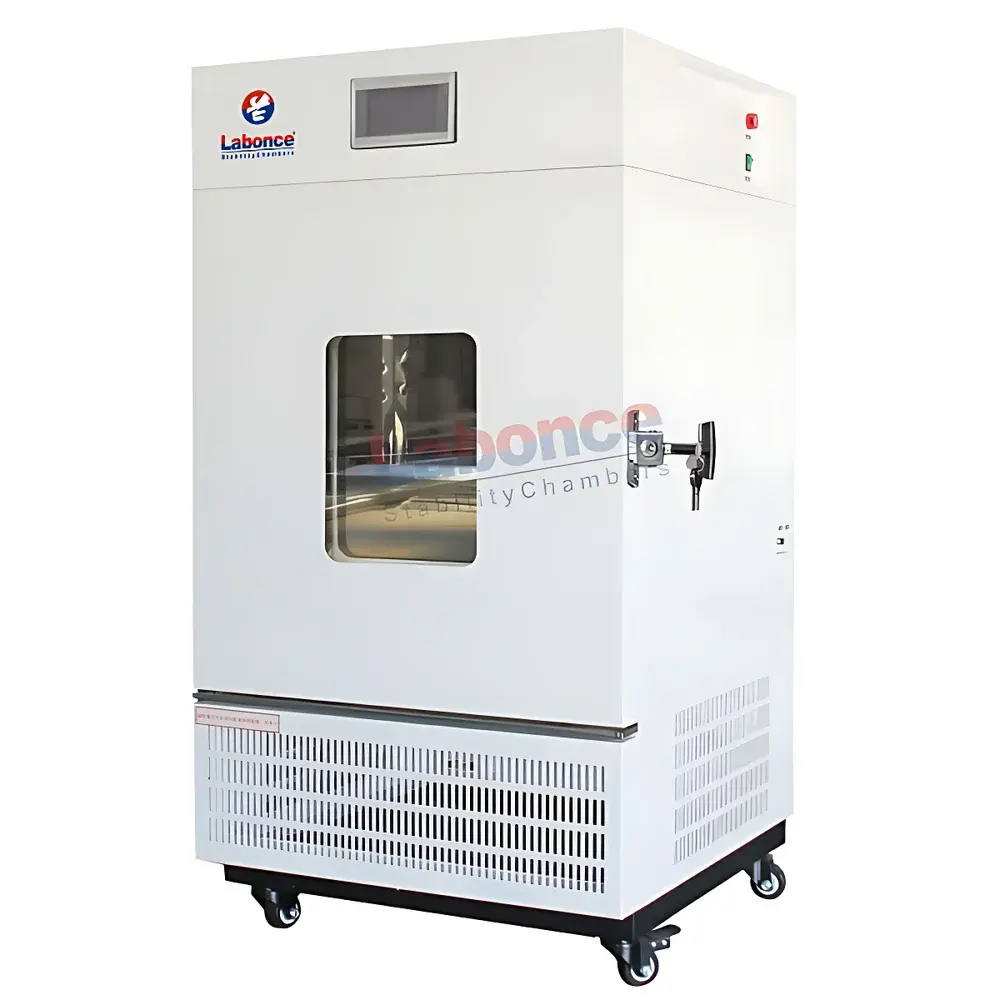
Labonce Labonce-250BC Pharmaceutical Refrigerated Storage Cabinet
| Brand | Labonce |
|---|---|
| Model | Labonce-250BC |
| Temperature Range | 2–14°C |
| Internal Volume | 250 L |
| Internal Dimensions (W×D×H) | 600×500×830 mm |
| External Dimensions (W×D×H) | 780×880×1650 mm |
| Power Consumption | 0.63 kW |
| Temperature Uniformity | ≤2.0°C |
| Temperature Fluctuation | <±1.0°C |
| Temperature Deviation | <±2.0°C |
| Ambient Operating Temperature | +5 to +30°C |
| Power Supply | AC 220 V ±10%, 50 Hz |
| Construction | Exterior – Powder-coated steel |
| Insulation | High-density polyurethane foam |
| Compressor | Imported hermetic industrial compressor |
| Control System | Programmable color touchscreen controller with triple-level user access and electronic data logging |
| Safety Features | Compressor overheat & high-pressure overload protection |
| Alarm System | Local audible alarm + remote SMS alert for temperature deviation and power failure |
| Standard Accessories | Test port with rubber plug, casters with brakes, door lock, observation window |
| Optional | Needle-type micro printer |
| Compliance | YY/T 0086–2020 Medical Refrigerated Cabinets |
Overview
The Labonce Labonce-250BC Pharmaceutical Refrigerated Storage Cabinet is an engineered solution for the secure, stable, and compliant cold-chain storage of temperature-sensitive pharmaceuticals, biologics, vaccines, reference standards, and clinical trial materials. Designed specifically for GxP-aligned laboratory and quality control environments, this cabinet maintains a tightly controlled operating range of 2–14°C — optimized for long-term stability testing and routine storage per ICH Q5C, Q1A(R2), and WHO Technical Report Series No. 961 guidelines. Its thermal architecture employs a forced-air convection system with a re-engineered airflow path to minimize vertical and horizontal thermal gradients across the entire 250 L internal volume. Unlike conventional refrigerated cabinets relying on passive air circulation, the Labonce-250BC utilizes a precisely balanced fan-assisted wind tunnel design that ensures uniform heat exchange throughout the chamber — critical for eliminating cold spots, condensation accumulation, and localized temperature excursions that compromise sample integrity.
Key Features
- High-stability temperature control: Achieves ≤2.0°C temperature uniformity, <±1.0°C fluctuation, and <±2.0°C deviation under steady-state conditions at 5°C setpoint (per YY/T 0086–2020 validation protocol)
- Dual-layer thermal insulation: 80 mm thick high-density polyurethane foam (density ≥40 kg/m³) with closed-cell structure, minimizing thermal bridging and moisture ingress
- Corrosion-resistant interior: Seamless 304 stainless steel inner chamber with mirror-polished surface (Ra ≤0.4 µm), facilitating rapid decontamination and eliminating particulate shedding
- Industrial-grade refrigeration: Hermetically sealed, low-noise scroll compressor with oil return optimization and embedded thermal protection circuitry
- Intelligent human-machine interface: 7-inch full-color capacitive touchscreen with programmable ramp-soak profiles, real-time trend graphs, and audit-trail-enabled event logging
- Multi-tier security architecture: Three-level password-protected access (Operator / Supervisor / Administrator), supporting role-based parameter restrictions and calibration lockout
- Redundant safety monitoring: Dual independent temperature sensors (PT100 class B), compressor overheat cutoff, high-pressure switch, and door-open duration detection
- Remote alerting infrastructure: Integrated GSM module enables configurable SMS notifications for out-of-specification events, including ambient temperature drift, power interruption, and door ajar status
Sample Compatibility & Compliance
The Labonce-250BC supports storage of vials, ampoules, syringes, blister packs, and secondary packaging formats commonly used in pharmaceutical QA/QC workflows. Its interior layout accommodates standard ISO 554-compliant humidity management (non-condensing operation at 60% RH typical), and the absence of internal plastic components eliminates VOC leaching risks. The cabinet is manufactured and validated in accordance with YY/T 0086–2020, the Chinese national standard for medical refrigerated cabinets, and its control firmware supports 21 CFR Part 11-compliant electronic records when paired with optional audit trail configuration. While not certified to UL/EN 61010–1 or IEC 61000–4 EMC standards out-of-the-box, its electrical design meets CE-equivalent safety thresholds for laboratory use in non-hazardous locations. Documentation packages include Factory Acceptance Test (FAT) reports, IQ/OQ templates, and temperature mapping protocols aligned with ISO 14644–3 and EU GMP Annex 15 requirements.
Software & Data Management
The embedded controller logs temperature, alarm status, door openings, and system faults at user-defined intervals (1–60 minutes), storing up to 12 months of compressed time-series data internally. Export is supported via USB 2.0 port in CSV format, compatible with LIMS integration (e.g., LabWare, STARLIMS) and statistical process control tools (Minitab, JMP). Optional firmware upgrade enables TLS 1.2-secured HTTP(S) API endpoints for centralized monitoring via enterprise SCADA platforms. All logged entries are timestamped with UTC synchronization capability and include immutable digital signatures to satisfy ALCOA+ principles (Attributable, Legible, Contemporaneous, Original, Accurate, Complete, Consistent, Enduring, Available). Electronic signature support requires administrator-level enrollment and biometric or PKI token authentication.
Applications
- ICH-compliant accelerated and long-term stability studies (25°C/60% RH, 30°C/65% RH, and 5°C reference conditions)
- Storage of monoclonal antibodies, recombinant proteins, and mRNA vaccine intermediates requiring strict 2–8°C chain-of-custody
- Retention sample archiving for batch release documentation and regulatory submissions (FDA, EMA, NMPA)
- QC lab inventory management of pharmacopeial reference standards (USP, EP, ChP) and working standards
- Biobank specimen staging prior to cryogenic transfer or analytical processing
- Pharmaceutical distribution center staging zones where ambient fluctuations necessitate active thermal buffering
FAQ
What is the recommended validation frequency for the Labonce-250BC in a GMP environment?
Annual operational qualification (OQ) with full temperature mapping (≥9-point sensor grid) is advised; quarterly performance checks using calibrated reference thermistors are recommended per ASTM E2875–23.
Does the cabinet support external data acquisition via RS485 or Ethernet?
Yes — optional RS485 Modbus RTU interface is available for integration with building management systems (BMS) or centralized environmental monitoring systems (EMS).
Can the internal lighting be disabled during stability testing to prevent photodegradation?
Yes — the LED interior light is software-controllable and can be deactivated via the touchscreen or scheduled profile settings.
Is the unit suitable for storing flammable solvents or compressed gases?
No — the Labonce-250BC is not explosion-proof and lacks intrinsically safe components; it is rated for non-hazardous laboratory environments only.
What documentation is provided for regulatory audits?
Standard delivery includes Declaration of Conformity, FAT report, user manual, maintenance logbook template, and IQ/OQ protocol drafts compliant with ISO/IEC 17025 and PIC/S TR 13.




