
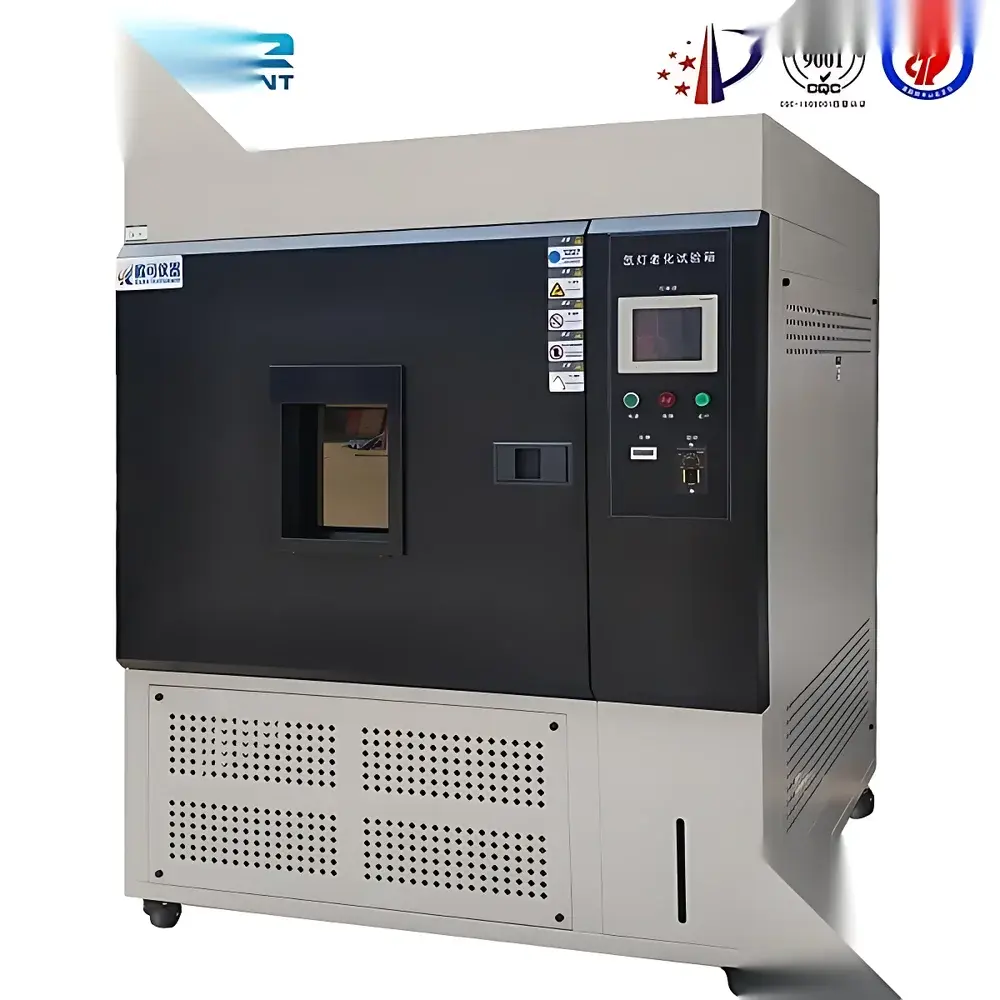
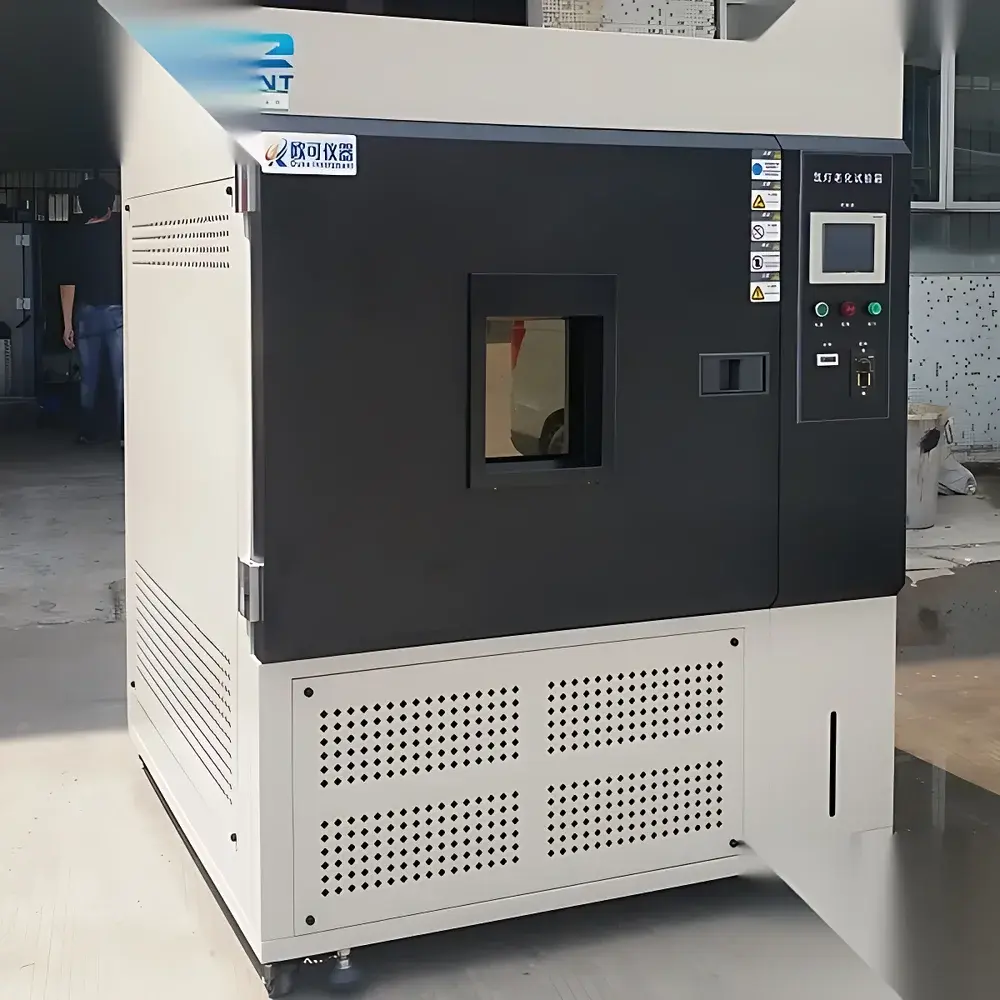
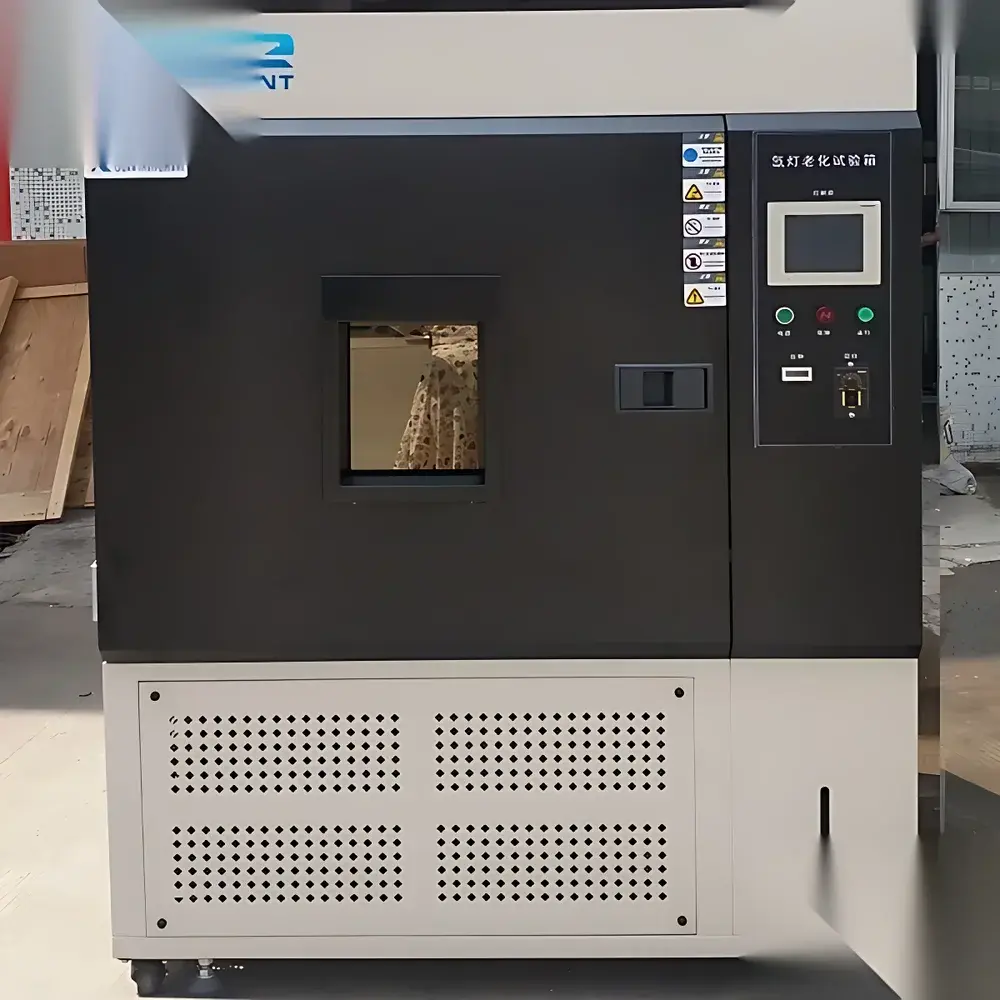
Xenon Arc Weathering Test Chamber
| Key | Temperature Range: RT+10°C to 70°C |
|---|---|
| Humidity Range | 50–98% RH |
| Black Panel Temperature | 63–100°C ±3°C |
| Temp. Uniformity | ≤±2.0°C |
| Temp. Stability | ≤±0.5°C |
| Humidity Stability | +2% to −3% RH |
| Rain Duration | 1–9999 min (adjustable, continuous) |
| Rain Cycle | 1–240 min (adjustable, intermittent) |
| Nozzle Diameter | Ø2.0 mm |
| Water Pressure | 0.12–0.15 MPa |
| Spray Cycle | 18 min ON / 102 min OFF or 12 min ON / 48 min OFF |
| Lamp Type | Air-Cooled Xenon Arc Lamp |
| Lamp Quantity | 1 |
| Lamp Power | 2–6 kW |
| Sample Distance from Lamp | 300–375 mm |
| Sample Holder Rotation | 360°, 1–5 rpm |
| Irradiance Spectrum | 290–800 nm |
| Irradiance Range | 50–1100 W/m² |
| Cumulative Radiant Exposure | 14,000–67,000 kJ/m² |
| Illumination Time Control | 1–999 h (continuously adjustable) |
| Power Supply | AC 380 V (±10%), 50 Hz, 3-phase 5-wire |
Overview
The Xenon Arc Weathering Test Chamber is an advanced environmental simulation system engineered for accelerated weathering and photostability assessment of polymeric materials, coatings, textiles, automotive components, and architectural finishes. It replicates the full solar spectrum—spanning 290 nm to 800 nm—using a high-intensity air-cooled xenon arc lamp, closely matching natural sunlight’s spectral distribution, including critical UV-B, UV-A, visible, and near-infrared regions. Unlike fluorescent UV or carbon-arc sources, xenon arc technology provides spectrally accurate irradiation essential for evaluating photochemical degradation mechanisms such as chalking, fading, cracking, gloss loss, and embrittlement. The chamber integrates precise control of four primary environmental stressors: radiant energy (irradiance), temperature (chamber air and black panel), relative humidity, and cyclic water exposure (rain or condensation). This multi-factor synergy enables realistic acceleration of outdoor aging—typically achieving 1–3 years of natural exposure in weeks—while maintaining metrological traceability and repeatability required for R&D validation and quality assurance.
Key Features
- Single-air-cooled xenon lamp (2–6 kW) with spectral output calibrated to ISO 4892-2 and ASTM G155 reference spectra, ensuring compliance with international weathering standards.
- Black panel temperature sensor (63–100°C ±3°C) mounted directly on specimen surface for accurate thermal load monitoring during irradiation.
- Precision climate control: temperature stability ≤±0.5°C; uniformity ≤±2.0°C; humidity regulation between 50–98% RH with dynamic response under irradiation.
- Programmable rain simulation: independent control of rainfall duration (1–9999 min), interval cycle (1–240 min), nozzle pressure (0.12–0.15 MPa), and spray pattern (18/102 or 12/48 min ON/OFF cycles).
- Motorized 360° rotating sample holder (1–5 rpm) ensures uniform irradiance distribution across all specimens—critical for inter-laboratory reproducibility per ISO 11341 and ASTM D4329.
- Real-time irradiance monitoring via calibrated broadband or narrowband sensors (290–400 nm or 340 nm), with cumulative dose logging up to 67,000 kJ/m².
- Robust stainless-steel construction with double-wall insulation, filtered air circulation, and quartz filter systems to maintain spectral fidelity and minimize ozone generation.
Sample Compatibility & Compliance
This chamber accommodates flat-panel specimens up to standard dimensions (e.g., 75 × 150 mm or custom fixtures), with adjustable sample distance (300–375 mm) to optimize irradiance intensity and thermal loading. Compatible with rigid and flexible substrates—including thermoplastics, elastomers, paints, adhesives, and composite laminates—without requiring special mounting hardware. Designed to meet stringent regulatory and industry requirements: fully compliant with ISO 4892-2 (Plastics — Methods of exposure to laboratory light sources — Part 2: Xenon-arc lamps), ASTM G155 (Standard Practice for Operating Xenon Arc Light Apparatus for Exposure of Non-Metallic Materials), and SAE J2527 (Surface Vehicle Recommended Practice for Accelerated Exposure of Automotive Exterior Materials Using a Controlled Irradiance Xenon-Arc Apparatus). Supports GLP/GMP documentation workflows through audit-trail-capable data logging and user-access-level controls.
Software & Data Management
The integrated controller features a high-resolution touchscreen interface with intuitive programming for multi-step test profiles—including ramped irradiance, stepped temperature/humidity, synchronized rain cycles, and dark periods. All operational parameters (irradiance, black panel temp, chamber RH, spray status, rotation speed) are logged at user-defined intervals (1 sec to 60 min) and exportable in CSV or Excel format. Optional Ethernet or USB connectivity enables remote monitoring, centralized fleet management, and integration with LIMS or MES platforms. Data integrity safeguards include electronic signatures, password-protected parameter modification, and time-stamped event logs—fully aligned with FDA 21 CFR Part 11 requirements for regulated environments.
Applications
- Accelerated durability testing of automotive interior/exterior trim, dashboards, and headlamp lenses per OEM specifications (Ford PV3907, GMW14124, VW TL226).
- UV resistance qualification of architectural sealants, roofing membranes, and façade cladding systems per ASTM D6695 and EN 15197.
- Photostability screening of pharmaceutical packaging (blister foils, HDPE bottles) under ICH Q1B guidelines.
- Material selection and formulation optimization for outdoor signage, agricultural films, and geotextiles.
- Root-cause analysis of field failures by correlating lab-induced degradation modes (e.g., carbonyl index via FTIR) with real-world exposure histories.
FAQ
What spectral filters are included, and how do they affect test validity?
Standard configurations include Daylight-Q (quartz inner + borosilicate outer) for general-purpose outdoor simulation, and Window Glass-Q for indoor or behind-glass exposure. Filter selection directly impacts UV cutoff and infrared heat load—each validated against CIE Publication 85 reference spectra.
Can this chamber be used for cyclic corrosion testing (CCT)?
No—this unit is purpose-built for solar radiation-driven weathering. For combined salt spray/UV/corrosion protocols, a dedicated CCT chamber with integrated xenon or UV modules is recommended.
Is calibration certification provided with the system?
Yes—NIST-traceable irradiance and temperature calibration certificates are supplied at commissioning, with annual recalibration services available under ISO/IEC 17025-accredited procedures.
How is lamp spectral drift compensated over time?
The system continuously monitors irradiance output and automatically adjusts lamp power to maintain setpoint stability; lamp replacement intervals are tracked based on cumulative radiant exposure (typically 1,500–2,000 hours for 6 kW lamps).
Does the chamber support third-party software integration (e.g., LabVIEW, Python API)?
Yes—RS485 Modbus RTU and optional Ethernet/IP interfaces enable bidirectional communication for custom automation, statistical process control (SPC), and predictive maintenance analytics.



