
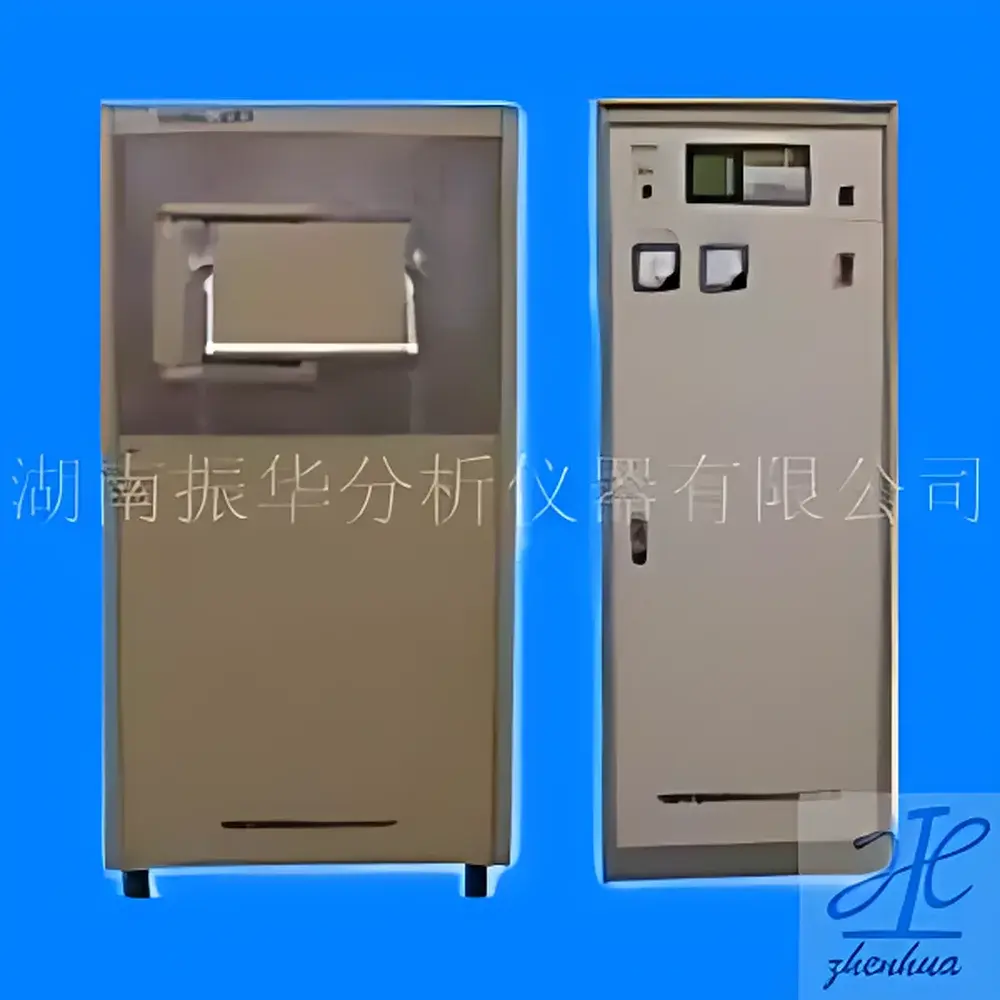
CSL-II Series Reheating Test Furnace
| Origin | Hunan, China |
|---|---|
| Manufacturer Type | Distributor |
| Origin Category | Domestic |
| Model | CSL-II |
| Pricing | Upon Request |
| Maximum Operating Temperature | 1700 °C (short-term up to 1750 °C) |
| Temperature Uniformity in Soak Zone | ±1 °C |
| Ramp Rate | 0–10 °C/min (programmable) |
| Hold Temperature Accuracy | ±2 °C |
| Control System | 50-Step Intelligent PID Programmable Controller |
| Power Rating | 6–36 kW |
| Interface | RS485/RS232 or Ethernet for PC Integration |
| Compliance | Designed per GB/T 5988–2007 “Test Method for Reheating Linear Change of Dense Shaped Refractory Products” |
Overview
The CSL-II Series Reheating Test Furnace is a precision-controlled high-temperature thermal testing system engineered for quantitative evaluation of dimensional stability in dense shaped refractory products under controlled thermal cycling. It operates on the principle of controlled isothermal exposure followed by precise linear change measurement—directly aligned with the thermomechanical response assessment defined in GB/T 5988–2007. Unlike general-purpose muffle furnaces, the CSL-II integrates calibrated thermal uniformity zones, programmable multi-segment thermal profiles, and real-time data logging capabilities to support standardized reheating line change (RLC) testing. Its design prioritizes reproducibility in refractory qualification workflows, enabling laboratories to quantify permanent expansion or contraction after exposure to service-relevant temperatures—critical for quality assurance in refractory manufacturing, R&D validation, and raw material screening.
Key Features
- High-stability heating chamber rated for continuous operation at 1700 °C, with short-term capability up to 1750 °C—validated via thermocouple mapping and periodic uniformity verification.
- Advanced 50-step PID-based temperature controller with dual-loop feedback architecture, delivering ±1 °C stability in the specified soak zone (per ASTM E220 calibration traceability guidelines).
- Programmable ramp rates from 0 to 10 °C/min, enabling simulation of industrial kiln profiles—including slow preheating, dwell segments, and controlled cooling sequences.
- Modular power configuration (6–36 kW) accommodates varying chamber volumes and thermal mass requirements—from benchtop test specimens (e.g., 230 × 114 × 65 mm bricks) to larger custom fixtures.
- Digital interface (RS485/RS232 or Ethernet) supports bidirectional communication with laboratory PCs, enabling remote start/stop, parameter upload/download, and time-stamped acquisition of temperature vs. time datasets.
- Refractory-grade insulation architecture minimizes external surface temperature rise (<45 °C at ambient), ensuring operator safety and energy efficiency compliant with ISO 50001-aligned operational practices.
Sample Compatibility & Compliance
The CSL-II accommodates standard refractory test specimens as defined in GB/T 5988–2007, including fired clay, high-alumina, silica, basic (magnesia–dolomite), and carbon-bonded shapes. Specimen dimensions are typically 230 × 114 × 65 mm or smaller cylindrical rods (Ø25 × 150 mm), placed on low-reactivity ceramic setters within the hot zone. The furnace meets structural and thermal performance criteria outlined in GB/T 5988 for uniformity, stability, and control accuracy. While not certified to IEC 61000-6-4 EMC standards out-of-box, optional shielding and grounding packages are available for GLP-compliant environments requiring audit-ready instrumentation. Data integrity aligns with ALCOA+ principles when used with validated software; full 21 CFR Part 11 compliance requires integration with third-party electronic lab notebook (ELN) systems supporting audit trails and electronic signatures.
Software & Data Management
The furnace interfaces with Windows-based control software featuring a native Chinese GUI (with optional English localization). Software functions include profile creation, real-time temperature curve visualization, automatic hold detection, and CSV export of timestamped thermocouple readings (T1–T4 channels). All control actions—including setpoint changes, ramp rate adjustments, and emergency shutdowns—are logged with user ID, timestamp, and parameter values. Raw data files include embedded metadata (furnace ID, operator, date/time, program name), facilitating traceability in ISO/IEC 17025-accredited labs. For automated reporting, APIs support integration with LIMS platforms via OPC UA or Modbus TCP protocols.
Applications
- Quantification of permanent linear change (%) in refractory bricks, monolithics, and castables after exposure to service temperatures (e.g., 1400–1650 °C).
- Comparative evaluation of binder decomposition behavior across alumina-silica formulations during staged heating cycles.
- Validation of sintering endpoints in advanced ceramic preforms prior to final densification.
- Thermal history studies for metallurgical crucibles subjected to repeated slag contact and thermal shock.
- Supporting ASTM C133, ISO 2245, and JIS R 2201 test protocols through configurable thermal profiles and documented calibration records.
FAQ
What refractory standards does the CSL-II directly support?
It is engineered to meet the thermal performance and procedural requirements of GB/T 5988–2007 and is routinely applied in labs performing ASTM C133 (cold crushing strength) and ISO 2245 (refractoriness under load) sample conditioning.
Can the furnace operate under inert or reducing atmospheres?
Standard configuration is air atmosphere; optional quartz tube inserts with flanged gas inlets (N₂, Ar, CO/CO₂ mixtures) are available for controlled-atmosphere testing—requires separate gas panel and leak-tested manifold.
Is calibration documentation provided with delivery?
Yes—each unit ships with a factory calibration certificate referencing NIST-traceable reference thermocouples (Type S), including temperature uniformity maps at 1000 °C, 1300 °C, and 1650 °C.
What maintenance intervals are recommended for long-term accuracy?
Thermocouple verification every 6 months; heating element resistance check annually; insulation integrity inspection before each 100-hour cumulative run at >1600 °C.
Does the system support automated data archiving to network drives?
Yes—the control software allows scheduled backups to UNC paths or mapped network locations, with configurable file naming conventions incorporating batch IDs and timestamps.



