
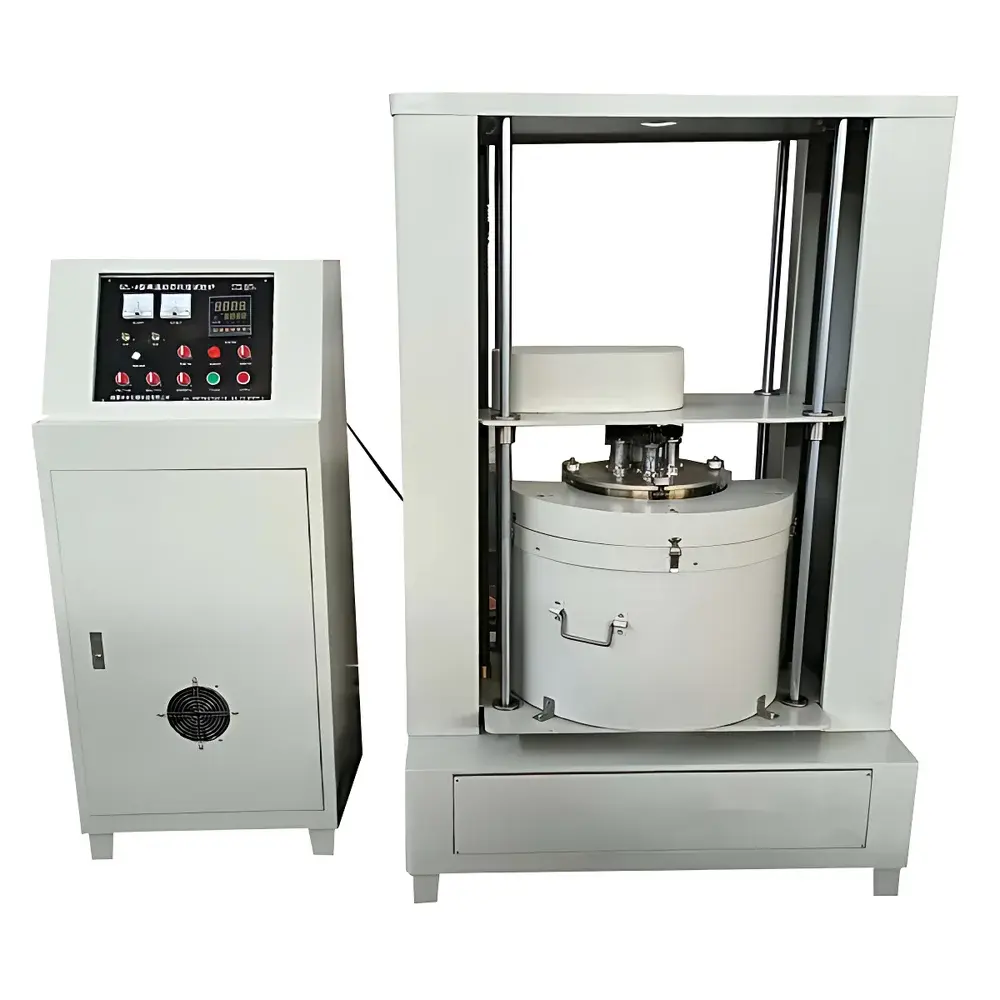
English Product Name
| Origin | Hunan, China |
|---|---|
| Manufacturer Type | Authorized Distributor |
| Origin Category | Domestic (China-made) |
| Model | GZL-B |
| Pricing | Upon Request |
| Max Operating Temperature | 1600 °C |
| Heating Element | Silicon Molybdenum (MoSi₂) Rods |
| Temperature Sensor | Type B Platinum–Rhodium Thermocouple |
| Heating Rate | 1–15 °C/min (RT–1300 °C), 1–5 °C/min (1300–1600 °C) |
| Rated Power | ~16 kW |
| Control System | 50-Stage Programmable PID Controller with Auto-Tuning |
| Temperature Uniformity | ±1 °C (Control), ±2 °C (Soak) |
| Atmosphere Options | Air, N₂, Ar |
| Gas Flow Range | 0–10 L/min |
| Sample Dimensions | 40 × 40 × 230 mm (4 specimens per run) |
| Rotation Mechanism | Planetary motion |
| Crucible | Graphite |
| Slag Addition Port | Integrated top-access port |
| Crucible Lift | Bottom-entry vertical hydraulic/pneumatic lift mechanism |
Overview
The GZL-B High-Temperature Dynamic Slag Resistance Testing Furnace is an engineered laboratory system designed for standardized evaluation of refractory material resistance to molten slag erosion under dynamic thermal and mechanical conditions. It implements the rotating gas-bubbling method specified in GB/T 8931–2007 “Test Methods for Slag Resistance of Refractories”, a national standard aligned with international practices for high-temperature corrosion testing in metallurgical and ceramic industries. The furnace operates as a vertical, atmosphere-controlled resistance-heated chamber, integrating precise thermal management, programmable rotational dynamics, and controlled gas injection to simulate realistic slag–refractory interaction mechanisms—including convective mass transfer, interfacial chemical dissolution, and mechanical scouring. Its core function is to quantify degradation kinetics (e.g., penetration depth, erosion rate, phase boundary migration) by exposing standardized refractory specimens to sustained contact with molten slag at temperatures up to 1600 °C while maintaining reproducible hydrodynamic conditions via planetary rotation and gas sparging.
Key Features
- High-stability temperature control architecture: 50-segment programmable PID controller with auto-tuning capability, enabling repeatable thermal profiles across multiple test cycles while minimizing overshoot and drift (±1 °C control accuracy, ±2 °C uniformity during soak).
- Dual-atmosphere compatibility: Fully sealed chamber supports inert (N₂, Ar) and oxidative (air) environments with calibrated mass flow control (0–10 L/min), critical for isolating redox-driven degradation pathways in slag–refractory systems.
- Dynamic specimen motion system: Four parallel specimens (40 × 40 × 230 mm) rotate simultaneously in planetary mode (5–30 rpm) while fully submerged in molten slag—ensuring uniform exposure, eliminating stagnant boundary layers, and replicating turbulent slag flow encountered in blast furnaces or ladle linings.
- Graphite crucible assembly: Custom-engineered with precise internal geometry (ID 210 mm, height 165 mm) to accommodate defined slag and metal bath heights (40 mm slag / 80 mm iron), with optimized specimen immersion depth (~20 mm above crucible base) to minimize conductive heat loss and ensure representative interfacial reaction zones.
- Integrated operational safety and accessibility: Bottom-lift crucible mechanism eliminates top-loading hazards; dedicated slag addition port enables controlled replenishment without thermal interruption; robust MoSi₂ heating elements and Type B thermocouples ensure long-term stability at 1600 °C.
Sample Compatibility & Compliance
The GZL-B is validated for use with standard refractory shapes per GB/T 8931–2007, including fired bricks, castables, and monolithic samples measuring 40 × 40 × 230 mm. Specimen preparation follows ASTM C704 and ISO 8894-1 protocols for dimensional consistency and surface conditioning. Test reporting complies with GLP principles: raw thermal profiles, rotation logs, gas flow records, and post-test dimensional measurements (e.g., slag line penetration, weight loss, microstructural analysis via SEM/EDS) are traceable to instrument timestamps and operator IDs. While not FDA-regulated, its programmable logic and data logging architecture support 21 CFR Part 11 readiness when integrated with compliant LIMS platforms.
Software & Data Management
The embedded control interface provides real-time visualization of temperature, rotation speed, gas flow, and power output. All setpoints and actual values are logged at user-defined intervals (default: 10 s) to non-volatile memory. Export formats include CSV and Excel-compatible .xls for downstream statistical analysis (e.g., linear regression of erosion depth vs. time). Optional Ethernet/RS485 connectivity enables remote monitoring and integration into centralized lab automation systems. Audit trails record parameter changes, start/stop events, and calibration actions—supporting ISO/IEC 17025 documentation requirements for accredited testing laboratories.
Applications
- Qualification of blast furnace hearth, tuyere, and tap-hole refractories against CaO–SiO₂–Al₂O₃–FeO slag systems.
- Evaluation of ladle lining materials (MgO–C, Al₂O₃–MgO) exposed to secondary steelmaking slags under argon stirring conditions.
- Development testing of novel refractory composites targeting extended campaign life in electric arc furnaces (EAF) and basic oxygen furnaces (BOF).
- Correlation studies between lab-scale dynamic slag resistance and full-scale industrial performance using accelerated testing protocols.
- Academic research on interfacial reaction thermodynamics and kinetic modeling of slag–refractory dissolution mechanisms.
FAQ
What standards does the GZL-B furnace comply with?
It is built to meet the mechanical, thermal, and procedural specifications of GB/T 8931–2007, with design features consistent with ASTM C611, ISO 8894-2, and EN 12934 for high-temperature corrosion testing equipment.
Can the furnace operate continuously at 1600 °C?
Yes—the MoSi₂ heating elements and graphite crucible are rated for continuous operation at 1600 °C in inert atmospheres; air operation is limited to ≤1500 °C to prevent rapid oxidation of heating elements.
Is rotation speed adjustable during a test cycle?
Yes—speed is programmable in real time via the controller interface and can be ramped or held constant at any value between 5 and 30 rpm to simulate varying turbulence intensities.
How is slag added without disrupting temperature stability?
The top-mounted slag addition port allows manual or automated introduction while the crucible remains sealed; thermal inertia of the furnace structure and active PID compensation maintain temperature deviation within ±3 °C during brief access.
What maintenance intervals are recommended for the graphite crucible?
Under typical usage (20–30 cycles at 1500–1600 °C), visual inspection after every 5 tests is advised; replacement is required when wall thickness reduction exceeds 15% or visible cracking occurs near the slag line.



