
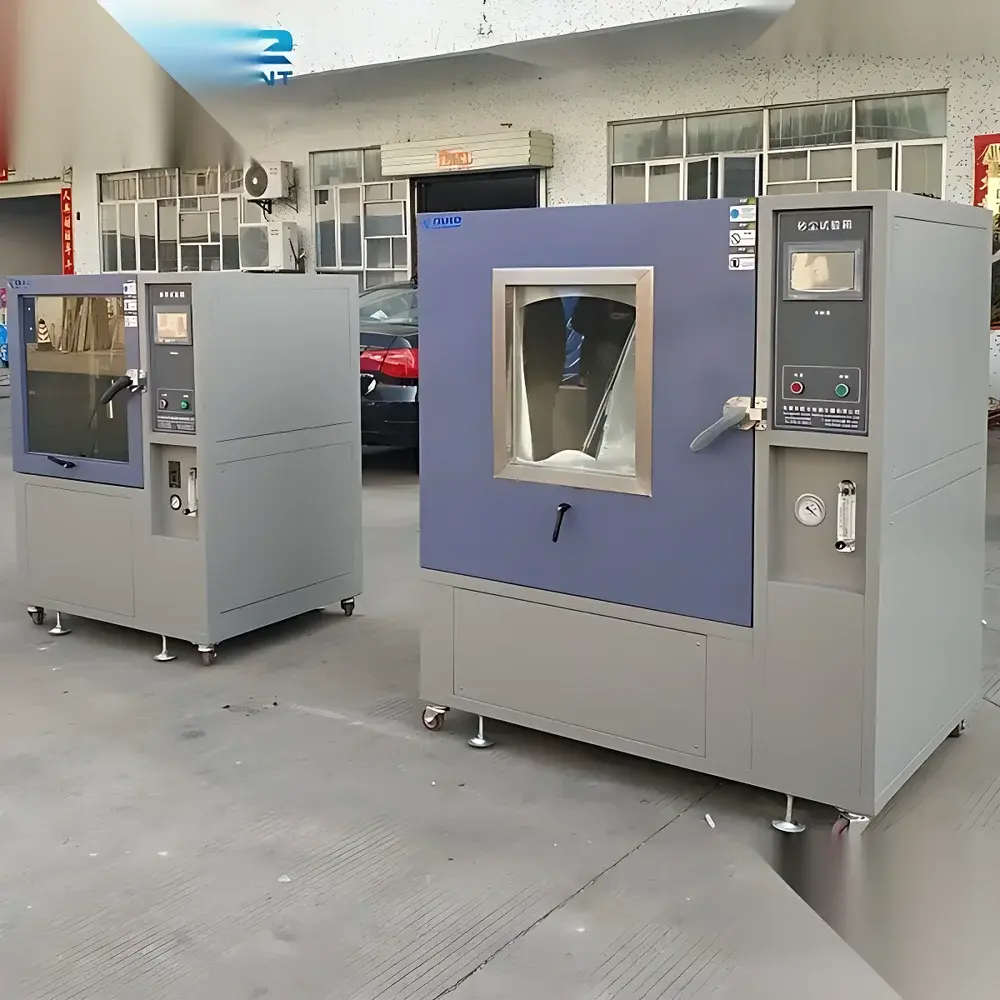
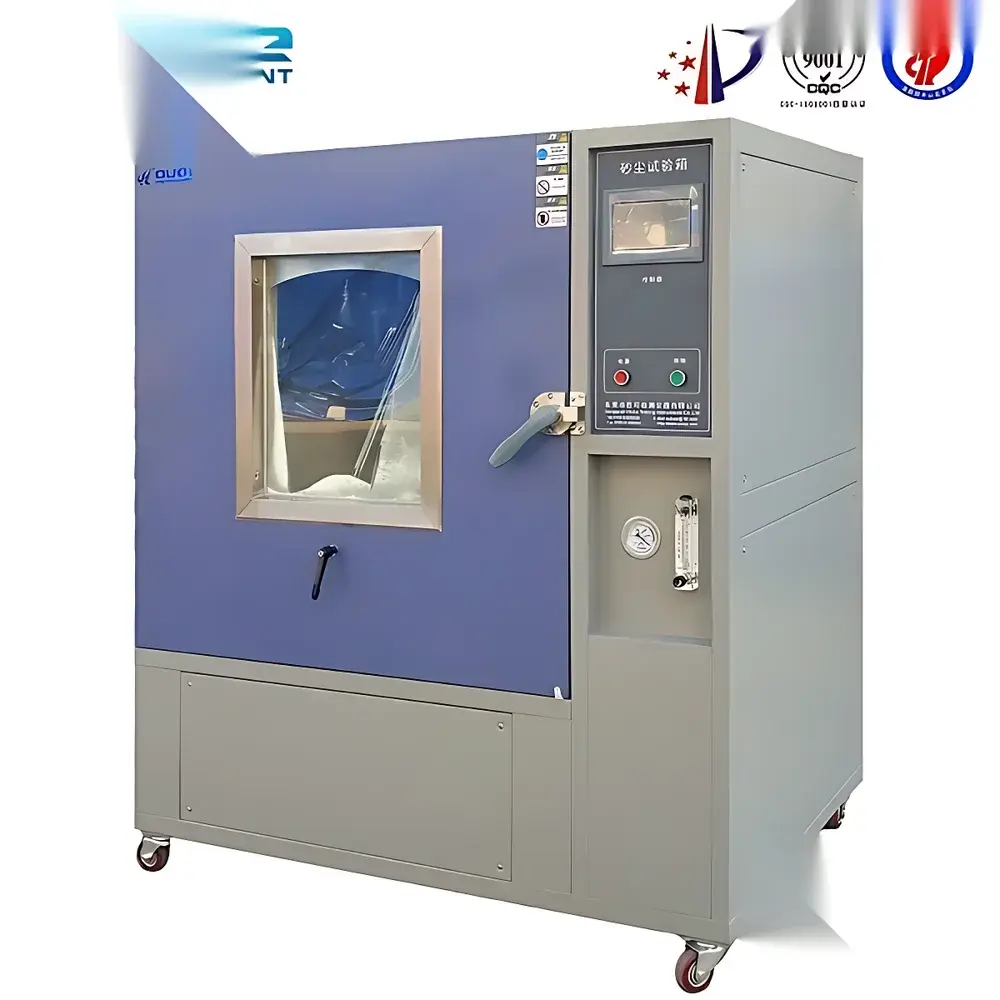
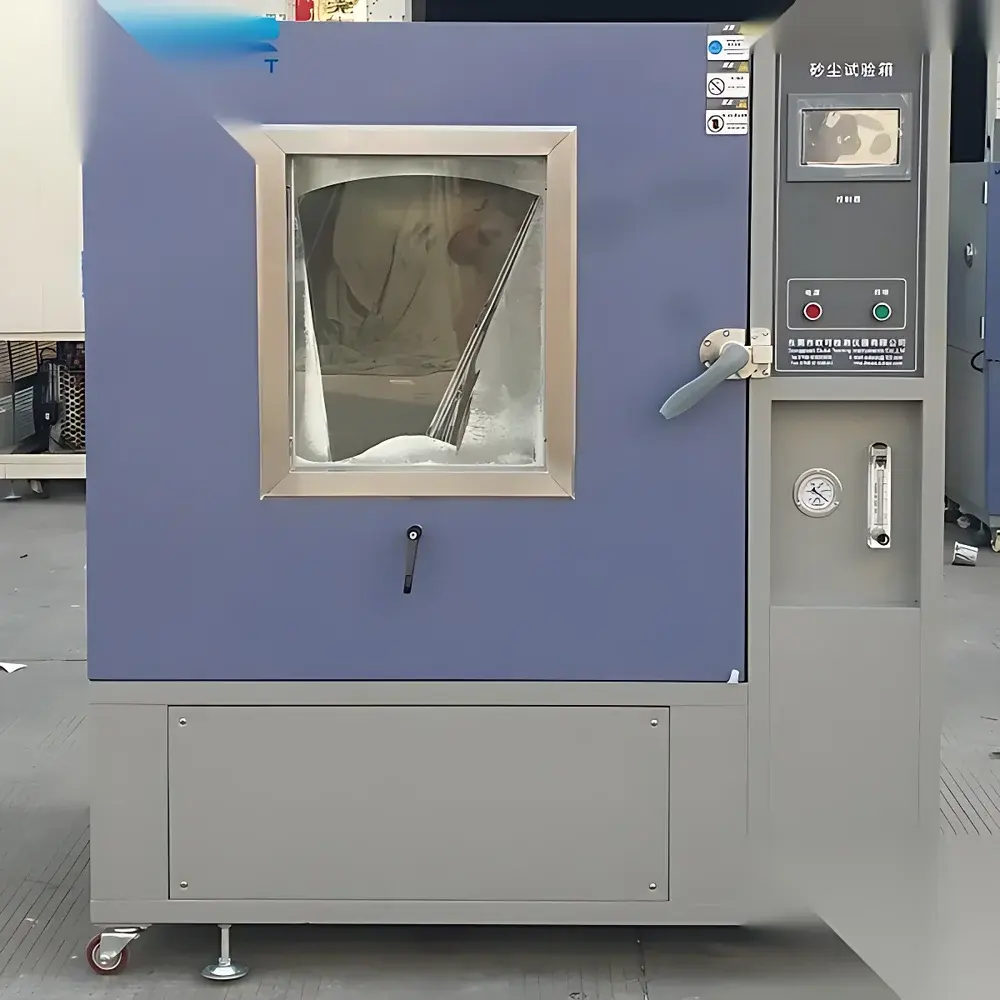
OK-HC-900 Sand and Dust Test Chamber
| Brand | OK |
|---|---|
| Model | HC-900 |
| Type | Ingress Protection (IP) Sand and Dust Test Chamber |
| Internal Dimensions | 900 × 900 × 900 mm (W×H×D) |
| External Dimensions | 1550 × 1800 × 1300 mm (W×H×D) |
| Weight | 320 kg |
| Temperature Range | 20 °C ±15 °C |
| Humidity Range | 45–85 %RH |
| Dust Concentration Options | F1: 60,000 mg/m³ |
| F2 | 3,000 mg/m³ |
| F3 | 100 mg/m³ |
| C1 (Flowing Dust) | 5,000 mg/m³ at 5 m/s |
| C2 (Flowing Dust) | 100 mg/m³ at 5 m/s |
| Test Duration | 0–99 hr (time control), 0–999 sec (cycle control) |
| Power Supply | 220 V AC, single-phase, 5 kW |
Overview
The OK-HC-900 Sand and Dust Test Chamber is an engineered environmental test system designed to evaluate the dust ingress resistance of electrical and electronic enclosures in accordance with IEC 60529 (IP Code), ISO 20653, and relevant national standards such as GB/T 4208. It supports both floating dust (non-fluidized, low-velocity suspension) and flowing dust (high-velocity, wind-driven particle transport) test modes—enabling full compliance verification for IP5X (dust-protected) and IP6X (dust-tight) classifications. The chamber operates on a controlled aerosol generation principle: dust is introduced via a high-efficiency pneumatic dispersion system, while integrated vibration actuators ensure consistent powder fluidization and uniform airborne concentration across repeated test cycles. Temperature and humidity are independently regulated within defined operational envelopes to replicate realistic ambient stress conditions during ingress evaluation.
Key Features
- Triple independent dust delivery channels (F1, F2, F3) with front-panel digital control—enabling rapid selection of standardized dust concentrations without hardware reconfiguration.
- Integrated mechanical vibration module synchronized with dust injection timing, minimizing inter-test variability in suspended particulate density.
- Calibrated dust concentration sampling port with ISO-standardized isokinetic probe geometry, facilitating traceable gravimetric or optical verification per ASTM D1317 or ISO 12103-1 reference dusts (e.g., A2 Fine Test Dust).
- Hybrid test capability: single-chamber architecture supports both static floating dust (IP5X/IP6X) and dynamic flowing dust (C1/C2) protocols—eliminating need for separate dedicated units.
- Robust stainless-steel internal chamber construction with sealed access ports, HEPA-filtered exhaust recirculation, and explosion-proof lighting compliant with Class II, Division 2 hazardous location requirements.
- Programmable cycle logic with dual time resolution: fine-grained 1-second step control for exposure initiation/termination and coarse 1-minute resolution for extended dwell periods up to 99 hours.
Sample Compatibility & Compliance
The OK-HC-900 accommodates samples up to 900 mm cubed, making it suitable for industrial control panels, automotive ECUs, outdoor lighting fixtures, and handheld consumer electronics. All test procedures align with the procedural rigor required for third-party certification bodies (e.g., UL, TÜV, SGS). The chamber meets the physical and metrological criteria specified in IEC 60529 Annex B and ISO 20653:2013 Clause 6 for dust testing—including air velocity profiles, particle size distribution fidelity (verified using cascade impactors), and chamber volume-to-sample ratio constraints. Optional calibration certificates traceable to NIST or PTB standards are available upon request for GLP/GMP-regulated validation protocols.
Software & Data Management
While the base configuration features a standalone PLC-based HMI with real-time parameter display and event logging, optional PC-integrated software provides expanded functionality: automated test sequence scripting, timestamped CSV data export (temperature, RH, elapsed time, selected mode), and audit-trail generation compliant with FDA 21 CFR Part 11 requirements. All logged parameters include operator ID tagging, change history, and electronic signature fields—supporting IQ/OQ/PQ documentation for regulated industries. Remote monitoring via Modbus TCP or Ethernet/IP is supported for integration into centralized lab management systems.
Applications
- Validation of ingress protection claims for IP54, IP55, IP56, IP65, IP66, IP67, and IP68-rated devices under simulated field dust exposure.
- Accelerated durability assessment of gasket integrity, sealing lip deformation, and filter media clogging behavior under cyclic thermal-humidity-dust stress.
- Comparative analysis of material surface erosion rates using standardized abrasion-sensitive substrates (e.g., aluminum foil witness plates per IEC 60529 Annex B.3.2).
- Pre-compliance screening for automotive components subject to ISO 20653 (road vehicle ingress protection) and MIL-STD-810H Method 510.7 (sand and dust).
- Research-grade studies on dust adhesion mechanisms, electrostatic charge accumulation on insulating surfaces, and filtration efficiency degradation over time.
FAQ
What dust types are compatible with the OK-HC-900?
The chamber is validated for use with ISO 12103-1 A2 Fine Test Dust and A4 Coarse Test Dust, as well as equivalent ASTM D1317-certified silica-based powders. Custom dust formulations (e.g., carbon black, talc, or metal oxides) may be used subject to safety review and chamber compatibility testing.
Does the system include dust recovery and filtration?
Yes—the chamber integrates a multi-stage filtration system comprising pre-filters, HEPA H14 final filters, and optional activated carbon scrubbers to meet occupational exposure limits (OELs) and local exhaust ventilation (LEV) regulations.
Can test parameters be exported for regulatory submission?
All runtime logs—including start/stop timestamps, setpoints, deviations, and operator actions—are exportable in CSV or PDF format with embedded digital signatures, satisfying documentation requirements for ISO/IEC 17025-accredited laboratories.
Is external temperature/humidity control required?
No—the built-in conditioning system maintains stable 20 °C ±15 °C and 45–85 %RH environments without auxiliary HVAC support; however, ambient room temperature must remain within 15–35 °C for optimal compressor performance.
What maintenance intervals are recommended?
Filter replacement every 200 operational hours, vibration actuator lubrication every 6 months, and annual calibration of temperature/RH sensors and dust concentration transducers—per manufacturer’s maintenance schedule aligned with ISO/IEC 17025 clause 6.4.3.
Related Products



