
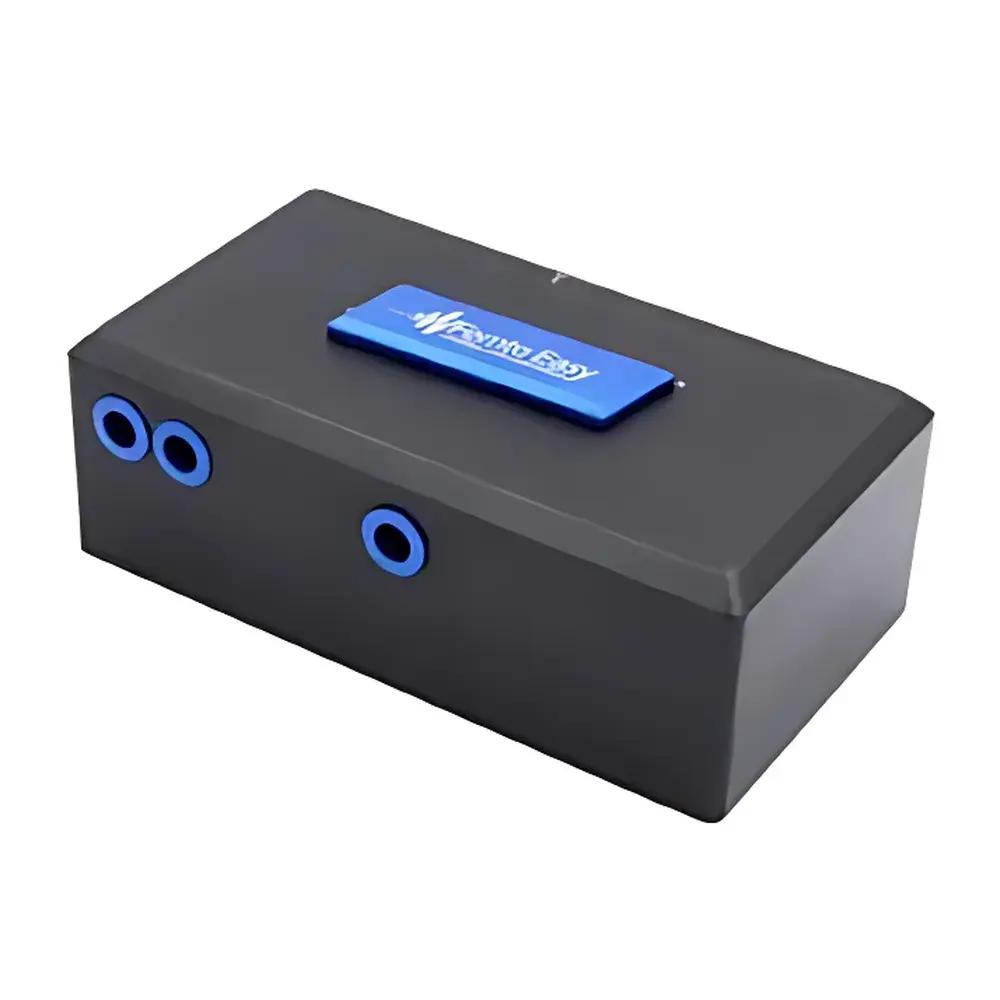
Femto Easy Nano4th Quadrupler for Low-Energy Femtosecond Pulse Harmonic Generation
| Brand | FEMTOEASY |
|---|---|
| Origin | France |
| Model | Nano4th (1064 nm / 532 nm / 266 nm) |
| Output Wavelengths | 1064 nm, 532 nm, 266 nm |
| Average Power (at 80 MHz) | 2 W @ 1064 nm, 1 W @ 532 nm, 750 mW @ 266 nm, 170 mW @ 266 nm (4th harmonic) |
| Pulse Duration | <120 fs (fundamental & SHG), <65 fs (THG), <60 fs (estimated for 4th harmonic) |
| Repetition Rate | 80 MHz |
| Conversion Efficiency | >45% (SHG), >35% (THG), >8% (4th harmonic) |
| Polarization | Vertical (1064 nm), Horizontal (532 nm), Vertical (266 nm) |
| Laser Compatibility | 1030–1064 nm fundamental, nJ-level pulse energy, MHz-repetition-rate ultrafast oscillators |
Overview
The Femto Easy Nano4th Quadrupler is an engineered optical frequency conversion module designed for precise, robust, and alignment-free generation of second (532 nm) and fourth (266 nm) harmonics from low-energy femtosecond infrared laser pulses. Operating on the principle of cascaded nonlinear optical processes—specifically type-I and type-II phase-matched second-harmonic generation (SHG) in beta-barium borate (BBO) and lithium triborate (LBO) crystals—the Nano4th delivers high-fidelity harmonic output without requiring active stabilization or real-time feedback control. It is optimized for oscillator-level sources with pulse energies in the nanojoule range, repetition rates up to 80 MHz, and pulse durations below 120 fs. Unlike bulk harmonic generators requiring manual crystal alignment and environmental isolation, the Nano4th integrates all nonlinear stages into a monolithic, hermetically sealed, nitrogen-purged platform—ensuring long-term stability under laboratory and industrial conditions. Its compact footprint (<100 mm × 80 mm × 50 mm) enables direct coupling to ultrafast oscillators such as Spark Lasers’ Alcor 1064, facilitating seamless integration into ultrafast spectroscopy, attosecond science, and UV-pump/IR-probe experimental architectures.
Key Features
- Monolithic, alignment-free architecture with pre-optimized phase-matching angles and temperature-stable crystal mounts
- Hermetically sealed enclosure with continuous nitrogen purge to suppress air-induced absorption and surface contamination at 266 nm
- Simultaneous, stable output at three wavelengths: fundamental (1064 nm), second harmonic (532 nm), and fourth harmonic (266 nm)
- High average power handling: up to 2 W at 1064 nm input, delivering >750 mW at 266 nm with >8% overall 4ω conversion efficiency
- Preserved ultrashort pulse duration: <60 fs (estimated) at 266 nm, enabling time-resolved studies in the deep-UV spectral region
- Industrial-grade mechanical design compliant with ISO 10110 optical mounting standards and RoHS directives
- No external software, drivers, or motorized actuators required—fully passive operation after initial installation
Sample Compatibility & Compliance
The Nano4th is validated for use with mode-locked Ti:sapphire and Yb-based fiber oscillators emitting between 1030 nm and 1064 nm, with pulse energies from 1–20 nJ and repetition rates from 10 MHz to 80 MHz. It meets optical safety Class 3B requirements per IEC 60825-1 when operated within specified input parameters. All internal optics are coated to MIL-C-48497A specifications for laser-induced damage threshold (LIDT > 500 MW/cm² for 100-fs pulses at 1064 nm). The device conforms to CE marking requirements for electromagnetic compatibility (EN 61326-1) and low-voltage directive (2014/35/EU). While not a regulated medical or diagnostic device, its optical performance traceability supports GLP-compliant data acquisition workflows when integrated with calibrated photodiodes and autocorrelators.
Software & Data Management
The Nano4th operates entirely in hardware—no firmware, no embedded controller, and no proprietary software interface. This design eliminates driver dependencies, OS compatibility constraints, and cybersecurity vulnerabilities associated with connected instrumentation. Harmonic output intensity and spatial mode are monitored externally using standard power meters (e.g., Ophir PD300 series) and beam profilers (e.g., Thorlabs BP209-VIS). For automated data logging, users integrate the Nano4th into existing LabVIEW, Python (PyVISA), or MATLAB environments via compatible power sensor APIs. Audit trails for calibration and usage history are maintained externally in accordance with ISO/IEC 17025 documentation practices. No FDA 21 CFR Part 11 compliance is claimed, as the device performs no analytical computation or electronic record generation.
Applications
- Deep-UV transient absorption spectroscopy (266 nm pump, IR probe)
- Two-photon and multi-photon microscopy excitation at 532 nm and 266 nm
- Photoelectron spectroscopy (PES) and angle-resolved PES (ARPES) light sources
- Seed injection for high-energy UV amplifier systems (e.g., Ti:sapphire + BBO OPA chains)
- In-situ monitoring of thin-film photochemical reactions under nanosecond-to-femtosecond UV irradiation
- Calibration reference source for UV spectroradiometers and monochromator linearity verification
FAQ
Can the Nano4th be used with amplified laser systems?
No—it is engineered exclusively for oscillator-level pulse energies (nJ range). Amplified systems (μJ to mJ) require custom-designed harmonic generators with water-cooled crystals and adaptive phase-matching.
Is vacuum compatibility available?
Standard units are nitrogen-purged only; vacuum-compatible variants (CF-35 flange, bakeable to 80°C) are available upon request with lead-time extension.
Does output polarization affect downstream experiments?
Yes—polarization states are fixed per harmonic (vertical @ 1064/266 nm, horizontal @ 532 nm). Users must account for this in polarization-sensitive setups such as SHG microscopy or chiral dichroism measurements.
What maintenance is required?
None beyond periodic inspection of purge gas flow rate and inlet filter integrity. No optical realignment or crystal replacement is needed over typical 5+ year service life.
Is third-harmonic generation supported?
Not natively—the Nano4th generates 2ω and 4ω directly. THG (3ω at 355 nm) requires separate BBO-based modules and is not part of this product’s functional scope.





