
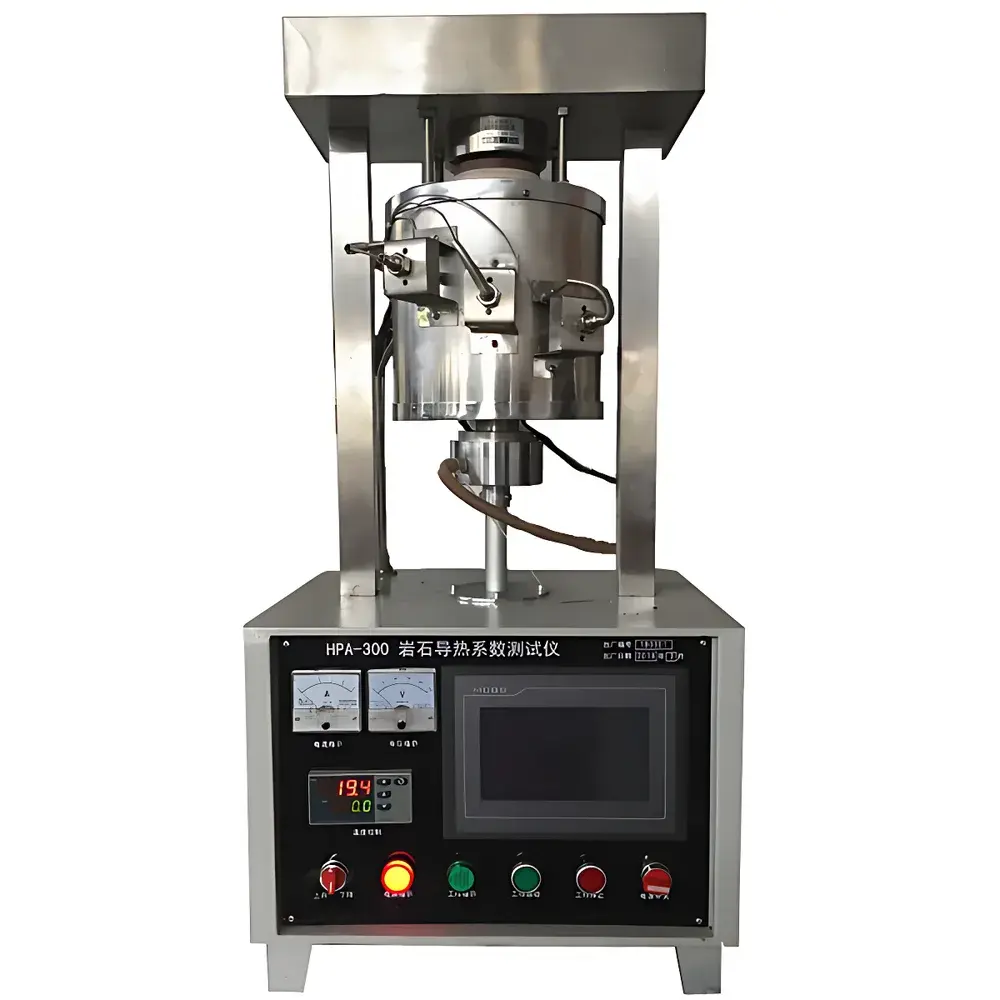
HPA-300 Rock Thermal Conductivity Analyzer
| Origin | Hunan, China |
|---|---|
| Manufacturer Type | Distributor |
| Origin Category | Domestic |
| Model | HPA-300 |
| Price Range | USD 7,000–14,000 |
| Instrument Type | Heat Flow Method |
| Dimensions (L×W×H) | 750 × 650 × 1100 mm |
| Accuracy | ±3% |
| Thermal Conductivity Range | 0.015–100 W/(m·K) |
| Repeatability | ±1% |
| Maximum Test Temperature | 300 °C |
| Applied Load Range | 0–1000 N (adjustable) |
| Specimen Size | φ50 × 100 mm or φ37.5 × 100 mm |
| Cooling Base Temperature | 20 °C (integrated constant-temperature water bath) |
| Axial Temperature Sensors | 4 points |
| Radial Temperature Sensors | 3–6 gradient points |
| Heating Power | 60 W |
| Software | Fully Automated Acquisition & Analysis Suite with Touchscreen Interface |
Overview
The HPA-300 Rock Thermal Conductivity Analyzer is a precision-engineered instrument designed for the quantitative determination of thermal conductivity and thermal resistance in geological specimens—including intact rock cores, sedimentary samples, engineered geomaterials, and high- to medium-conductivity composites. It operates on the principle of the transient heat flow method under controlled uniaxial compression, combining longitudinal heat flux measurement with radial temperature profiling to resolve both axial and lateral heat transfer behavior. Unlike steady-state guarded-hot-plate systems, the HPA-300 utilizes dynamic thermal response acquisition during controlled heating cycles, enabling rapid characterization (typical test duration: 8–15 minutes per specimen) without requiring extended thermal equilibration. The system maintains a fixed cold-end reference at 20 °C via an integrated recirculating water bath, while the hot end is actively heated up to 300 °C—enabling evaluation across geologically relevant temperature gradients. Its vertical loading architecture ensures uniform interfacial contact pressure (0–1000 N, digitally regulated), minimizing contact resistance artifacts commonly observed in heterogeneous rock matrices.
Key Features
- Vertical modular design with motorized load application and real-time pressure feedback control
- Dual-axis temperature mapping: 4-point axial thermocouple array + 3–6-point radial gradient sensing for anisotropic thermal profiling
- Integrated constant-temperature cooling base (20 °C) with PID-regulated water bath subsystem
- 60 W programmable heater with time-resolved power modulation for transient thermal excitation
- Touchscreen human-machine interface (HMI) with embedded test sequencing logic and parameter validation
- Automated data acquisition synchronized with thermal transients, sampling at ≥10 Hz resolution
- Compliance-ready architecture supporting audit trails, user access levels, and electronic signature protocols per FDA 21 CFR Part 11 guidelines
Sample Compatibility & Compliance
The HPA-300 accommodates cylindrical rock specimens conforming to ASTM D5432 (Standard Test Method for Thermal Conductivity of Geologic Materials) and ISO 22007-2 (Plastics — Determination of Thermal Conductivity and Thermal Diffusivity — Part 2: Transient Plane Source Method). Standard sample geometries include φ50 × 100 mm and φ37.5 × 100 mm core plugs, compatible with common core logging and reservoir simulation workflows. The system supports dry, saturated, and partially saturated conditions when used with optional environmental enclosures. All thermal calibration procedures follow NIST-traceable reference standards (e.g., SRM 1470a, certified quartzite). Data output formats comply with ASTM E2584 (Digital Data Exchange for Thermal Properties) and are exportable as CSV, XML, or PDF reports suitable for GLP/GMP documentation and regulatory submission.
Software & Data Management
The proprietary HPA-ControlSuite software provides full lifecycle management—from test configuration and real-time monitoring to post-acquisition curve fitting and uncertainty quantification. It implements ISO/IEC 17025-compliant uncertainty propagation models incorporating sensor drift, contact resistance variability, and dimensional tolerances. Raw thermal response curves are processed using inverse numerical modeling (1D+ radial finite-difference solver) to decouple conductive and interfacial contributions. The software enforces role-based access control (administrator, operator, reviewer), logs all parameter changes with timestamps and user IDs, and generates tamper-evident digital signatures. Export modules support direct integration with LIMS platforms via OPC UA or RESTful API interfaces.
Applications
- Geothermal reservoir characterization: thermal diffusivity mapping of igneous, metamorphic, and sedimentary formations
- Petroleum engineering: thermal conductivity profiling of drill core samples for enhanced oil recovery (EOR) modeling
- Nuclear waste disposal studies: long-term thermal stability assessment of host rock barriers (e.g., granite, claystone)
- Carbon sequestration site evaluation: monitoring thermal evolution in CO₂-saturated caprock systems
- Building material R&D: comparative analysis of engineered aggregates and cementitious composites
- Academic research in rock physics, planetary geology, and subsurface energy storage
FAQ
What standards does the HPA-300 comply with for geological thermal testing?
The instrument conforms to ASTM D5432, ISO 22007-2, and GB/T 10294 (Chinese national standard for thermal conductivity testing), with calibration traceability to NIST SRMs.
Can the HPA-300 measure anisotropic thermal conductivity?
Yes—the radial temperature gradient array enables directional thermal resistance estimation; combined with axial flux data, it supports tensor-based interpretation for weakly anisotropic rocks.
Is external water chiller required for operation?
No—the unit includes a self-contained, PID-controlled water bath maintaining 20 °C at the cold boundary without auxiliary cooling infrastructure.
How is contact resistance minimized during high-pressure testing?
The automated loading system applies incremental force while monitoring thermal impedance in real time, terminating compression at the inflection point where interfacial resistance stabilizes.
Does the software support multi-specimen batch processing?
Yes—HPA-ControlSuite allows queued test sequences with automatic report generation, metadata tagging, and cross-sample statistical comparison.



