
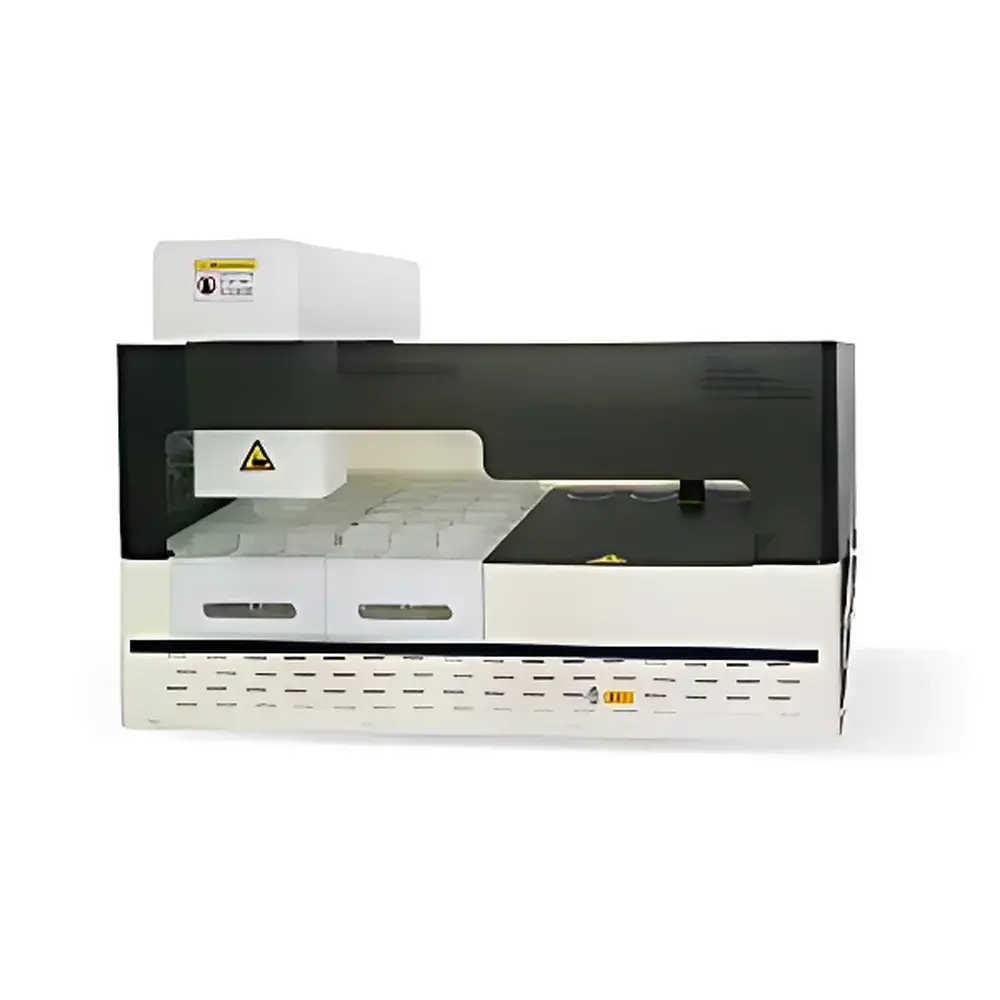
HUANKONG Model 1800 Fully Automatic Titrator
| Brand | HUANKONG |
|---|---|
| Origin | Shandong, China |
| Manufacturer Type | Direct Manufacturer |
| Country of Origin | China |
| Model | 1800 |
| Pricing | Upon Request |
Overview
The HUANKONG Model 1800 Fully Automatic Titrator is an intelligent, colorimetric endpoint detection system engineered for precise and reproducible volumetric analysis in compliance with standardized wet-chemistry methods. Unlike potentiometric or pH-based titrators, this instrument employs a high-sensitivity optical sensor architecture inspired by biomimetic spectral recognition principles—capable of dynamically distinguishing subtle chromatic transitions in colored or turbid solutions without reliance on reference electrodes or indicator-specific calibration. It is specifically designed to automate classical visual endpoint titrations defined in national environmental, food safety, and potable water standards—including redox, acid-base, complexometric, and precipitation titrations—while eliminating subjective interpretation and operator-induced variability.
Key Features
- Multi-position sample carousel supporting up to 16 independent sample positions, enabling true unattended batch processing with sequential auto-loading, titrant delivery, endpoint detection, and result calculation.
- Imported optical endpoint sensor with adaptive spectral filtering, calibrated to recognize endpoint shifts across broad visible wavelengths (400–700 nm); validated performance under variable matrix conditions including highly colored, suspended, or opalescent samples.
- Preloaded method library compliant with key Chinese national standards (e.g., HJ 828, GB 5750.4, GB 5009.34), with user-configurable titration parameters including titrant concentration, equivalence point algorithm (first derivative, inflection point, or fixed ΔA threshold), and volume increment logic.
- Integrated fluidic management system featuring automatic post-titration line rinsing with dual-solvent capability (water + organic solvent), programmable waste aspiration, and peristaltic pump-driven reagent delivery with real-time flow monitoring and air-bubble detection.
- Rugged industrial-grade chassis with IP54-rated enclosure, corrosion-resistant reagent handling components (PTFE-coated tubing, ceramic valve manifolds), and ambient temperature operation range of 10–35 °C.
Sample Compatibility & Compliance
The Model 1800 supports aqueous, alcoholic, and mildly acidic/alkaline matrices typical of environmental wastewater, drinking water, food extracts, and pharmaceutical excipients. Its optical detection modality ensures compatibility with samples that would otherwise interfere with conventional electrode-based systems—such as iodine-starch complexes (SO₂ analysis), dichromate-COD digests, EDTA-metal chelates (hardness), or iodometric redox systems. Method validation aligns with GLP principles and supports audit-ready documentation per ISO/IEC 17025 requirements. While not certified to FDA 21 CFR Part 11 out-of-the-box, the firmware architecture permits traceable electronic signatures and full audit trail configuration when deployed within validated laboratory information management systems (LIMS).
Software & Data Management
The embedded control software provides intuitive touchscreen navigation, real-time titration curve visualization (absorbance vs. volume), and automated report generation in PDF and CSV formats. All raw absorbance data, titrant consumption logs, endpoint coordinates, and operator metadata are timestamped and stored locally with optional network backup via Ethernet or USB export. The system supports method export/import for cross-instrument standardization and includes password-protected user roles (Operator, Supervisor, Administrator) to enforce procedural integrity. Raw data files retain native resolution (0.01 mL volume increments, 0.001 AU absorbance steps) and are compatible with third-party statistical analysis platforms.
Applications
- Environmental testing: COD determination per HJ 828 using potassium dichromate oxidation with ferroin endpoint detection.
- Drinking water quality: Total hardness quantification (Ca²⁺/Mg²⁺) via EDTA titration with Eriochrome Black T indicator (GB 5750.4).
- Food safety analysis: SO₂ content in dried fruits and wine using iodometric titration (GB 5009.34); also applicable to acid value, peroxide value, and iodine value assays.
- Industrial QA/QC: Salt iodization level verification, cation exchange capacity (CEC) in soils, and organic matter estimation in agricultural samples.
- Educational laboratories: Standardized teaching platform for fundamental titrimetric concepts with minimized consumables waste and repeatable pedagogical outcomes.
FAQ
Does the Model 1800 support non-standard or custom titration methods?
Yes—users may define new methods via editable parameter templates, including custom indicator selection, absorbance threshold logic, and multi-step titration sequences.
Is calibration required before each analysis?
No routine recalibration is needed; however, periodic verification using certified reference materials (e.g., 0.1 mol/L KHP for acid-base, 0.02 mol/L KMnO₄ for redox) is recommended per ISO 8655 and internal QA protocols.
Can the instrument integrate with LIMS or ELN systems?
It supports ASCII-based data export via RS-232 or TCP/IP; direct API integration requires middleware configuration compatible with ASTM E1384 or HL7 standards.
What maintenance intervals are recommended?
Daily: rinse lines and check tip cleanliness. Quarterly: replace peristaltic pump tubing and validate sensor baseline drift. Annually: full optical alignment verification and firmware update.
Is the system suitable for GMP-regulated environments?
When configured with enabled audit trails, electronic signatures, and documented change control procedures, it meets foundational GMP data integrity expectations for QC labs performing compendial testing.



