
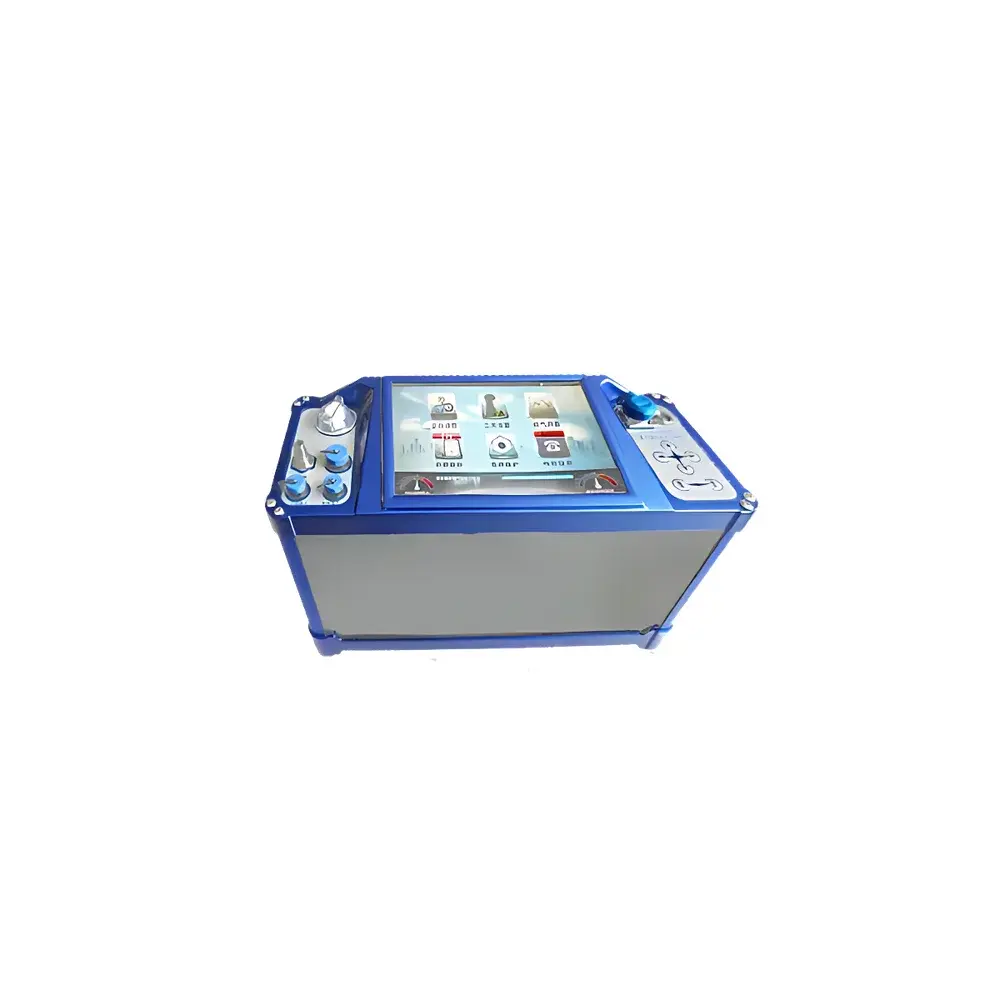
HUANKONG GHK-2400 Portable UV Differential Optical Absorption Spectroscopy (DOAS) Flue Gas Analyzer
| Brand | HUANKONG |
|---|---|
| Origin | Shandong, China |
| Manufacturer Type | Direct Manufacturer |
| Instrument Type | Portable Flue Gas Analyzer |
| Model | GHK-2400 |
| Measurement Principle | UV DOAS (Differential Optical Absorption Spectroscopy) |
| Measured Gases | SO₂, NO, NO₂, O₂, CO, CO₂ |
| Measurement Uncertainty | ≤ ±5.0% FS |
| Repeatability | ≤ 2.0% RSD |
| Response Time (T₉₀) | ≤ 90 s |
| Zero Drift & Span Drift (24 h) | ≤ 5.0% FS |
| Water Vapor Interference | Negligible (DOAS-based water vapor correction embedded) |
| Regulatory Compliance | GB/T 37186–2018, HJ 1131–2020, HJ 1132–2020, HJ 1045–2019, JJG 968–2002, DB37/T 2704–2015, DB37/T 2705–2015, DB37/T 2641–2015, HJ/T 397–2007, GB 13233–2011 |
Overview
The HUANKONG GHK-2400 is a field-deployable, UV-based differential optical absorption spectroscopy (DOAS) flue gas analyzer engineered for high-fidelity, multi-component emission monitoring in stationary source exhaust streams. Unlike conventional electrochemical or NDIR-based analyzers, the GHK-2400 employs broadband ultraviolet light (190–230 nm) coupled with chemometric spectral deconvolution to quantify SO₂, NO, NO₂, O₂, CO, and CO₂ simultaneously—without cross-sensitivity to water vapor, particulate scattering, or optical window fouling. This physical measurement principle ensures trace-level detection stability under high-humidity, low-concentration, and sulfur-rich industrial conditions—particularly relevant for coal-fired power plants, waste incinerators, cement kilns, and chemical process heaters operating under ultra-low emission (ULE) regulatory regimes. The instrument’s optical path is sealed and temperature-stabilized, minimizing thermal drift and enabling continuous operation across ambient temperatures from –10 °C to 50 °C.
Key Features
- UV DOAS core engine with pulsed xenon lamp source: 10,000 h lifetime, and inherent immunity to lamp intensity drift via reference-channel normalization
- Dual-range auto-switching optical detection: High-sensitivity mode (e.g., 0–100 ppm SO₂) and extended-range mode (e.g., 0–5000 ppm SO₂) selected dynamically based on real-time signal saturation thresholds
- Integrated sampling probe assembly: Titanium alloy inner tube (rated to 600 °C), rotatable Pitot tube for directional alignment, and integrated thermocouple + pressure sensor—all housed in a single ergonomic probe
- Quadruple-function cable: Unified conduit for thermocouple signal (smoke temperature), RS232/USB communication, DC power supply (12–26 V), and conditioned sample gas flow—reducing field setup complexity and trip hazards
- Robust environmental hardening: Internal thermostatic control (±0.5 °C) for optical cell and detector; shock-absorbing mounting for critical optics; IP54-rated enclosure with corrosion-resistant anodized aluminum chassis
- Human-centered interface: 7-inch capacitive touchscreen with glove-compatible operation, redundant tactile keypad, anti-glare display, and context-aware menu navigation
- Onboard energy management: Rechargeable Li-ion battery pack supporting ≥4 h continuous dual-load operation (analyzer + heated probe), with intelligent low-power sleep and state-of-charge telemetry
- Wide-input universal power: Accepts AC 80–260 V / 50–60 Hz or DC 12–26 V, featuring reverse-polarity, overvoltage, and overcurrent protection per IEC 61000-4-5
Sample Compatibility & Compliance
The GHK-2400 is validated for direct-stack and duct-mounted sampling of hot, wet, and particulate-laden flue gases up to 200 °C (with optional high-temp probe extension). Its DOAS architecture inherently corrects for broadband water vapor absorption and Mie scattering effects—eliminating the need for aggressive gas conditioning (e.g., chiller-based dew point suppression) that compromises NO₂ recovery or introduces CO oxidation artifacts. All measurement algorithms and calibration protocols conform to Chinese national and provincial standards including GB/T 37186–2018 (SO₂/NOₓ by UV-DOAS), HJ 1131–2020 and HJ 1132–2020 (portable UV absorption methods), and HJ 1045–2019 (performance verification requirements). Data integrity meets GLP-aligned audit trail specifications: timestamped raw spectra, calibrated concentration outputs, diagnostic logs (lamp energy, cell temperature, flow rate), and user action records are stored with write-once/read-many (WORM) attributes. Optional Bluetooth 5.0 printer output supports field-validated hardcopy reporting compliant with HJ/T 397–2007 sampling documentation requirements.
Software & Data Management
Firmware v3.2+ includes embedded spectral processing engine performing real-time DOAS fitting using least-squares minimization against high-resolution reference cross-sections (HITRAN-based libraries for SO₂, NO, NO₂, O₂, H₂O, CO, CO₂). All calibration coefficients—including zero/span drift compensation factors—are stored in tamper-evident EEPROM with cryptographic checksums. Data logging occurs at 1-second resolution for raw spectra and 60-second intervals for averaged concentration values, with internal storage capacity exceeding 10 million data points. Export options include FAT32-formatted USB flash drives (CSV/Excel-ready), PC synchronization via USB-C or Bluetooth, and optional LTE-M/NB-IoT module (certified per CE RED and FCC Part 24) enabling secure TLS 1.2 transmission to cloud platforms compliant with ISO/IEC 27001. Audit log entries record operator ID, calibration events, firmware updates, and configuration changes—supporting FDA 21 CFR Part 11 readiness when paired with external identity management systems.
Applications
- Regulatory stack testing per GB 13233–2011 (coal-fired power plants) and local ULE mandates (e.g., Shandong DB37/T 2641–2015)
- Performance verification of selective catalytic reduction (SCR) and wet flue gas desulfurization (WFGD) systems
- Commissioning and periodic QA/QC of continuous emission monitoring systems (CEMS)
- Source apportionment studies requiring speciated NOₓ (NO vs. NO₂) and sulfur speciation under variable load conditions
- Mobile monitoring campaigns across multiple stacks using single-instrument multi-point survey protocols
- Research-grade combustion diagnostics where water vapor robustness and sub-ppm NO₂ detection are critical
FAQ
Does the GHK-2400 require zero/span calibration before each use?
No—daily zero calibration is recommended but not mandatory due to built-in zero-tracking algorithm; full span calibration is required every 7 days or after filter replacement, per HJ 1045–2019.
Can the instrument measure NH₃ or H₂S out-of-the-box?
NH₃ and H₂S are supported via optional firmware-enabled spectral library expansion (requires factory configuration); hardware modification is not needed.
Is the GHK-2400 suitable for high-dust applications?
Yes—the integrated heated probe and cyclonic pre-filter reduce particle loading; however, for >5 g/m³ dust loads, an external ceramic filter (e.g., Schiedel type) is recommended upstream.
What is the minimum detectable concentration (MDC) for NO₂?
Based on HJ 1132–2020 test methodology, MDC is 0.3 ppm (S/N ≥ 3) in standard range mode, verified using certified gas standards traceable to NIM.
How is data security ensured during wireless transmission?
All IoT modules employ AES-256 encryption for payload, certificate-based mutual TLS authentication, and configurable data retention policies aligned with ISO/IEC 27001 Annex A.8.2.3.







