
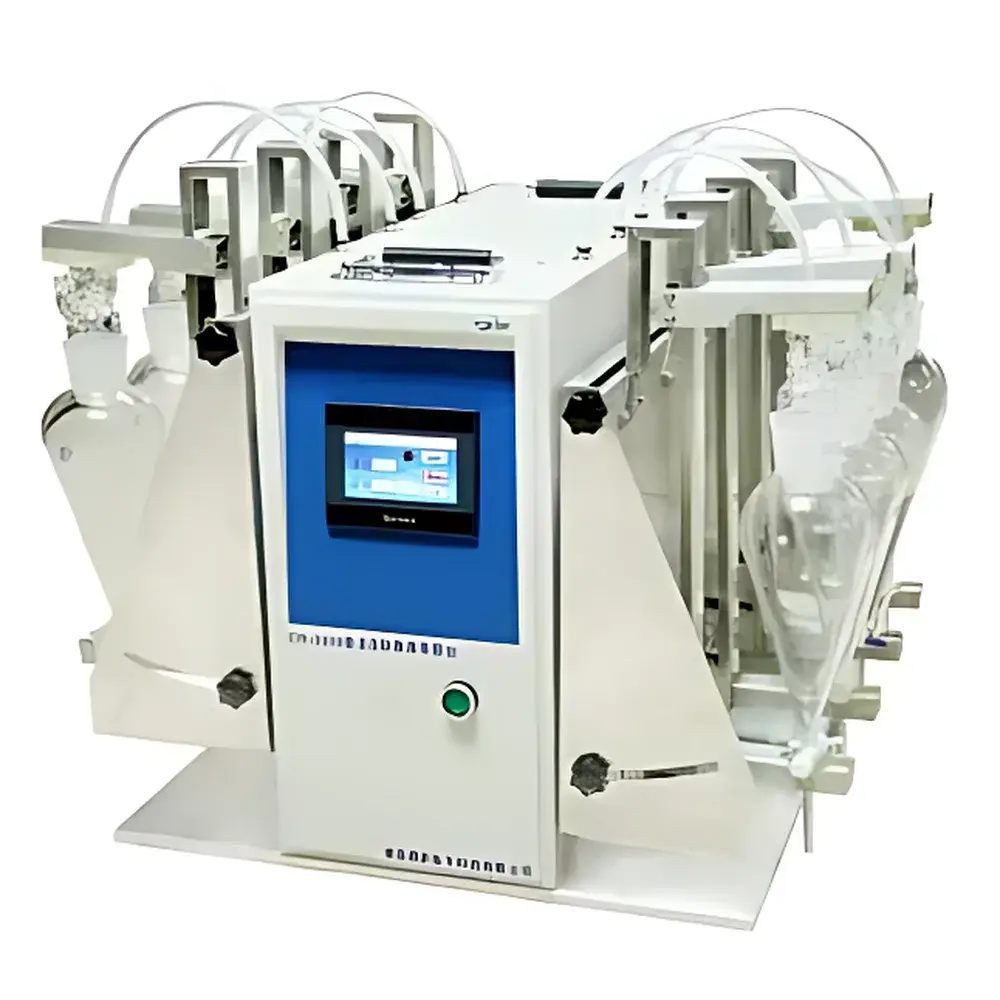
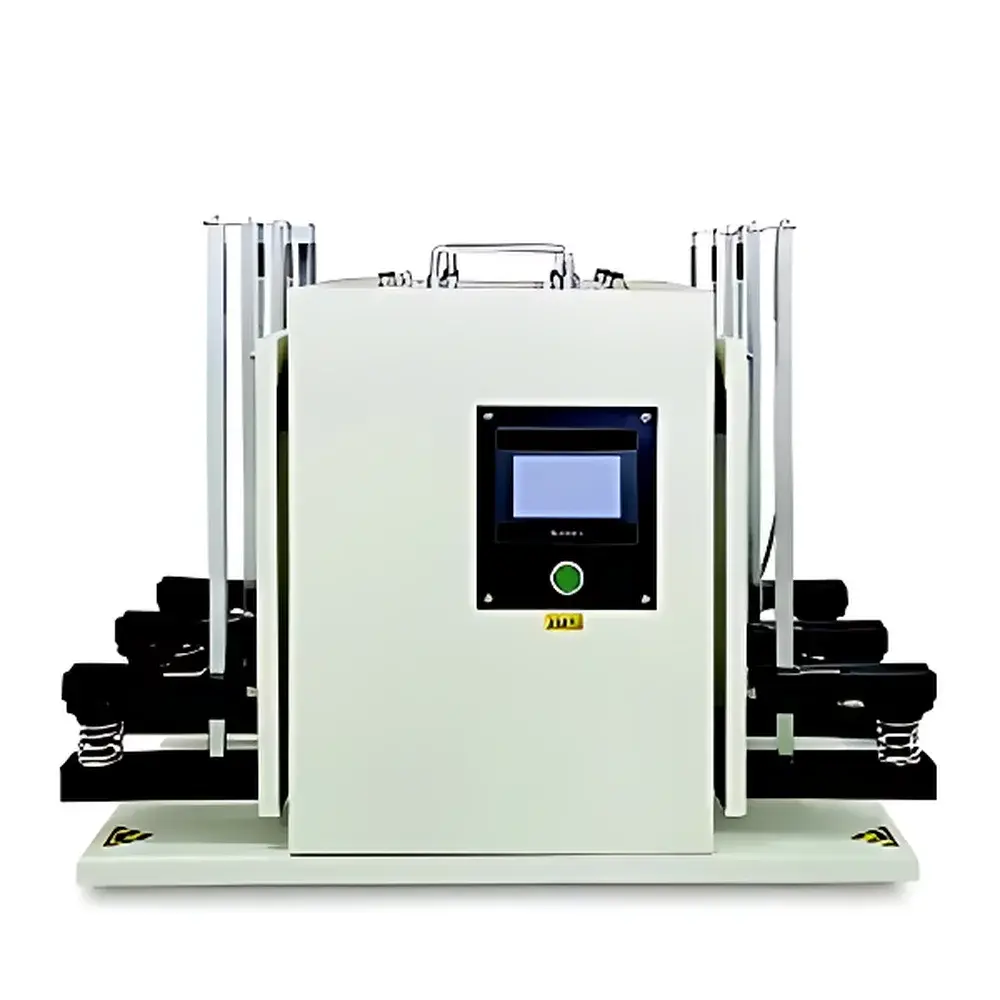
HUANKONG 3000 Series Fully Automated Liquid-Liquid Extraction System
| Brand | HUANKONG |
|---|---|
| Origin | Shandong, China |
| Manufacturer Type | Direct Manufacturer |
| Model | 3000 Series |
| Oscillation Mode | Vertical or Tilted |
| Simultaneous Extraction Positions | 6 or 8 |
| Extraction Frequency Range | 0–400 cycles/min |
| Extraction Time Setting Range | 0–6000 min |
| Sample Vessel Capacity Compatibility | 50–1000 mL |
| Exhaust Handling | Centralized collection + activated carbon adsorption |
| Cleaning Mode | Automated solvent/water rinse |
| Power Supply | 220 V / 50 Hz, 300 W |
Overview
The HUANKONG 3000 Series Fully Automated Liquid-Liquid Extraction System is an engineered solution for reproducible, operator-safe sample preparation in environmental, pharmaceutical, and regulatory testing laboratories. Designed around the fundamental principle of mechanical agitation-driven partitioning—where analytes are transferred from an aqueous phase into an immiscible organic solvent based on distribution coefficients—the system replaces manual shaking, vortexing, or jet mixing with programmable, closed-loop oscillation. Unlike conventional methods requiring periodic venting, manual inversion, or open-vessel handling, the 3000 Series integrates real-time pressure monitoring, automated venting, and sealed exhaust management to eliminate uncontrolled solvent vapor release. Its architecture conforms to core laboratory safety objectives: minimizing operator exposure to volatile organic compounds (VOCs), preventing cross-contamination between samples, and ensuring consistent phase separation kinetics across all extraction positions.
Key Features
- Programmable dual-mode oscillation: vertically aligned or tilted-axis motion—configurable per method to optimize interfacial contact area and emulsion formation for diverse analyte classes (e.g., petroleum hydrocarbons, phenolic compounds, anionic surfactants).
- Intelligent pressure-responsive venting: integrated pressure-sensing algorithm dynamically adjusts vent timing and duration based on oscillation amplitude and vessel headspace pressure—eliminating manual venting while maintaining phase integrity.
- Centralized VOC exhaust management: all vented gases are routed through a dedicated manifold to an activated carbon filtration module compliant with ISO 10156 and OSHA 1910.1200 requirements for hazardous vapor control.
- Microprocessor-controlled drive system: brushless DC motor with stepless speed regulation (0–400 cycles/min) ensures torque stability across load variations; startup/shutdown ramping protects glassware from mechanical shock.
- Full-cycle automation: includes post-extraction automated rinsing with solvent and deionized water—reducing carryover risk and eliminating manual cleaning steps that compromise trace-level analysis.
- Ergonomic modular fixture design: telescoping clamps accommodate standard separatory funnels and centrifuge tubes (50–1000 mL), with positive-lock engagement verified by tactile feedback and visual status indicators.
- Human-machine interface: 7-inch capacitive touchscreen with multilingual OS support (English default); real-time display of elapsed time, cycle count, current RPM, pressure status, and fault diagnostics.
Sample Compatibility & Compliance
The system supports EPA Method 1664 (petroleum hydrocarbons), EPA 425.1 (phenols), and ASTM D2467 (anionic detergents), with validated performance across matrices including wastewater, soil leachates, and biological fluids. All wetted components are chemically resistant to chlorinated solvents (e.g., dichloromethane, chloroform), ethyl ether, and hexane. The enclosed extraction chamber meets IEC 61010-1:2010 safety standards for laboratory equipment. Exhaust filtration efficiency exceeds 95% for benzene, toluene, and xylene (BTX) at 200 ppm inlet concentration (per ASTM D5228). Data logging complies with ALCOA+ principles—time-stamped, user-identified, non-erasable records support GLP audits and FDA 21 CFR Part 11 readiness when paired with validated LIMS integration.
Software & Data Management
Embedded firmware enables method storage (up to 100 protocols), parameter locking for SOP enforcement, and CSV export of run logs (start/stop timestamps, actual vs. setpoint RPM, vent events, error codes). Optional Ethernet/Wi-Fi connectivity allows remote monitoring via secure HTTPS interface and synchronization with enterprise laboratory information management systems (LIMS). Audit trail functionality records all user actions—including parameter changes, method selections, and maintenance alerts—with immutable timestamps and operator IDs. No cloud storage is performed by default; data residency remains fully on-premise unless explicitly configured per institutional IT policy.
Applications
- Environmental analysis: extraction of total petroleum hydrocarbons (TPH), polycyclic aromatic hydrocarbons (PAHs), and halogenated organics from aqueous effluents prior to GC-FID or GC-MS quantification.
- Pharmaceutical QC: isolation of active pharmaceutical ingredients (APIs) and degradation products from dissolution media using ethyl acetate or MTBE.
- Food safety testing: recovery of pesticide residues (e.g., organophosphates, carbamates) from fruit juice or dairy extracts under AOAC 2007.01-compliant conditions.
- Clinical toxicology: preparation of urine or plasma samples for amphetamine, opioid, or benzodiazepine screening via liquid-liquid back-extraction protocols.
- Regulatory compliance: method transfer-ready platform supporting USP , EP 2.4.24, and ISO 17025-accredited workflows where operator variability must be eliminated from sample prep.
FAQ
Does the system require external compressed air or vacuum sources?
No—ventilation and rinsing functions are self-contained via integrated diaphragm pump and pressure-regulated solenoid valves.
Can it be integrated with autosamplers or robotic liquid handlers?
Yes—the 3000 Series offers RS-232 and Modbus TCP interfaces for OEM-level synchronization with third-party automation platforms.
What maintenance intervals are recommended for the activated carbon filter?
Filter replacement is advised every 500 operational hours or upon detection of breakthrough odor—verified using optional photoionization detector (PID) add-on module.
Is validation documentation provided for IQ/OQ/PQ protocols?
Factory-issued test certificates cover mechanical accuracy, temperature stability (ambient only), and pressure response linearity; full qualification packages are available upon request with site-specific URS alignment.
How is sample cross-contamination prevented during high-throughput runs?
Each position features independent fluid pathways, isolated vent manifolds, and post-run purge cycles—validated to achieve ≤0.01% carryover for 100 ng/mL spiked standards.



