
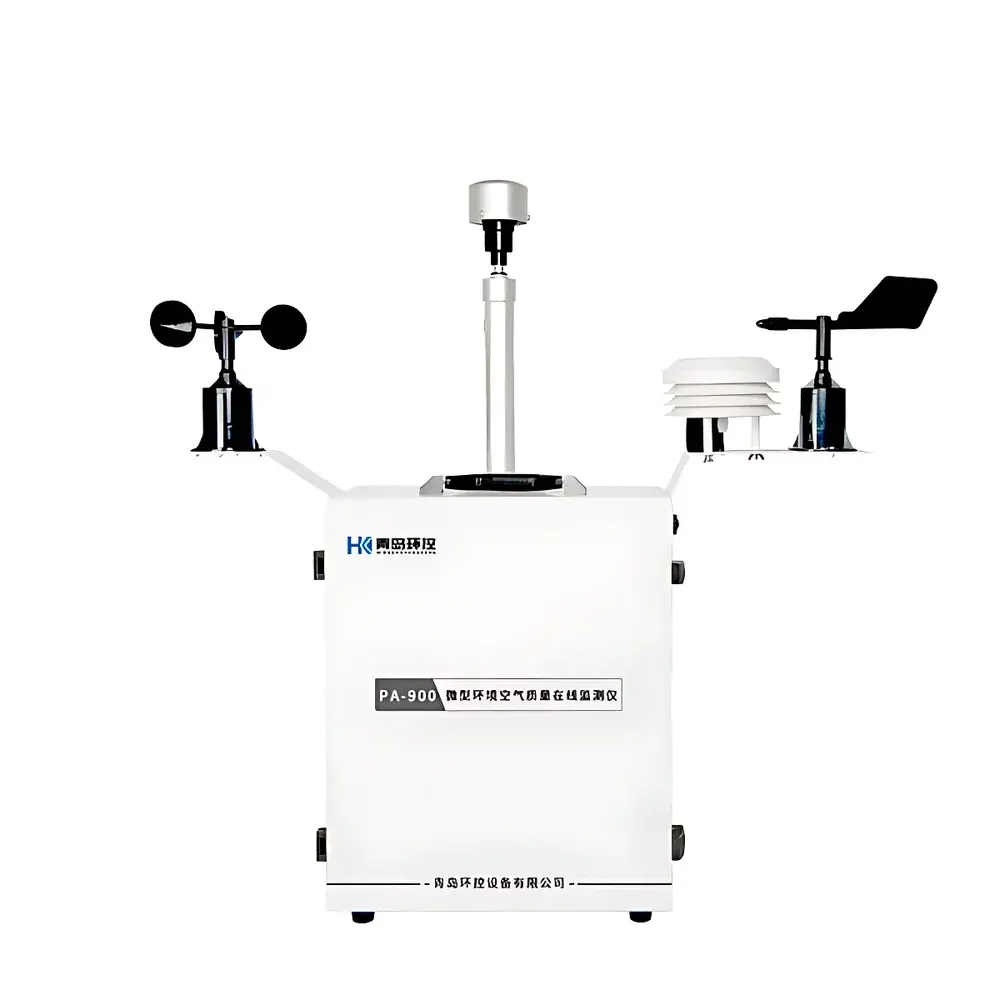
HUANKONG PA-900 Compact Environmental Monitoring Station
| Brand | HUANKONG |
|---|---|
| Origin | Shandong, China |
| Manufacturer Type | Direct Manufacturer |
| Country of Origin | China |
| Model | PA-900 |
| Instrument Type | Compact Multi-Pollutant & Meteorological Monitoring Station |
| Sensor Technologies | Electrochemical, NDIR, UV-DOAS, PID, Metal Oxide Semiconductor (MOS) |
| Measured Parameters | Wind Speed/Direction, Temperature, Humidity, Atmospheric Pressure, Rainfall (Meteorological 5), TSP, PM₁₀, PM₂.₅, SO₂, NO₂, CO, O₃, CO₂, CH₄, N₂O, VOCs, BTEX (Benzene, Toluene, Ethylbenzene, Xylenes, Styrene, Cumene) |
| Compliance Standards | GB 3095–2012, HJ 653–2013, HJ 633–2012, HJ 212–2017, HJ 663–2013 |
| Data Storage | Local flash memory supporting ≥1 year of minute-interval data (circular overwrite) |
| Connectivity | Integrated 4G LTE module, RS-485 interface, optional Ethernet |
| Power Supply | AC 220 V ±10%, 50 Hz (standard) |
| Enclosure | IP65-rated aluminum alloy housing with splash-resistant design |
| Optional Add-ons | Outdoor LED display panel, synchronized video overlay module, Class 2 sound level meter (IEC 61672), remote OTA firmware update capability |
Overview
The HUANKONG PA-900 Compact Environmental Monitoring Station is an integrated, multi-parameter ambient air quality and meteorological observation system engineered for high-density deployment in urban grids, industrial parks, and enterprise boundary monitoring applications. Unlike conventional weather-only stations, the PA-900 combines real-time meteorological profiling—wind speed and direction, ambient temperature, relative humidity, atmospheric pressure, and precipitation—with simultaneous quantitative analysis of gaseous pollutants (SO₂, NO₂, CO, O₃, CO₂, CH₄, N₂O), particulate matter (TSP, PM₁₀, PM₂.₅), volatile organic compounds (VOCs), and speciated aromatic hydrocarbons (BTEX). Its modular architecture leverages complementary sensing principles: electrochemical cells for reactive gases, non-dispersive infrared (NDIR) for CO₂ and CH₄, ultraviolet differential optical absorption spectroscopy (UV-DOAS) for SO₂ and NO₂, photoionization detection (PID) for total VOCs, and metal oxide semiconductor (MOS) or laser scattering for particulate mass concentration. Designed to meet the stringent technical requirements of China’s national ambient air quality monitoring infrastructure, the PA-900 operates continuously under outdoor conditions while maintaining metrological traceability per GB 3095–2012 and HJ 653–2013.
Key Features
- Compact, IP65-rated aluminum alloy enclosure enabling robust all-weather operation—including rain, dust, and temperature extremes from −20 °C to +50 °C
- Simultaneous acquisition of meteorological five parameters (wind, temp, RH, pressure, rainfall) alongside ≥15 air quality indicators
- Modular sensor bays permitting field-configurable expansion for greenhouse gas (CO₂/CH₄/N₂O) or BTEX-speciation modules
- Onboard data logging with ≥1-year local storage capacity (minute-resolution), supporting circular overwrite and USB-based data export
- Integrated 4G LTE communication module compliant with HJ 212–2017 data transmission protocol; optional Ethernet and RS-485 interfaces for SCADA integration
- Remote management via secure web-based platform: real-time data visualization, alarm threshold configuration, over-the-air (OTA) firmware updates, and remote calibration support
- Flexible power options: standard AC 220 V supply or solar-battery hybrid configuration for off-grid deployment
- Expandable peripheral integration—including outdoor LED display panels, synchronized IP camera modules with parameter overlay, and IEC 61672-compliant Class 2 sound level measurement
Sample Compatibility & Compliance
The PA-900 is validated for continuous unattended monitoring of ambient air in regulatory-grade environments. Its sensor suite meets the performance criteria defined in HJ 653–2013 for PM₁₀/PM₂.₅ analyzers and HJ 633–2012 for gaseous pollutant monitors. All measurements are referenced to standard temperature and pressure (STP) conditions and reported in standardized units (µg/m³ for particulates; ppb or mg/m³ for gases). The system complies with national emission monitoring data integrity protocols under HJ 212–2017, including mandatory data packet signing, timestamp synchronization (NTP/4G-assisted), and audit-trail logging for configuration changes. While not certified to ISO/IEC 17025, its design aligns with GLP-aligned operational practices for environmental data collection, including automatic zero/span validation logs and sensor health diagnostics.
Software & Data Management
Data acquisition is managed by embedded Linux-based firmware supporting dual-mode storage: real-time streaming to central platforms via MQTT or HTTP POST, and local retention on industrial-grade NAND flash. The HUANKONG Cloud Platform provides role-based access to time-series dashboards (instantaneous, 1-min, 1-hr, and daily averages), automated exceedance alerts (email/SMS), and historical query tools with CSV/PDF export. System-level functions include remote instrument reconfiguration, firmware version control, and secure OTA updates signed with ECDSA-256. RS-485 Modbus RTU support enables third-party integration into existing EMS or SCADA systems. All data transmissions adhere to HJ 212–2017 framing rules, ensuring interoperability with provincial and national environmental monitoring networks.
Applications
- High-resolution air quality mapping in urban microgrids and smart city infrastructure
- Compliance monitoring at fenceline locations of petrochemical, pharmaceutical, and manufacturing facilities
- Baseline and impact assessment for EIA projects requiring spatially dense temporal datasets
- Greenhouse gas flux tracking in landfill, agricultural, and municipal waste management sites
- Indoor-outdoor air exchange studies using synchronized BTEX and VOC profiles
- Noise-pollution co-monitoring when integrated with optional Class 2 sound level meter
FAQ
Does the PA-900 meet international calibration traceability standards?
The system follows manufacturer-recommended calibration intervals and supports field zero/span checks using certified gas standards; however, it is not pre-certified to ISO/IEC 17025 or EN 14625. Users requiring accredited calibration must engage a third-party lab.
Can the PA-900 be deployed without municipal power?
Yes—optional solar panel + LiFePO₄ battery configuration enables fully autonomous operation for ≥7 days under typical insolation conditions.
Is raw sensor data accessible for custom algorithm development?
Yes—RS-485 Modbus RTU interface provides register-level access to calibrated analog outputs and diagnostic registers, enabling OEM integration and proprietary modeling.
What is the minimum reporting interval for pollutant concentrations?
Standard output is 1-minute averaged values; sub-minute raw sensor readings (e.g., 1 Hz PM scatter pulses) are available via RS-485 upon request.
How is cybersecurity addressed in remote data transmission?
All 4G and Ethernet communications use TLS 1.2 encryption; device authentication employs certificate-based mutual TLS (mTLS); no default credentials are shipped.







