
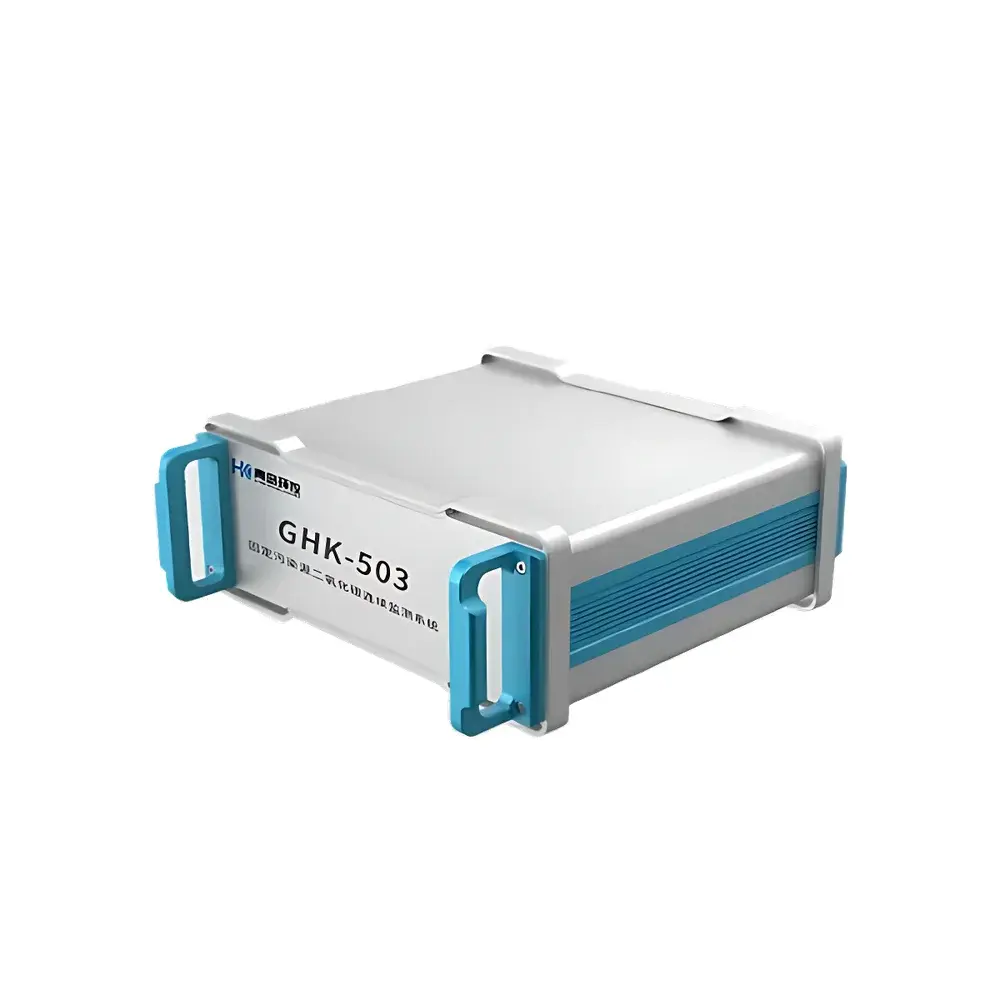
GHK-503 CO₂ Continuous Monitoring System by HUANKONG
| Brand | HUANKONG |
|---|---|
| Model | GHK-503 |
| Detection Principle | Non-Dispersive Infrared (NDIR) Spectroscopy |
| Origin | Shandong, China |
| Manufacturer Type | Original Equipment Manufacturer (OEM) |
| Regional Classification | Domestic (China) |
| Application Field | Environmental Protection & Industrial Emissions Monitoring |
| Compliance Context | Designed for alignment with ISO 14064-1, EPA Method TO-11A, and China’s HJ 75-2017 & HJ 76-2017 standards |
Overview
The GHK-503 CO₂ Continuous Monitoring System is an industrial-grade, fixed-position gas analyzer engineered for real-time, long-term quantification of carbon dioxide (CO₂) concentration in ambient or process streams. It employs non-dispersive infrared (NDIR) spectroscopy—a well-established, physics-based optical absorption technique—where CO₂ molecules selectively absorb infrared radiation at a characteristic wavelength near 4.26 µm. The system measures the attenuation of IR energy across a calibrated optical path to determine CO₂ concentration via the Beer–Lambert law, delivering high selectivity, low cross-sensitivity to common interferents (e.g., CO, CH₄, H₂O vapor), and stable baseline performance over extended deployment cycles. Designed for continuous operation in demanding field environments, the GHK-503 meets the functional requirements of continuous emissions monitoring systems (CEMS) and greenhouse gas (GHG) inventory verification protocols, supporting regulatory reporting, process optimization, and carbon accounting workflows.
Key Features
- NDIR-based detection with dual-beam optical architecture for enhanced signal stability and drift compensation
- Automated zero-point calibration function—executes periodic zero checks using certified zero air or internal purge gas; calibration frequency configurable via software (e.g., hourly, daily, or event-triggered)
- Modular hardware design: sensor module, sampling interface, data acquisition unit, and power management subsystem are physically and electrically decoupled—enabling rapid field replacement without full system shutdown
- Extended component service life: IR source rated for >20,000 hours; thermopile detector with hermetic packaging; optical windows coated for anti-fouling and humidity resistance
- Site-adaptive installation support: includes configurable sample probe lengths, heated sample lines (optional), particulate filtration stages (0.3 µm absolute rating), and condensate management kits for high-humidity or dirty-gas applications
- Low total cost of ownership (TCO): no consumables required beyond routine filter changes; diagnostic logs support predictive maintenance scheduling
Sample Compatibility & Compliance
The GHK-503 accommodates gaseous samples across a wide range of matrices—including flue gas from coal-fired power plants, biogas from landfills and anaerobic digesters, ventilation air from livestock barns, and ambient air in agricultural greenhouses. It operates within a standard sample temperature range of 0–50 °C and relative humidity up to 90% non-condensing (with optional integrated chiller/dryer). Pressure tolerance spans 80–110 kPa absolute. The system complies with key technical specifications outlined in China’s HJ 75-2017 (Technical Specifications for Continuous Emission Monitoring of Flue Gas) and HJ 76-2017 (Verification Procedures for CEMS), and its measurement methodology aligns with internationally recognized reference methods including EPA Method TO-11A (for CO₂ in ambient air) and ISO 14064-1 Annex A (quantification of GHG emissions). Data output formats support integration into SCADA, DCS, and environmental data management platforms compliant with IEC 62443 cybersecurity guidelines.
Software & Data Management
Embedded firmware provides local data logging (≥30 days at 1-minute intervals), alarm configuration (high/low concentration thresholds, fault conditions), and remote diagnostics via RS-485 Modbus RTU or optional Ethernet TCP/IP. The accompanying PC-based configuration and visualization software supports calibration certificate generation, trend analysis, and export to CSV or XML for third-party LIMS or GHG reporting tools (e.g., IPCC Tier 2/3 templates). Audit trails record all parameter changes, calibration events, and user logins—supporting GLP-aligned documentation practices. While not natively 21 CFR Part 11 compliant, the system can be deployed within validated IT infrastructure where electronic records are governed by organizational SOPs meeting ALCOA+ principles.
Applications
- Continuous stack monitoring in thermal power generation, cement kilns, and iron & steel sintering facilities
- Biogas quality control and methane recovery efficiency tracking at landfill sites and wastewater treatment plants
- Carbon flux measurement in controlled-environment agriculture (CEA), including vertical farms and polytunnel horticulture
- Leak detection and fugitive emission quantification in upstream oil & gas operations (wellheads, compressor stations)
- Baseline CO₂ profiling in urban air quality networks and national GHG monitoring pilot zones
- Process feedback control in fermentation, food packaging, and modified-atmosphere storage facilities
FAQ
What is the typical measurement range for CO₂ on the GHK-503 system?
The standard configuration covers 0–5,000 ppm, with optional ranges available from 0–10% (0–100,000 ppm) or 0–100% for high-concentration biogas applications.
Does the GHK-503 require span gas calibration?
Yes—span calibration using certified CO₂-in-N₂ standard gas (e.g., 2,000 ppm ±1%) is recommended at commissioning and at intervals defined by site QA/QC protocols (typically every 7–30 days depending on regulatory context).
Can the system operate unattended for extended periods?
Yes—designed for 24/7 operation with built-in diagnostics, automatic zero correction, and remote status monitoring; mean time between failures (MTBF) exceeds 12,000 hours under normal operating conditions.
Is explosion-proof certification available?
ATEX and IECEx certifications are not standard but can be provided upon request for custom-engineered variants intended for Zone 1/21 hazardous locations.
How is data integrity ensured during power interruption?
Internal non-volatile memory retains configuration and the last 72 hours of logged data; external UPS integration is recommended for mission-critical installations requiring uninterrupted logging.







