
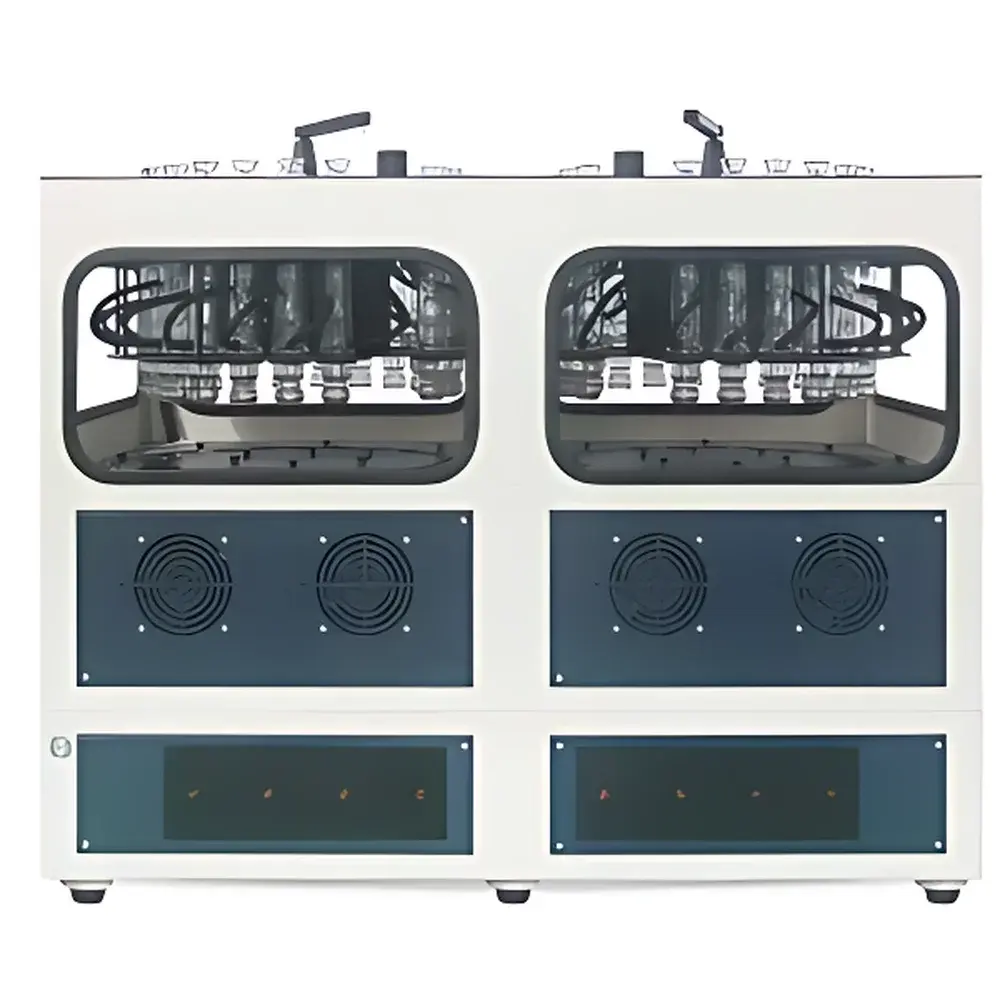
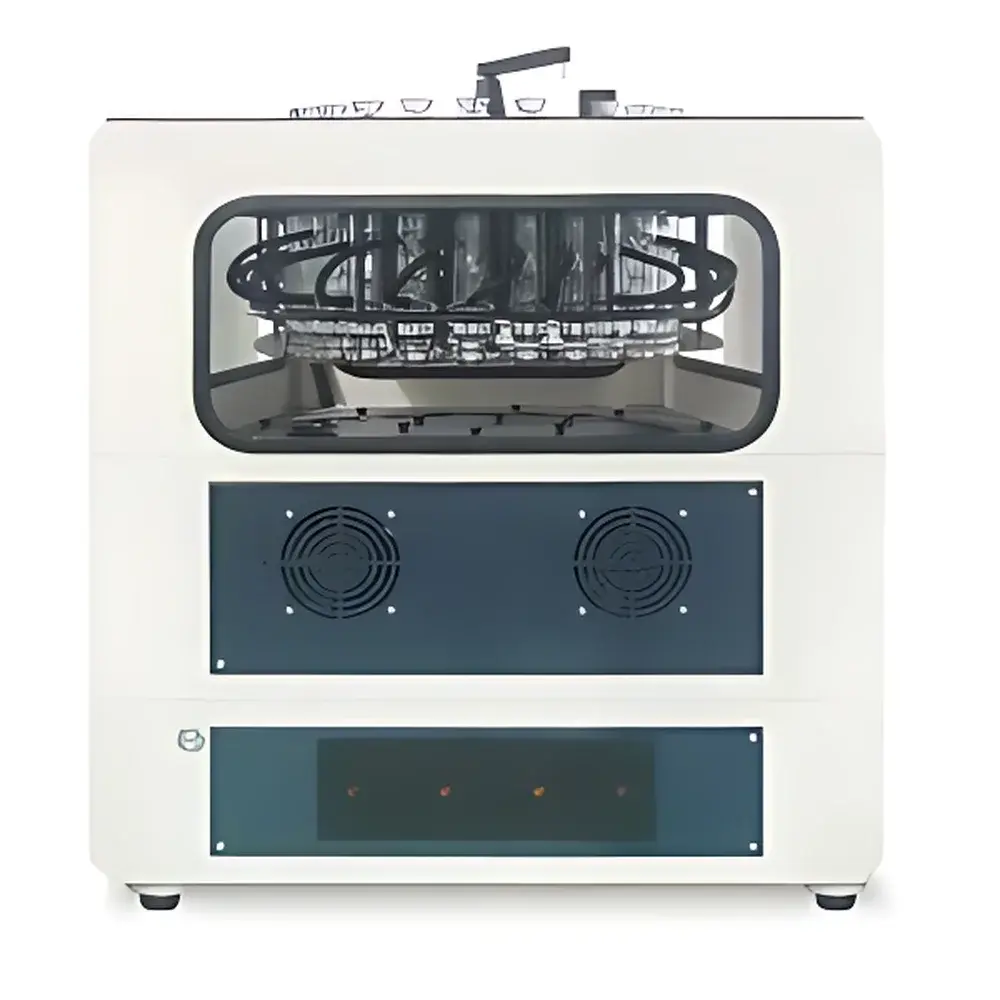
HUANKONG 1510 Fully Automated CODCr Analyzer (42-Position)
| Brand | HUANKONG |
|---|---|
| Origin | Shandong, China |
| Manufacturer Type | Direct Manufacturer |
| Instrument Type | Laboratory Benchtop Analyzer |
| Measurement Principle | Potassium Dichromate Digestion Method (Online Closed-System) |
| Accuracy | ±2% |
| LOD | 4 mg/L COD |
| Batch Capacity | 20 / 32 / 42 samples per run |
| Compliance | GB/T 11914 & HJ/T 828 |
Overview
The HUANKONG 1510 Fully Automated CODCr Analyzer is an integrated laboratory instrument engineered for precise, unattended determination of Chemical Oxygen Demand (COD) in water and wastewater matrices using the standardized potassium dichromate digestion method. Based on the fundamental redox reaction between Cr(VI) and organic matter under strong acidic, high-temperature conditions—followed by spectrophotometric or colorimetric titration—the system delivers traceable, regulatory-compliant results aligned with GB/T 11914 and HJ/T 828. Unlike manual or semi-automated workflows involving hazardous concentrated sulfuric acid handling, open reflux, and subjective endpoint detection, the 1510 employs a closed-loop, robotic architecture to eliminate operator exposure, minimize reagent variability, and ensure thermal and volumetric reproducibility across all 42 sample positions. Its design prioritizes analytical integrity through physical isolation of reagents, thermally uniform digestion, sealed condensation, and full-spectrum colorimetric endpoint recognition—enabling robust operation in environmental monitoring labs, municipal wastewater treatment QC facilities, and industrial effluent compliance testing environments.
Key Features
- 42-position circular digestion carousel with far-infrared microcrystalline carbon heating elements—providing rapid, uniform thermal transfer, corrosion resistance, and automatic post-digestion thermal disengagement to prevent residual heat interference.
- Dual robotic arms for precise, contamination-free reagent dispensing: eight independent fluidic channels, each driven by a dedicated precision metering pump; no cross-channel carryover or dilution error.
- Automated, elastic-sealed coupling between digestion vials and spherical reflux condensers—preventing volatile loss and ensuring quantitative recovery of condensed vapors during reflux.
- Closed-loop recirculating cooling system with adjustable setpoint temperature and auxiliary air-cooling module—maintaining stable condensation efficiency over extended batch runs.
- Full-spectrum colorimetric titration engine: real-time RGB-based endpoint detection replaces subjective visual assessment, delivering objective, repeatable titration outcomes across low- and high-concentration ranges (4–1000 mg/L COD).
- Integrated safety architecture: automated position verification, empty-well detection, acid-level monitoring, and hardware interlocks prevent misloading, overpressure, or uncontrolled acid exposure.
Sample Compatibility & Compliance
The 1510 supports direct analysis of raw and filtered samples from surface water, domestic sewage, and industrial effluents without pre-dilution or transfer steps—reducing handling-induced contamination and procedural bias. All digestion and titration protocols strictly adhere to the procedural requirements of HJ/T 828 and GB/T 11914, including specified reagent concentrations (e.g., 0.25 mol/L K2Cr2O7, Ag2SO4-H2SO4 catalyst), reflux duration (120 min), and titrant standardization (FAS). The system’s closed-vessel design meets ISO/IEC 17025 documentation requirements for method validation, and its audit-ready software logs support GLP-compliant data integrity practices—including user access control, electronic signatures, and immutable run records traceable to individual samples and reagent lots.
Software & Data Management
Control and data acquisition are managed via PC-based workstation software with intuitive graphical sequencing interface. Each sample position is assigned a unique ID, matrix type (e.g., “Industrial Wastewater – High Chloride”), and custom digestion/titration parameters. Real-time status mapping uses color-coded indicators (green = running, amber = standby, red = fault) for immediate operational awareness. All raw absorbance curves, titration profiles, calibration logs, and QC check results are stored in structured .csv and .pdf formats compliant with internal QA/QC review and external regulatory submission. The software supports export to LIMS via ASTM E1384-compliant data exchange schema and includes configurable report templates aligned with regional discharge permit reporting formats.
Applications
- Routine compliance monitoring for municipal wastewater treatment plants (WWTPs) subject to national discharge standards.
- Industrial pretreatment verification for electroplating, pharmaceutical, food processing, and textile manufacturing facilities.
- Environmental field lab deployment supporting river basin surveillance programs and pollution source tracing.
- Method validation and reference material analysis in accredited environmental testing laboratories (CNAS-CL01 certified).
- Research applications requiring high-throughput COD profiling across time-series or spatial sampling campaigns.
FAQ
Does the 1510 comply with international COD standards such as ISO 6060?
The instrument implements the core chemistry and procedural logic of ISO 6060 (potassium dichromate oxidation under reflux), but its validation and certification are explicitly aligned with Chinese national standards GB/T 11914 and HJ/T 828. For ISO 6060 compliance, method equivalence studies must be conducted per ISO/IEC 17025 Annex A.3.
Can the system handle high-chloride samples without mercury sulfate masking?
The 1510 does not include automated mercury sulfate addition; users must manually spike chloride-interference correction reagents prior to loading, consistent with HJ/T 828 Section 7.2. Alternative chloride-tolerant methods (e.g., chlorine-resistant catalysts) require external validation.
Is remote monitoring or cloud-based data backup supported?
Local network connectivity (Ethernet) enables remote desktop access and scheduled data export to network drives. Native cloud synchronization is not embedded but can be implemented via third-party IT infrastructure meeting ISO 27001 data governance policies.
What maintenance intervals are recommended for fluidic components?
Pump tubing and sealing O-rings should be inspected every 200 runs and replaced every 500 runs or sooner if leakage or pressure deviation exceeds ±5% of nominal flow rate.
How is calibration traceability maintained?
Primary calibration uses NIST-traceable potassium hydrogen phthalate (KHP) standards. Daily system suitability checks include blank response verification, linearity assessment (5-point curve), and repeatability testing (n=6 at mid-range concentration).







