
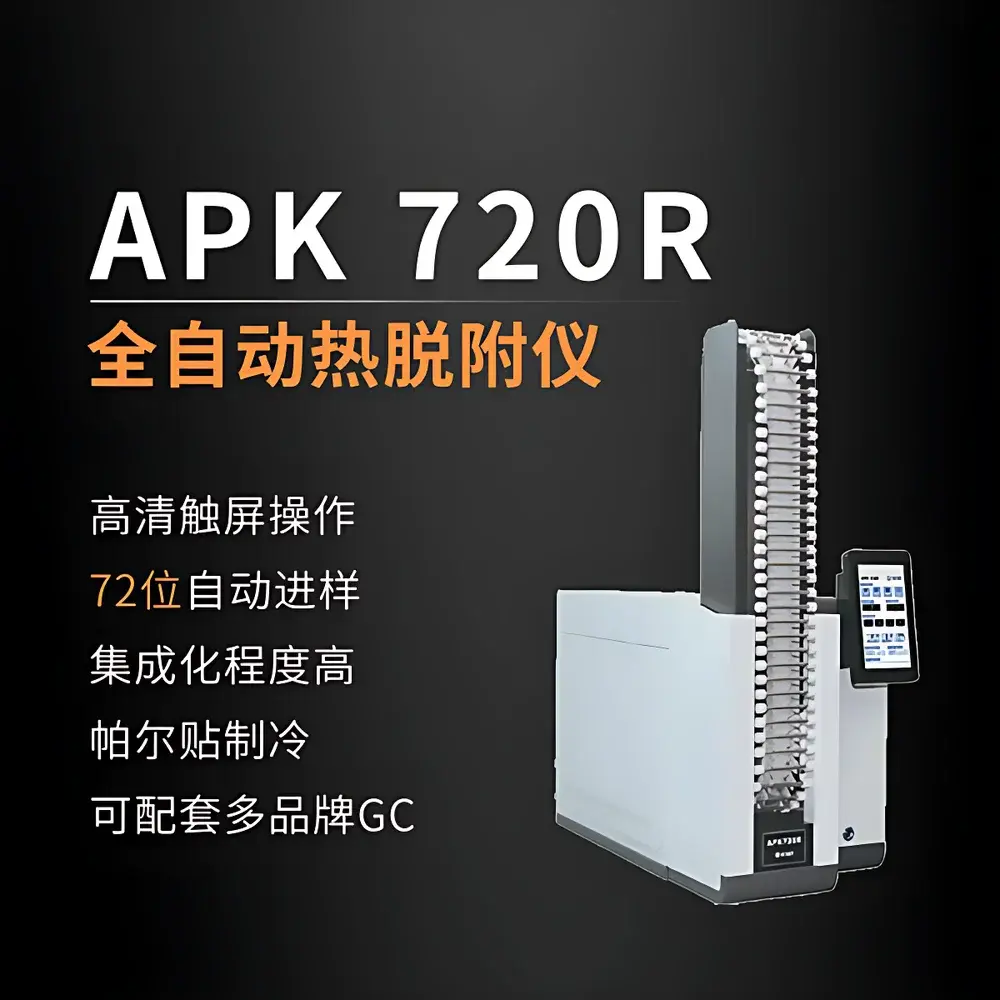
HUANKONG APK720R Fully Automated Thermal Desorber
| Brand | HUANKONG |
|---|---|
| Origin | Shandong, China |
| Manufacturer Type | Manufacturer |
| Product Category | Domestic |
| Model | APK720R |
| Instrument Type | Dual-Stage Thermal Desorber |
| Automation Level | Fully Automated |
| Valve Injection Zone Temperature Range | 50–400 °C |
| Transfer Line Temperature Range | Ambient to 200 °C |
| Cold Trap Temperature Range | −30 °C |
| Sample Capacity | 72 Adsorption Tubes |
| Desorption Recovery Efficiency | High |
| Cold Trap Technology | Peltier-Cooled Focusing Trap |
| Sample Enrichment Sensitivity | ppb–ppt Level |
| Compliance | Compatible with ASTM D6196, EPA TO-14A, TO-17, and US EPA Method 320 |
Overview
The HUANKONG APK720R Fully Automated Thermal Desorber is a dual-stage thermal desorption system engineered for high-fidelity preconcentration and quantitative transfer of volatile organic compounds (VOCs) from sorbent tubes into gas chromatography (GC) systems. It operates on the principle of controlled thermal desorption—first-stage desorption releases analytes from the sorbent tube under inert carrier gas flow, followed by cryogenic focusing in a Peltier-cooled cold trap at −30 °C, and second-stage rapid flash desorption directly into the GC inlet. This two-step process ensures minimal analyte loss, sharp band focusing, and exceptional reproducibility for trace-level VOC analysis. Designed as a standalone front-end solution, the APK720R interfaces seamlessly with GC instruments from Agilent, Thermo Fisher, Shimadzu, PerkinElmer, and other major vendors—enabling method portability across laboratories without hardware modification.
Key Features
- Fully automated 72-position sorbent tube carousel with barcode-readable sample tracking and positional memory for unattended overnight operation
- Integrated valve-based injection module with precise temperature control (50–400 °C), eliminating carryover and ensuring consistent desorption kinetics
- Peltier-cooled cold trap operating at −30 °C—no liquid nitrogen or cryogenic consumables required; enables rapid cooling/warming cycles and extended service life
- Closed-loop heating architecture for both desorption oven and transfer line (ambient to 200 °C), minimizing thermal gradients and preventing analyte condensation or degradation
- Customizable cold trap packing options—including Tenax TA, Carbopack B/C, and multi-bed configurations—to optimize recovery across C2–C12 hydrocarbons, oxygenates, halocarbons, and polar VOCs
- High-resolution color LCD touchscreen interface with intuitive workflow navigation, real-time status monitoring, and method parameter logging
- ppb–ppt level detection capability enabled by efficient analyte enrichment and low system blank performance, validated per EPA TO-14A and TO-17 protocols
Sample Compatibility & Compliance
The APK720R supports standard 6 mm OD × 89 mm quartz or stainless-steel sorbent tubes (e.g., Markes UNITY, Gerstel TD tubes) and is compatible with common sampling media including SKC, Anasorb, and custom-packed tubes. It meets functional requirements for regulatory methods including U.S. EPA TO-14A (ambient air), TO-17 (indoor air), Method 320 (stack emissions), and ASTM D6196 (VOC content in consumer products). The system architecture supports audit-ready data integrity through time-stamped method execution logs, user access control, and electronic signature support—facilitating alignment with GLP, GMP, and FDA 21 CFR Part 11 documentation expectations when paired with compliant LIMS or chromatography data systems.
Software & Data Management
Controlled via embedded firmware with USB and Ethernet connectivity, the APK720R allows remote configuration, method upload/download, and real-time diagnostics through a Windows-compatible desktop application. All method parameters—including desorption time/temperature ramps, trap hold times, GC trigger signals, and valve sequencing—are fully programmable and stored with versioned timestamps. Raw instrument event logs (including temperature profiles, valve actuation events, and error codes) are exportable in CSV format for QA/QC review. Optional integration with third-party chromatography data systems (CDS) enables synchronized method launch and result correlation—critical for high-throughput environmental and occupational hygiene labs requiring strict chain-of-custody documentation.
Applications
The APK720R serves as a core preconcentration platform in environmental monitoring (ambient/indoor air, soil headspace, stack testing), industrial hygiene (workplace exposure assessment per OSHA and NIOSH methods), product emissions testing (building materials, adhesives, coatings), and forensic VOC profiling. Its 72-tube capacity and compatibility with optional APK2600 gas bag autosampler extend utility to dynamic sampling matrices—including Tedlar® and FlexFoil® bags—supporting EPA Method TO-15 and ISO 16017-1 workflows. The system’s broad analyte coverage makes it suitable for BTEX, PAMS, aldehydes, chlorinated solvents, and emerging contaminants such as SVOC semi-volatiles when coupled with appropriate sorbent selection and GC–MS detection.
FAQ
Is the APK720R compatible with my existing GC system?
Yes—the APK720R uses standard GC-compatible pneumatic and electrical interfaces (e.g., TTL trigger, 24 VDC valve control, carrier gas pressure regulation) and has been validated with Agilent 7890/8890, Thermo ISQ EC, Shimadzu GC-2030, and PerkinElmer Clarus series.
Does the system require liquid nitrogen or other cryogens?
No—cold trapping is achieved exclusively via solid-state Peltier cooling to −30 °C, eliminating logistical constraints and safety concerns associated with cryogenic handling.
Can I customize the cold trap adsorbent for specific analytes?
Yes—users may specify single- or multi-bed trap configurations (e.g., Carbopack X + Carbosieve SIII) during ordering or retrofit existing traps using standardized ¼″ OD stainless-steel trap bodies.
How is data integrity ensured during unattended runs?
All method executions generate immutable logs with operator ID, timestamp, temperature profiles, and system status flags—exportable for internal QA review or external regulatory submission.
What maintenance intervals are recommended for routine operation?
Valve seals and transfer line ferrules should be inspected every 500 runs; cold trap cartridges are rated for ≥1,000 desorption cycles under typical VOC load conditions; full system calibration verification is recommended quarterly or per SOP.




