
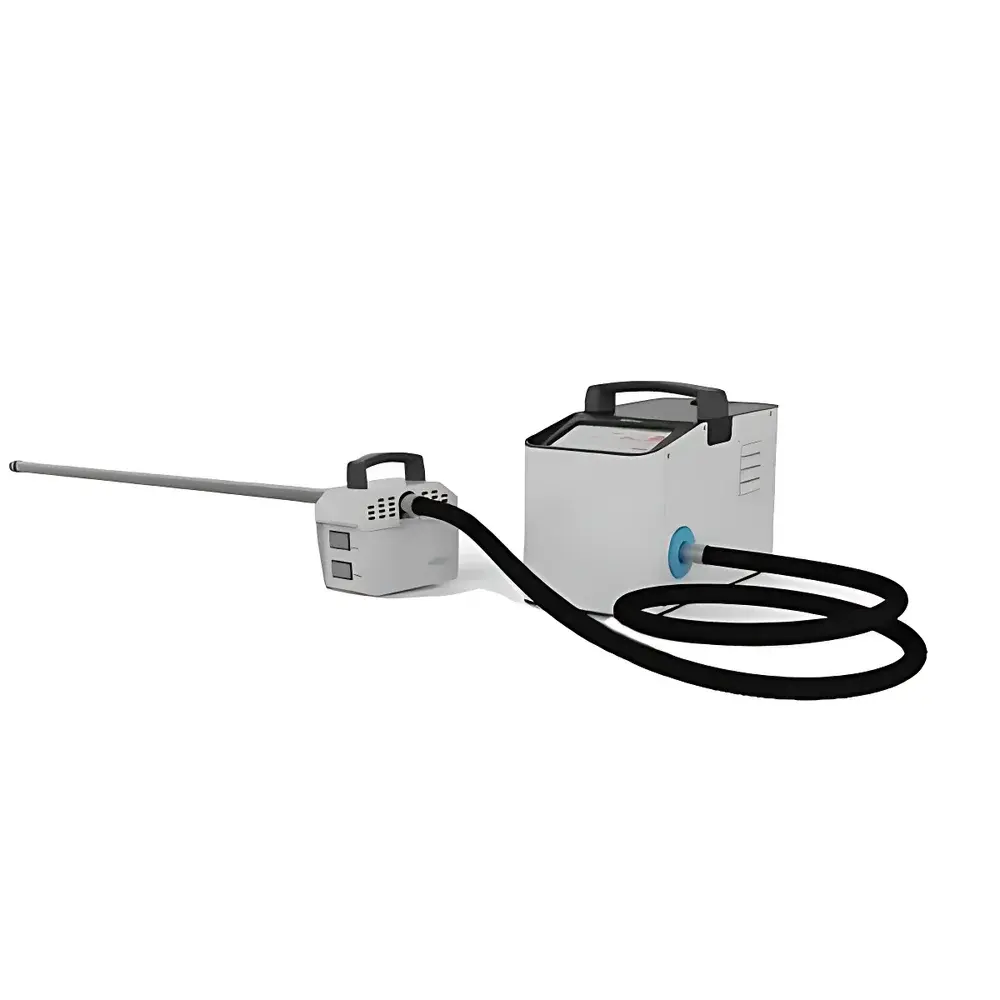
HUANKONG HK3500 Online Ammonia Slip Monitor
| Brand | HUANKONG |
|---|---|
| Origin | Shandong, China |
| Manufacturer Type | OEM Manufacturer |
| Country of Origin | China |
| Model | HK3500 |
| Pricing | Upon Request |
| Instrument Type | Online Gas Analyzer |
| Measurement Principle | Tunable Diode Laser Absorption Spectroscopy (TDLAS) at Near-Infrared Wavelength |
| Sampling Method | Heated Extractive Sampling (220 °C Full-Path Heating) |
| Compliance Standard | DLT 1916–2018 |
Overview
The HUANKONG HK3500 Online Ammonia Slip Monitor is an industrial-grade, in-situ extractive gas analyzer engineered for continuous, real-time quantification of ammonia (NH₃) concentration in flue gas streams downstream of selective non-catalytic reduction (SNCR), selective catalytic reduction (SCR), and activated coke denitrification systems. It operates on the physical principle of tunable diode laser absorption spectroscopy (TDLAS) in the near-infrared spectral region—specifically targeting a fundamental rotational-vibrational absorption line of NH₃ with high spectral selectivity and minimal cross-sensitivity to interfering species. The system employs wavelength modulation spectroscopy (WMS) combined with second-harmonic (2f) detection to extract concentration-dependent signals from background noise, enabling sub-part-per-trillion (ppt) detection limits and high signal-to-noise ratio under challenging process conditions.
Unlike traditional electrochemical or chemiluminescence-based analyzers, the HK3500 eliminates reliance on consumables, catalysts, or wet chemistry. Its fully heated extractive architecture—maintaining the entire sample path (probe, filter, transport line, and cell) at a constant 220 °C—prevents NH₃ adsorption onto surfaces and inhibits ammonium salt formation (e.g., NH₄HSO₄, NH₄NO₃), which commonly occur in low-temperature, high-humidity, high-dust environments typical of coal-fired boiler ducts, cement kilns, and coke oven gas streams.
Key Features
- Fully heated extractive sampling train operating continuously at 220 °C—ensuring representative gas-phase NH₃ integrity across temperature gradients and preventing condensation-induced bias
- Advanced digital signal processing with harmonic-based TDLAS algorithm to suppress interference from water vapor (H₂O), particulate scattering, CO₂, SO₂, NOₓ, and volatile organic compounds (VOCs)
- Integrated automatic zero/span calibration capability using certified reference gases—reducing drift accumulation and supporting long-term measurement stability without manual intervention
- Modular probe design with extendable sampling rods (optional) to enable multi-point “grid” sampling across duct cross-sections per ISO 16911-1 and EPA Method 320 guidelines
- Ruggedized stainless-steel housing rated IP65, designed for permanent installation in harsh industrial environments including high ambient temperatures, vibration, and electromagnetic noise
- Embedded diagnostics with real-time status monitoring of laser output power, detector response, cell temperature, and flow rate—facilitating predictive maintenance and remote troubleshooting
Sample Compatibility & Compliance
The HK3500 is validated for operation in flue gas matrices characterized by dust loadings up to 50 g/Nm³, moisture content up to 25 vol%, and operating temperatures ranging from 80 °C to 200 °C at the sampling point. It complies with the Chinese national standard DLT 1916–2018 (“Technical Requirements for Portable Ammonia Slip Measurement Systems”) for performance criteria including accuracy (±10% of reading or ±0.5 ppm, whichever is greater), repeatability (≤3%), and response time (T₉₀ ≤ 120 s). While not certified to EU Measuring Instruments Directive (MID) or US EPA Performance Specification 17 (PS-17), its measurement methodology aligns with the underlying physics referenced in ISO 14956:2002 (Air quality — Evaluation of the suitability of measuring methods) and ASTM D6348–21 (Standard Test Method for Determination of Gaseous Compounds by Multi-Gas Analyzers).
Software & Data Management
The analyzer integrates a Linux-based embedded controller running proprietary firmware with dual communication interfaces: Modbus TCP (Ethernet) and RS-485 (Modbus RTU). Local HMI provides real-time concentration display, trend logging, alarm thresholds, and event history (including calibration logs and fault codes). Data export supports CSV and XML formats via USB or network transfer. For enterprise integration, optional OPC UA server functionality enables seamless connection to DCS, SCADA, or environmental data management systems (EDMS). Audit trails—including user login, parameter changes, and calibration events—are timestamped and retained for ≥180 days, supporting GLP-aligned recordkeeping practices where applicable.
Applications
- Regulatory compliance monitoring of NH₃ slip during SNCR/SCR system commissioning, routine operation, and post-maintenance verification
- Ammonia injection optimization studies—correlating NH₃ concentration profiles with NOₓ removal efficiency and catalyst health indicators
- Source testing and stack emission audits conducted by environmental monitoring stations and third-party inspection bodies
- Field validation of CFD-based ammonia distribution models in large ducts or SCR reactor inlets
- Quarterly performance verification per China’s “Technical Guidelines for Supervision of Flue Gas Desulfurization and Denitrification Facilities” (HJ 75–2017)
- Research applications in combustion laboratories and materials science institutes studying ammonium salt deposition mechanisms
FAQ
What is the recommended maintenance interval for the HK3500?
Scheduled maintenance—including optical window cleaning, filter replacement, and laser alignment verification—is recommended every 6 months under continuous operation; intervals may be extended to 12 months in low-dust environments with stable process conditions.
Can the HK3500 measure NH₃ in wet gas without condensation traps?
Yes—the full-path 220 °C heating ensures all water remains in vapor phase throughout the sampling train, eliminating need for chilled mirrors or permeation dryers while preserving NH₃ integrity.
Is the system compatible with existing DCS platforms?
Yes—native Modbus TCP and optional OPC UA support enable direct integration with major DCS vendors including Siemens Desigo, Honeywell Experion, Yokogawa CENTUM VP, and Emerson DeltaV.
Does the analyzer require periodic certification against traceable standards?
Per DLT 1916–2018, initial site-specific calibration verification must be performed using NIST-traceable NH₃ standards prior to commissioning; subsequent verification is required semi-annually or after any major hardware intervention.
How does the HK3500 handle high particulate loading?
The front-end ceramic filter (pore size: 5 µm) and heated cyclonic pre-separator remove >99.5% of particles >10 µm; combined with continuous purge airflow, this prevents optical fouling and maintains measurement continuity over extended runtimes.







